Arsenal Dominates Coventry in Premier League Opener
Under the Emirates floodlights, Arsenal opened their 2026 Premier League campaign with the kind of controlled, methodical dominance that has become Mikel Arteta’s signature. A 3-0 win over newly promoted Coventry did more than bank three early points; it offered a first, clear glimpse of how this retooled squad intends to navigate a long season.
Following this result, Arsenal sit 2nd in the table with 3 points and a goal difference of 3, their home record reading one win from one, 3 goals scored and none conceded. Coventry, by contrast, leave north London 19th, with 0 points, a goal difference of -3, and an away record of one defeat, 0 scored and 3 conceded. The numbers are stark, but the story of how each squad functioned within its tactical framework is more revealing.
Arsenal's Tactical Setup
Arteta’s 4-2-3-1 was built on continuity and subtle evolution. David Raya, in goal, had a quiet evening behind a back four of Ben White, C. Mosquera, Gabriel and Riccardo Calafiori. In front of them, the double pivot of M. Lewis-Skelly and Declan Rice provided both security and circulation, while the line of three — Bukayo Saka to the right, Martin Ødegaard central, Christos Tzolis from the left — supported Kai Havertz as the lone forward.
What stood out was how seamlessly new and established pieces meshed despite notable absences. W. Saliba and J. Timber, both listed as missing through injury, would normally be central to Arsenal’s defensive identity. Instead, Mosquera and Calafiori stepped into a high-line system that demands bravery on the ball and positional clarity. Calafiori, in particular, offered more than mere solidity: he delivered an assist, completed 24 passes at 83% accuracy, and won 2 of his 3 duels. His presence as an auxiliary playmaker on the left allowed Tzolis to stay high and wide, stretching Coventry’s right side.
On the opposite flank, White quietly authored one of the game’s most influential performances. With 78 completed passes at 94% accuracy and 2 key passes, plus an assist, he acted as a de facto deep-lying playmaker from right-back. His timing in stepping into midfield dovetailed with Ødegaard’s roaming, creating overloads that Coventry’s 4-1-4-1 simply could not track.
In the “engine room,” Rice and Lewis-Skelly were the hinges on which Arsenal’s structure turned. Rice’s remit was broad: screen transitions, recycle possession, and allow Ødegaard to operate between the lines. Lewis-Skelly complemented him with vertical energy, linking back to front and ensuring the press could be triggered aggressively without leaving the centre exposed.
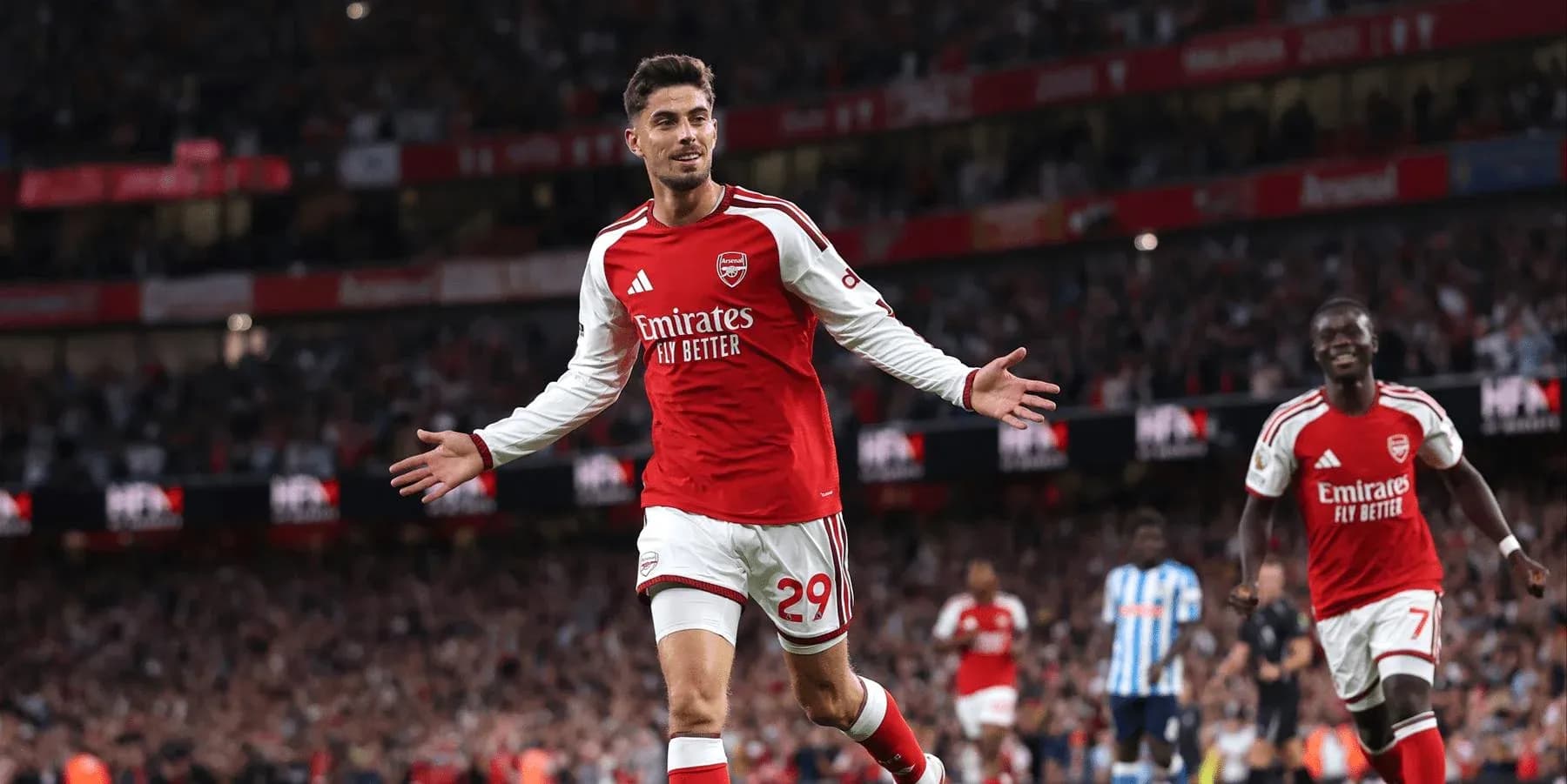
Higher up, the attacking trident delivered both end product and control. Saka’s numbers underline his efficiency: 1 goal from 1 shot on target, 34 passes at 88% accuracy, 2 key passes, and a perfect 1/1 dribble success. Ødegaard mirrored that precision with his own goal, 56 passes at 92% accuracy, 3 key passes and 3 tackles — a captain in all but armband, knitting Arsenal’s possession game together while setting the press. Havertz, often the lightning rod for tactical debate, justified his central role: 1 goal, 25 passes at 80%, 1 interception and 5 duels won from 10, a blend of target-man presence and link play that pinned Coventry’s centre-backs.
Defensively, Arsenal’s season snapshot after one game is immaculate: in total this campaign, they have conceded 0 goals, with an overall average of 0.0 goals against per match, and they have kept 1 clean sheet at home. Gabriel, who picked up a yellow card in the 31-45 minute window (the only Arsenal booking in that period), still managed 57 passes at 94% accuracy and 1 interception, embodying the risk-reward balance of defending on the halfway line.
Coventry's Approach
Coventry arrived with a clear plan under Frank Lampard: a compact 4-1-4-1 with M. Grimes as the single pivot, tasked with screening and initiating counters. Ahead of him, L. Tchaouna, Caleb Marfo Yirenkyi, F. Onyeka and B. Thomas-Asante supported E. Simms up front. On paper, the structure offered width and central numbers; in practice, it was starved of oxygen.
Yirenkyi’s evening encapsulated Coventry’s struggle. He completed 13 passes at 76% accuracy, won 1 of 3 duels, and committed 2 fouls, earning a yellow card in the 16-30 minute window. That caution, one of Coventry’s early disciplinary notes, blunted his ability to press aggressively, allowing Arsenal’s right side — White and Saka — to dictate tempo. Coventry’s overall disciplinary pattern this season so far shows 1 yellow card in that 16-30 window and none elsewhere, highlighting a tendency to be stretched and reactive just as games are settling into rhythm.
Behind Yirenkyi, Grimes was often left isolated. With Arsenal committing Ødegaard between the lines and Havertz dropping off Simms’ shoulder, Coventry’s pivot had to choose between stepping out and protecting the space in front of his centre-backs. Too often he did neither fully, leaving channels for Arsenal’s third-man runs.
Out wide, Tchaouna and Thomas-Asante were pinned back by the advanced positions of Calafiori and White. Coventry’s full-backs, M. van Ewijk and J. Dasilva, spent long spells in their own third, unable to provide the overlapping outlets that a 4-1-4-1 badly needs in transition. Simms, isolated at the tip, was forced to feed on long balls and half-counters that rarely materialised into sustained possession.
Statistical Overview
Statistically, Coventry’s early-season profile is brutally simple: on their travels they have played 1, lost 1, scored 0 and conceded 3, with an away average of 3.0 goals against and 0.0 goals for. They have failed to score in that away match and have yet to keep a clean sheet. The biggest defeat so far, a 3-0 away loss, is precisely this game at the Emirates.
In the “hunter vs shield” matchup, Arsenal’s frontline — with Saka, Ødegaard and Havertz all on the scoresheet — overwhelmed a Coventry defence still searching for Premier League rhythm. Conversely, Coventry’s “engine room” of Grimes and Onyeka never truly disrupted Arsenal’s patterns, especially once Rice and Lewis-Skelly established control.
No penalties were awarded, and with both sides showing 0 penalties taken and 0 missed in total this campaign, there was no drama from the spot to distort the tactical picture. Instead, the outcome aligned cleanly with the underlying metrics: a side that, in total, averages 3.0 goals scored and 0.0 conceded at home against one that averages 0.0 scored and 3.0 conceded away.
Following this result, Arsenal’s squad looks deep, coherent and tactically literate even without key injured defenders, while Coventry’s group appears honest and industrious but light on Premier League-grade resistance and attacking punch. If the statistical trajectories hold — Arsenal’s defensive solidity and multi-source goals, Coventry’s vulnerability on their travels and lack of cutting edge — this match may be remembered as a faithful early chapter in a season where one club chases the summit and the other fights to keep its footing.