Anderlecht Dominates Kairat Almaty with Tactical Superiority
The 3-0 scoreline in Anderlecht’s favour at Central Stadium was the product of a clear structural and territorial superiority rather than sheer shot volume. With 67% possession and an 8-2 edge in corners, Vitor Bruno’s side controlled both the ball and the pitch, while Kairat Almaty’s 4-4-1-1 was quickly forced into emergency defending, especially after going down to ten men.
Kairat's Starting Shape
Kairat’s starting shape, with T. Anarbekov behind a back four of E. Tapalov, A. Shirobokov, Lucas Africo and L. Mata, was designed to offer a compact block in front of the box. In midfield, A. Mrynskiy and J. Oksanen flanked G. Mendonsa and O. Jukkola, with M. Gual underneath Edmilson as the lone striker. On paper, this offered two banks of four and a link player to press Anderlecht’s first phase. In practice, the early own goal from Oksanen after just 2 minutes immediately undermined the game plan, forcing Kairat to chase while still trying to stay compact.
Anderlecht's Formation
Anderlecht’s 4-3-3, anchored by C. Coosemans in goal, built from a back four of A. Maamar, L. Petrot, G. Biancone and L. Augustinsson. Ahead of them, the trio of L. Ambros, M. Kana and E. Llansana gave the Belgians a stable central platform. High up, M. Cvetkovic, D. Sikan and J. Nga Kana formed a flexible front line. The possession split (67% to 33%) reflects how effectively this structure pinned Kairat back: Anderlecht recycled the ball through Ambros and Llansana, using the full-backs, especially Augustinsson, to keep Kairat’s wide midfielders deep.
Shot Profile
The shot profile underlines the pattern. Anderlecht produced 4 shots on goal and 2 off target, with a remarkable 5 blocked efforts. That blocked count shows how often they were able to work shooting positions in and around the Kairat box, forcing last-ditch interventions. Kairat, by contrast, managed only 2 shots on goal and 2 off target, plus a single blocked attempt. For a home side, that is a very low attacking output, consistent with being a man down and spending long phases without the ball.
Turning Point
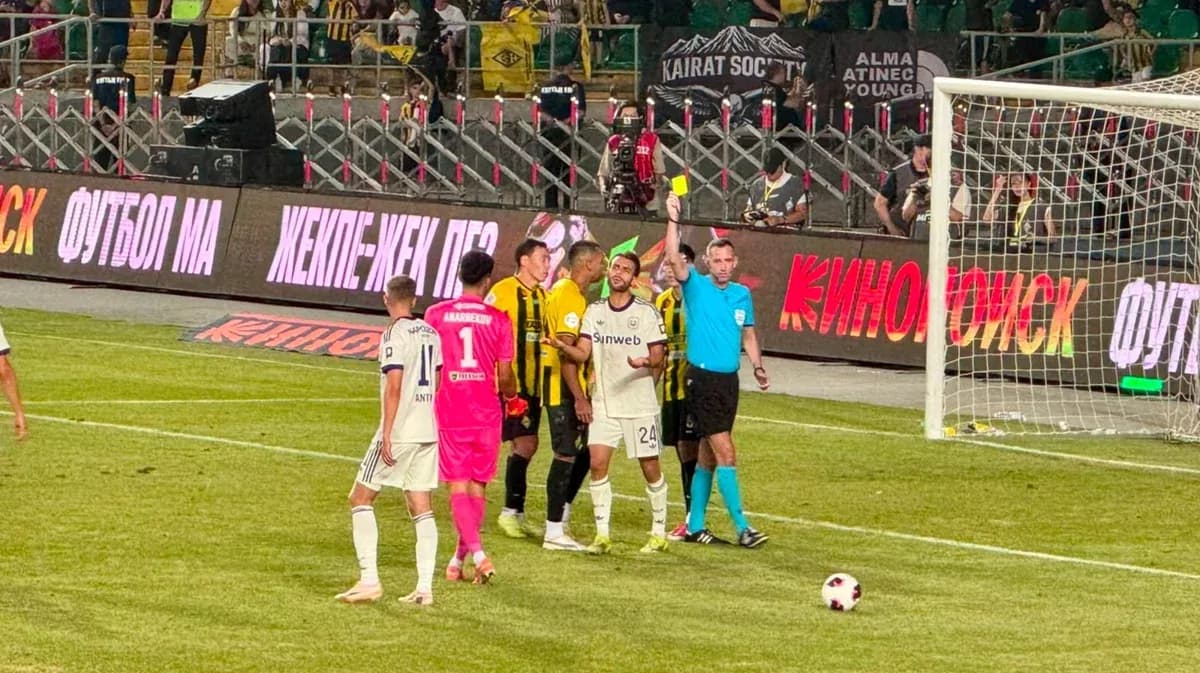
The turning point was not just tactical but disciplinary. At 39', Aleksandr Shirobokov’s red card left Kairat with three defenders against a front three and overlapping full-backs. From that moment, Kairat’s 4-4-1-1 morphed into a 4-4-1 that was almost permanently pinned in its own third. The half-time score of 0-3, with further goals from L. Ambros and D. Sikan, meant that by the interval Anderlecht could manage the game rather than chase more goals, which partly explains why their shot count did not explode despite their territorial dominance.
Foul Numbers
Foul numbers (17 for Anderlecht, 11 for Kairat) reveal another layer. Anderlecht’s higher foul count is typical of a team pressing aggressively after losing the ball, trying to prevent transitions. With so much of the game played in Kairat’s half, Anderlecht could afford to counter-press high and break up any attempted counters at source. Kairat’s 11 fouls, meanwhile, were spread across defensive phases, often deeper and more reactive.
Set Pieces
Set pieces further illustrate control. Anderlecht’s 8 corners against Kairat’s 2 show how frequently the visitors forced blocks and deflections near goal. Kairat’s limited corners reflect their inability to sustain pressure or reach the byline in numbers. Even when Kairat tried to adjust with substitutions — introducing O. Baybek, A. Tuyakbaev, I. Bekbolat and L. Kurgin from the bench — the underlying dynamic of the match did not shift: they remained short of possession and territory.
Defensive Struggles
Defensively, Kairat’s back line and deeper midfielders were overworked. The 5 blocked shots for Anderlecht point to a Kairat unit that often collapsed into its own box, sacrificing any real counter-attacking threat. The red card forced even more conservative spacing: full-backs Tapalov and Mata had to stay at home, which in turn left Edmilson and the advanced midfielders increasingly isolated whenever Kairat did win the ball.
Anderlecht's Flexibility
Anderlecht, on the other hand, could rotate personnel without losing structure. The second-half substitutions — notably the introduction of M. Winkler, O. Antman, N. Ojea and A. Bertaccini — allowed them to refresh legs in midfield and attack while keeping the same 4-3-3 framework. The fact that they still finished with 4 shots on goal despite being three up by half-time underlines that they continued to find controlled entries into the final third rather than merely sitting off.
Possession Dynamics
In possession terms, the 67% share for Anderlecht meant long, patient sequences. Kairat’s 33% was largely fragmented, with few multi-pass moves through midfield. The absence of passing data prevents a precise breakdown, but the possession and foul patterns strongly suggest Kairat were forced into direct, low-percentage balls towards Edmilson and later substitutes, which Anderlecht’s back four and holding players could handle comfortably.
Overall, the tactical story is of a structurally sound Anderlecht side exploiting early gifts and numerical advantage to dominate territory, while Kairat’s 4-4-1-1, already under pressure, collapsed into survival mode after the red card. The statistical markers — possession, corners, shots on goal and blocked shots — all align with a match where the visitors dictated rhythm and field position from start to finish.