A Breakdown of All 308 Goals at the 2026 World Cup
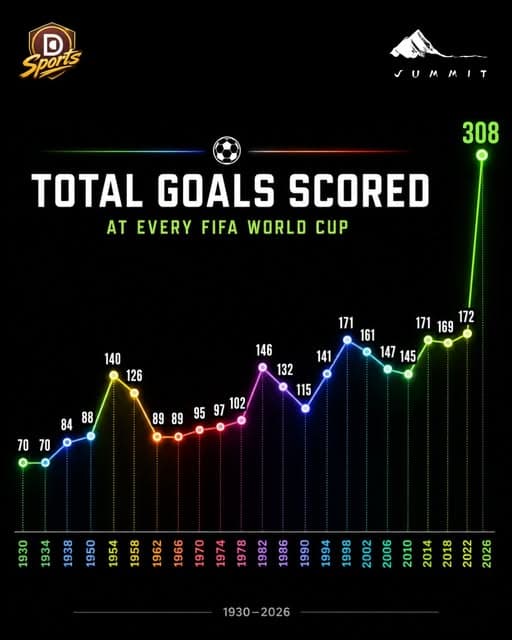
The FIFA World Cup 2026™ has etched itself in football lore, with Spain claiming their second title and the tournament delivering some striking statistics. Across 104 matches, a total of 308 goals were netted, resulting in an average of 2.96 goals per game. This is the highest scoring rate since 1970’s 2.97 goals per match, surpassing recent tournaments like Qatar 2022 (2.69), Russia 2018 (2.64), and Brazil 2014 (2.67).
The record for most goals per game still belongs to Switzerland 1954, with an astonishing 5.38 goals per match. On the lower end, tournaments such as Italy 1990 (2.21), South Africa 2010 (2.27), and Germany 2006 (2.30) produced fewer goals.
Top Scorers Shine in Expanded Format
This first-ever 48-team World Cup saw goal scorers flourish, setting new records. Six players scored six or more goals: Kylian Mbappe led with ten goals, followed by Lionel Messi with eight, Jude Bellingham and Erling Haaland each with seven, and Ousmane Dembele and Harry Kane with six apiece.
Mbappe made history by becoming the first player to claim the Golden Boot twice, having also topped the charts at the 2022 World Cup. His ten-goal haul was the best since Gerd Muller’s in 1970, with only Just Fontaine (13 in 1958) and Sandor Kocsis (11 in 1954) ahead of him.
The Race for All-Time World Cup Goals
The tournament also highlighted the rivalry between Messi and Mbappe for the all-time World Cup scoring crown. Starting the event with 13 and 12 goals respectively, both chased Miroslav Klose’s 16-goal record. Messi matched this with a hat-trick in Argentina's opener against Algeria and then moved ahead with further strikes, finishing with 21 goals after scoring against Austria, Jordan, Cabo Verde, and Egypt.
Mbappe remained close behind, eventually surpassing Messi by netting twice in the bronze final despite France losing 6-4 to England. He now holds the record with 22 World Cup goals.
Set Pieces and Long Shots Play Big Roles
Set pieces continued to be valuable, accounting for 54 of the 308 goals, including 16 penalties—making up 17.5% of the total. Corners, free kicks, and long throw-ins delivered 38 goals.
Shots from outside the penalty area gained prominence, with 43 goals scored this way—seven from direct free kicks and 36 during open play. This represents nearly 15% of goals, up significantly from just 8% at the previous World Cup in Qatar. Jurgen Klinsmann of FIFA's Technical Study Group noted that long-range attempts become practical when space near the goal is congested.
Crosses Continue to Yield Results
Crossing the ball into the box remained an effective strategy, producing 75 goals, about one in four across the tournament. This includes the decisive goal in the final for Spain and other key moments like Lautaro Martinez’s winning strike for Argentina, Haaland’s opener against Brazil, and Enzo Fernandez’s goal against Egypt. These crosses exclude goals directly scored from set-piece deliveries like corners or free kicks.
Clubs and Leagues Leading the Scoring Charts
Players from Real Madrid topped the club scoring list with 22 goals combined: 10 from Mbappe, 7 from Bellingham, 4 from Vinicius Junior, and 1 from Arda Guler. Paris Saint-Germain followed with 15 goals, and Arsenal FC took third place with 13. Despite these tallies, it was FC Barcelona’s Ferran Torres who netted the tournament's most crucial goal.
The Premier League again demonstrated its strength, supplying 79 goals from its players, which is 25.6% of all World Cup goals. Spain’s La Liga came second with 41 goals, trailed by Germany’s Bundesliga (25), France’s Ligue 1 (23), and Italy’s Serie A (22).