World Cup Final Showdown: Messi vs. Mbappé and Key Players
The World Cup is down to its last 90 minutes – plus whatever chaos the clock chooses to add – and still the arguments keep multiplying.
Kylian Mbappé and Lionel Messi are level in the Golden Boot race, locked together on goals. Messi sits marginally ahead thanks to one extra assist. It’s the tiniest of margins, yet it fuels the oldest debate in tournament football: should a goal in the final carry more weight than one in a third-place play-off that half the world ignores?
On Sunday night in New Jersey, that question stops being theoretical. Mbappé in one corner, Messi in the other, both with the chance to tilt history with a single swing of the boot.
Rodri’s World Cup Renaissance
Away from the headline forwards, this has quietly become Rodri’s World Cup.
There were genuine fears after his ACL injury that the midfielder might never fully return to the player he was – that half-second of doubt, that reluctance to trust a repaired knee, often separates the elite from the merely very good. Yet in this tournament he has looked liberated, authoritative, back to running games at his tempo.
He has stitched Argentina’s play together, broken up counters, and dictated entire evenings with the ball at his feet. It has taken time for him to trust his body again. Now he is playing like a man who has finally stopped asking it questions.
The suspicion lingers that this might have been his final act in a Manchester City shirt. If so, he has chosen quite a stage to remind Europe of his worth.
Tuchel, England and the Art of Overthinking
In England, the postmortem rolls on, and it is not gentle.
Thomas Tuchel remains in post despite a semi-final exit that has exposed more than just a bad night. His use of substitutions had been praised earlier in the tournament as game-changing. But as one observer pointed out, if your bench keeps bailing you out, perhaps the real story is that your starting line-up never quite worked.
England staggered into the last four, the least convincing of the semi-finalists by some distance. Against Norway the changes felt muddled rather than masterful, and the eventual defeat has left players reportedly bemused by the tactical approach.
Tuchel stays. The questions do too.
Now comes the third-place game, football’s most awkward fixture. Does he chase a consolatory win or turn it into a thank-you note to the squad? There is a strong argument for rotation: a half each for the goalkeepers, minutes for Ollie Watkins and Ivan Toney, a proper run-out for Kobbie Mainoo. A bronze medal rarely changes legacies, but opportunities in a World Cup do.
Politics in the VIP Boxes
The final will not just be a meeting of footballing superpowers. It will be a summit of political ones as well.
Spanish prime minister Pedro Sánchez will be in attendance to watch his country face Argentina, before heading on to an official visit in Algeria. On the other side of the aisle, Donald Trump will also be at the stadium, his presence framed by the White House as a celebration of the United States’ ability to host the world.
The diplomatic theatre does not stop there. In London, Keir Starmer has backed calls for Fifa to investigate Argentina players who displayed a banner asserting their country’s claim to the Falkland Islands after the semi-final win over England. The World Cup never exists in a vacuum; it drags history and geopolitics into the penalty area with it.
Infantino’s Iron Grip
Above it all, Gianni Infantino’s hold on power tightens.
More than 200 of Fifa’s 211 member associations have formally endorsed him for a fourth term as president. Only a handful remain silent, with Germany the most notable association yet to send its backing. Barring a political earthquake, Infantino will be re-elected by a landslide at the congress in March.
Football has survived Blatter, Warner, Blazer. It will, as one writer put it, survive Infantino too. The game endures, even when its governors test the limits of that resilience.
Alexander-Arnold, Mourinho and a New Madrid
Back in club land, Real Madrid are already repositioning themselves for the next cycle.
Trent Alexander-Arnold, now a year into his Spanish adventure, has spoken of the “pleasure” of working under Jose Mourinho, who returned to the Bernabéu in June for a second spell after a flat domestic and European campaign. The right-back, who endured an injury-hit first season and rotated in and out of the side, suddenly sees a clear path: Dani Carvajal has departed, and the role is there to be claimed.
Alexander-Arnold describes training as intense, the demands high, the learning curve steep. He talks about laying a foundation for a successful season. For a player once defined by his attacking flair and defensive scrutiny, this feels like a pivotal year. Mourinho has rarely been shy about moulding full-backs in his image. If the partnership clicks, Madrid will be built on a very different right flank.
Argentina’s Edge of Steel
If Argentina are back in another World Cup final, it is not just because of Messi’s orchestration or Emi Martínez’s penalty theatrics.
Cristian Romero has embodied the edge that runs through this team. In club colours he can veer towards chaos; in the white and blue of La Albiceleste he becomes something else entirely – one of 11 players seemingly prepared to run through anything for the cause.
Alongside Lisandro Martínez, Romero has taken on the role of enforcer, often the last barrier between a desperate attacker and Martínez in goal. Strip away Messi and the goalkeeper, and he has a strong claim to being Argentina’s most consistent performer across this run to a third final in four tournaments.
It is not pretty. It is not meant to be. It is effective, and it has carried them back to the brink.
The Broadcast Circus Winds Down
Across the Atlantic, the American television circus prepares to pack up its tents.
Fox’s coverage, a curious blend of bombast and sentimentality, is heading for its final act. Geoff Shreeves, the sideline voice with the air of a middle-aged Oliver Twist, signs off. Tom Rinaldi, with his carefully folded pocket squares and grand, almost cosmic musings on balls and planets and destiny, follows. Chef Nick, whose early experiments in kangaroo corndogs and fufu chicken tikka masala proved too wild for the tournament’s more conservative final stages, steps back into the shadows.
Even Jameis Winston, drafted in as a fan correspondent and delivering reports with the manic energy of a man being jolted mid-baptism, will vanish from screens. The World Cup does that to broadcasters: inflates them, then spits them out the moment the trophy is lifted.
Life After the Final
Among supporters, a different anxiety is setting in.
The late nights, the early alarms, the days shaped around kick-off times – all of it ends in a couple of days. One fan admits their body clock has finally adjusted to the chaos, only for normality to loom again. Perhaps, they muse, this is the moment to dive into the South American leagues or MLS to keep the habit going.
They will not be alone. Every World Cup leaves behind a small army of insomniacs searching for a new 2am kick-off.
An Old Argument, A New Night
And so the stage is set.
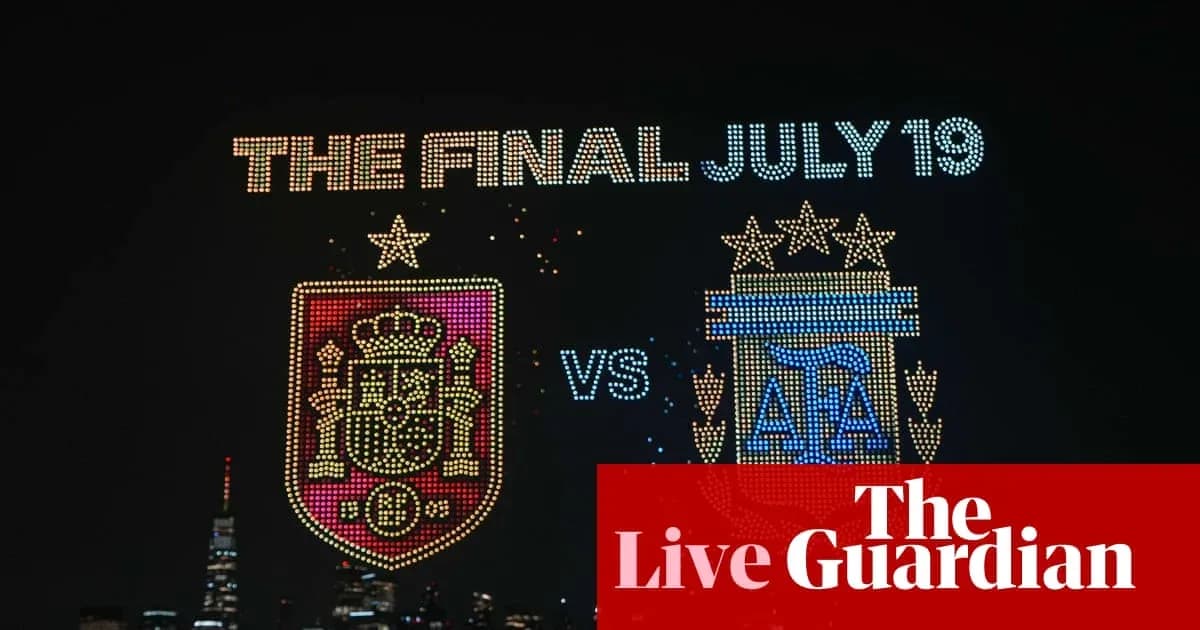
Spain against Argentina. Messi against the future. Mbappé chasing numbers, Messi chasing meaning. A prime minister on one side of the stadium, a former US president on the other. Infantino in the stands, the game marching on with or without him.
Somewhere in all of this, a Golden Boot will be decided. Maybe by a goal in a final. Maybe by one scored in a match that many will call meaningless.
When the net ripples and the stadium erupts, who will dare say it counts for less?