Villarreal vs Sevilla: Tactical Insights from a Surprising 3-2 Victory
Under the floodlights of Estadio de la Ceramica, this was supposed to be another statement of power from a Villarreal side that has turned their home into a fortress. Heading into this game, they sat 3rd in La Liga with 69 points, a goal difference of 24 (67 scored, 43 conceded overall), and a home record built on 14 wins from 18, averaging 2.4 goals at home and conceding just 1.0. Instead, Sevilla – 12th with 43 points and a goal difference of -12 (46 for, 58 against overall) – walked away with a 3-2 victory, reshaping the narrative of both squads as the season enters its final stretch.
I. The Big Picture: Structures and Identities
The lineups told an immediate tactical story. Villarreal, under Marcelino, stayed loyal to their season’s template: a 4-4-2 that has been used in 35 of 36 league matches. A. Tenas in goal sat behind a back four of A. Pedraza, Renato Veiga, P. Navarro and A. Freeman. In front of them, a technically gifted midfield line of A. Moleiro, P. Gueye, D. Parejo and N. Pepe supported the dual threat of G. Moreno and G. Mikautadze.
This shape is the embodiment of Villarreal’s “seasonal DNA”: width from the flanks, control through Parejo’s passing, and vertical surges from Moleiro and Pepe. It is no coincidence that Mikautadze has 12 goals and 6 assists in La Liga, and Moleiro 10 goals and 5 assists; the structure is built to put creative and finishing responsibility on them.
Sevilla, by contrast, arrived with a chameleon’s profile. Over the season they have used a wide spread of systems – from 4-2-3-1 to 3-4-3 – but here Luis Garcia Plaza chose a 5-3-2, leaning into defensive density to withstand one of the league’s most prolific home attacks. O. Vlachodimos was shielded by a back five of Oso, G. Suazo, K. Salas, C. Azpilicueta and J. A. Carmona, with a midfield trio of D. Sow, L. Agoume and R. Vargas behind the front pair A. Adams and N. Maupay.
On their travels this season, Sevilla had conceded 34 goals in 18 away games – an average of 1.9 – so the extra centre-back and wing-backs were a clear attempt to patch that vulnerability against a side scoring 2.4 at home.
II. Tactical Voids: Absences and Discipline
Both teams came into the fixture with important absentees that subtly reshaped their options. Villarreal were without P. Cabanes (convalescence) and J. Foyth (Achilles tendon injury). Foyth’s absence in particular removed a versatile defensive option who could have offered either full-back solidity or a third centre-back in a back three adjustment if Marcelino had wanted to mirror Sevilla’s shape.
Sevilla’s list was longer: M. Bueno (knee injury), Marcao (wrist injury) and Isaac Romero (injury) all missed out. Marcao’s absence forced further reliance on K. Salas and Azpilicueta at the heart of the back line, while losing Isaac – who has 4 league goals but also 1 red card and a penalty missed – took away a chaotic, aggressive forward who often stretches games and draws cards.
From a disciplinary standpoint, both sides carried warning signs. Villarreal’s season yellow-card distribution shows a late-game surge: 25.64% of their yellows arrive between 76-90 minutes, with another 21.79% between 61-75. Sevilla are similarly volatile late, with 18.63% of yellows in 76-90 and 20.59% in 91-105. In a contest that finished 3-2, it is easy to imagine the closing stages laced with tactical fouls, time management and emotional duels.
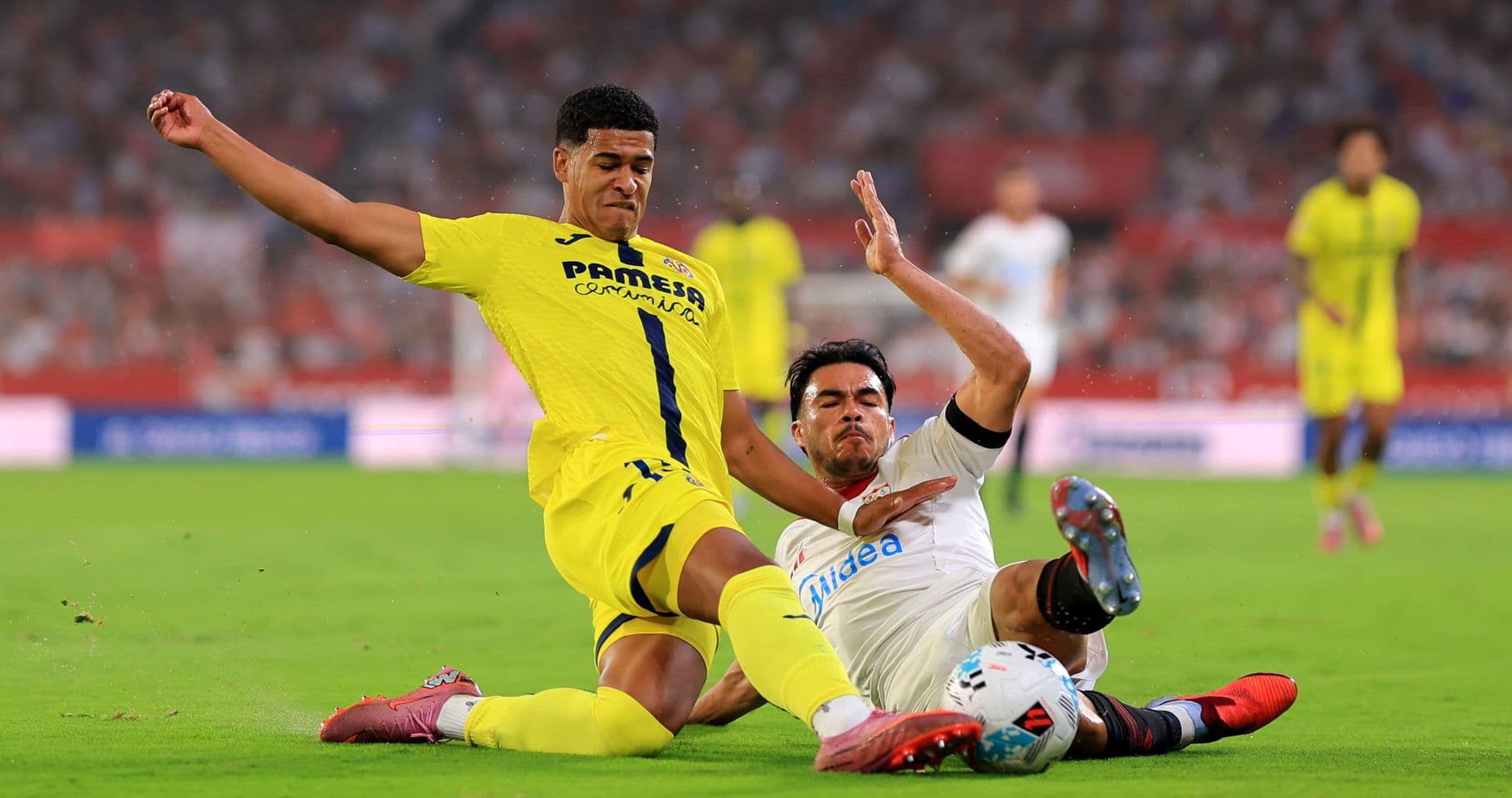
Sevilla’s on-pitch personnel amplified that risk. J. A. Carmona, the league’s leading yellow-card collector with 13 bookings, and L. Agoume, with 10 yellows, formed the right-hand defensive axis and central screen. Their presence guaranteed intensity but also meant Villarreal’s dribblers, especially Pepe and Mikautadze, could draw fouls and tilt momentum.
III. Key Matchups: Hunter vs Shield, Engine Room vs Enforcer
The first decisive duel was the “Hunter vs Shield”: Villarreal’s home attack against Sevilla’s fragile away defence. Heading into this game, Villarreal had scored 43 times at home, Sevilla had conceded 34 away. Mikautadze, with 12 goals from 51 shots (29 on target), and Moreno, the experienced foil, were the hunters. The shield was a back five fronted by Agoume, whose 66 tackles, 47 interceptions and 5 blocks this season define him as Sevilla’s primary enforcer.
In the end, Villarreal’s two first-half goals – reflected in the 2-2 half-time score – were a logical extension of their attacking profile. The 4-4-2 found spaces between Sevilla’s wing-backs and outer centre-backs, with Moleiro drifting inside to combine with Parejo and Mikautadze, while Pepe stretched the line on the right.
The second key battleground was the “Engine Room”: D. Parejo and P. Gueye versus L. Agoume and D. Sow. Parejo’s role as tempo-setter was to manipulate Sevilla’s compact 5-3-2 block, drawing them out with short passes and then hitting diagonal switches to the flanks. Agoume, who has 1250 passes at 80% accuracy and 28 key passes, mirrored that responsibility for Sevilla, but with a more defensive slant, tasked with breaking Villarreal’s rhythm and launching transitions to A. Adams.
Adams himself, with 10 league goals and 3 assists, was the spear of those transitions. His duels (228 total, 85 won) and aerial presence offered Sevilla an outlet against Villarreal’s back line, where Renato Veiga’s 30 blocks and 24 interceptions usually underpin their solidity. In a game that finished 3-2 to Sevilla, the Nigerian’s threat – supported by the intelligent movement of Maupay – clearly unsettled a Villarreal defence that has conceded just 18 at home all season.
IV. Statistical Prognosis and What This Result Tells Us
Even without explicit xG data, the season trends frame this result as a statistical upset. Villarreal’s overall averages of 1.9 goals for and 1.2 against, combined with their 14 home wins from 18, normally tilt any tactical preview heavily in their favour. Sevilla, with 1.2 goals scored and 1.9 conceded away, usually find themselves on the wrong side of fine margins.
Yet the 3-2 away win hints at a different reading. Sevilla’s flexible formation usage – nine different systems over the campaign – allowed them to tailor a 5-3-2 specifically to this opponent. The compactness around the box, the work of Vargas (6 assists this season) as a transitional connector, and the dual threat of Adams and Maupay gave them enough cutting edge to exploit Villarreal’s high-risk, high-reward structure.
For Villarreal, the loss does not erase a season of dominance at home, but it exposes a recurring theme: when the game becomes stretched and emotional in the final quarter, their card profile and defensive openness can undermine their attacking supremacy. With no penalties missed this season (6 scored from 6 overall), they remain ruthlessly efficient from the spot, but they did not have that safety valve here.
Following this result, the tactical lesson is clear. Villarreal’s 4-4-2, powered by Mikautadze, Moleiro and Pepe, is one of La Liga’s most entertaining machines, but against well-drilled back fives and powerful transition strikers like Adams, they must find an extra layer of control and protection. Sevilla, meanwhile, have discovered a blueprint: a disciplined 5-3-2 anchored by Agoume and Carmona, with Adams as the spear, can turn daunting away days into statement victories.