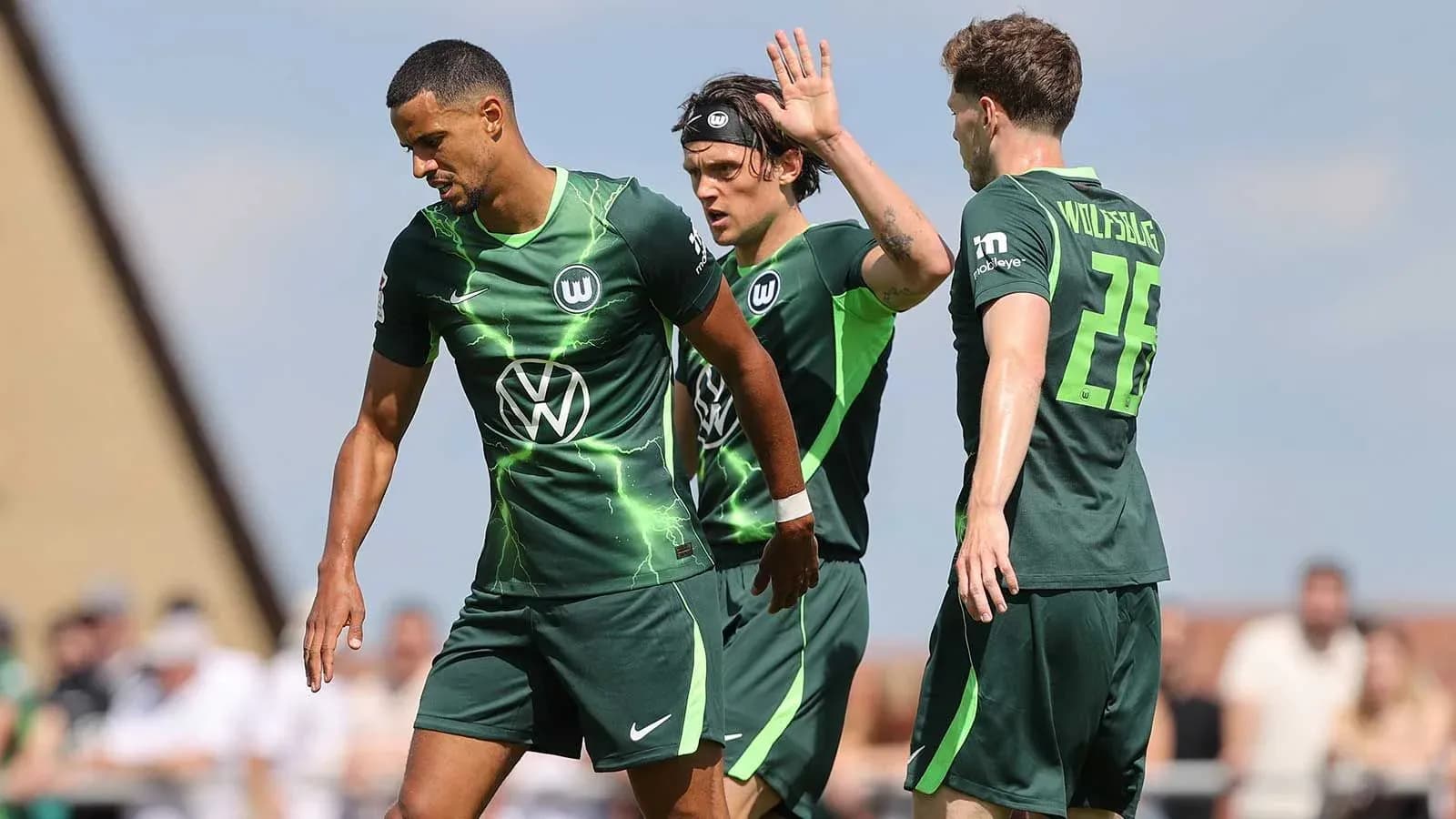
VfL Wolfsburg's Bold Strategy in 2. Bundesliga
VfL Wolfsburg were supposed to fall. Financially, structurally, emotionally. Relegation from the Bundesliga usually means cuts, compromises, and a long, hard look at reality.
Wolfsburg chose a different route. They reached for the chequebook.
A heavyweight in a featherweight league
While the rest of the 2. Bundesliga counts every euro, Wolfsburg are operating like a club that has barely noticed the drop. The numbers are brutal: VfL have already invested 22.7 million euros in new players this summer. All 17 other clubs combined? Just under 19 million in publicly known transfer fees.
One second-division side is outspending the entire league.
It is not just a curiosity. It is a structural question. At what point does financial power stop being an advantage and start becoming a distortion of competition? When a relegated club can reshape a squad at this scale, the balance of power in the 2. Bundesliga tilts sharply.
No transfer shows that more clearly than Fabian Reese.
The face of Hertha, now in Wolfsburg green
For Hertha BSC, Reese was not just a winger or a forward. He was the new face of the club. Captain, leader, fan favourite, symbol of a fresh start in Berlin after years of chaos.
Wolfsburg paid eight million euros to tear that symbol away.
Reese’s numbers in the 2. Bundesliga speak for themselves: 91 competitive games, 35 goals, 31 assists. One of the outstanding performers in the division, and Wolfsburg sporting director Pirmin Schwegler had no hesitation labelling him “one of the strongest players in the 2. Bundesliga” on arrival.
For Reese, this was not a cold, calculated move. He spoke openly about how tough the decision was, pointing to the way VfL had pursued him, the professional environment and “the values of the club, of Volkswagen and of the people around it” as decisive.
Only a year ago, such a departure felt unthinkable. In November 2025, Hertha had staged his contract extension like a declaration of faith. Reese signed early until 2030, with sporting director Benjamin Wieber stressing how much the club wanted to bind “Fabi” long term and how completely he identified with Hertha BSC.
The message: this is our man, our future, our Berlin.
Reese himself called Hertha the club closest to his heart and talked about big plans in the capital. The 2030 deal sounded like something that went beyond the usual football logic.
Less than twelve months later, that chapter is closed. And not because a Champions League club came calling. A direct rival in the same division paid eight million euros and walked away with the player Hertha had turned into a symbol of their rebirth.
For many in Berlin, this cuts deeper than the loss of a key attacker. They are losing a figure of identification, someone who embodied the club’s attempt to reconnect with its city and its supporters. Now he is joining a club that, in many respects, represents almost the opposite model: corporate backing, industrial strength, financial security.
Sportingly, Hertha lose a top performer and have not bought a single player. Wolfsburg gain both quality and identity in one move. Above all, the transfer lays bare the financial gap inside the same league: a relegated club can spend eight million euros on a second-division player from another major second-division club. That says everything.
Shopping in the same aisle – and buying the whole shelf
Reese is not an isolated case. He is part of a pattern.
Fraser Hornby has arrived from SV Darmstadt 98 for four million euros. Another direct rival, another important player gone. Muhammed Damar joins from TSG Hoffenheim. Hauke Wahl comes in from a relegated Bundesliga club for 1.8 million euros.
Robert Glatzel cost only around 1.7 million euros, but the fee is only half the story. Wolfsburg can offer wages that most of the league simply cannot match. Glatzel brings more than 180 second-division games and a proven track record of double-figure seasons. For many 2. Bundesliga clubs, such a striker is a dream. For Wolfsburg, he is a piece in a promotion puzzle.
And they do not stop at established names.
VfL paid 700,000 euros to SC Freiburg for Swiss centre-forward Alessio Besio, a player who did not make a single professional appearance for Freiburg in three years and spent last season on loan in the third division at Verl. Timon Wellenreuther came from Feyenoord for around one million euros, though he is now out for weeks with a knee injury. Elvis Rexhbecaj arrived on a free from FC Augsburg, but even “free” looks different at this level when the player brings more than 150 Bundesliga appearances and commands a salary package many second-tier clubs could never afford.
This is not a youth project. Wolfsburg are not quietly rebuilding in the background. The 2009 German champions are targeting proven professionals, players who have already delivered either in the Bundesliga or at the top end of the 2. Bundesliga.
The scale only truly hits home when you compare it with recent seasons from other fallen giants.
Schalke 04, in the 2025/26 second-division campaign, brought in about 8.75 million euros from sales and spent just 3.4 million. Transfer surplus: 5.35 million. Their most expensive new arrival, Christian Gomis, cost 1.5 million euros.
Fabian Reese alone cost Wolfsburg more than twice Schalke’s entire transfer outlay that summer.
Hamburger SV, before winning promotion in 2024/25, operated on a much smaller scale despite big ambitions. They spent around nine million euros on new players, with about three million coming in. Their record signing that summer, Alexander Rossing-Lelesiit, cost roughly 2.8 million euros.
Hannover 96 offer another stark contrast. In 2025/26, they generated 11 million euros in transfer income and spent only 4.33 million. Surplus: around 6.68 million.
Wolfsburg’s current window sits in a different universe.
Big spending – but not reckless
Yet it would be too simple to say Wolfsburg have just turned on the tap and started flooding the market. The money going out is matched by money coming in.
Patrick Wimmer moved to TSG Hoffenheim for around ten million euros. Jakub Kamiński joined 1. FC Cologne for 5.5 million. Lovro Majer reportedly left for AEK Athens for six million. In total, Wolfsburg have brought in around 24 million euros so far.
On paper, that even leaves a small transfer surplus despite the headline-grabbing investments.
That is the nuance: Wolfsburg are not burning cash without thought. They are financing most of their new arrivals through their own sales. Their special status does not lie in the balance sheet, but in what they can do with the money they generate. Where others must save, VfL can reinvest almost every euro into a squad built for an immediate return to the Bundesliga.
There is precedent. When VfB Stuttgart dropped in 2019/20 and chased an instant comeback, they spent heavily as well: around 25.4 million euros on new players. Silas alone cost eight million from Paris FC, Sasa Kalajdzic around six million from Admira Wacker.
Stuttgart actually operated on an even bigger transfer volume than Wolfsburg now. But the context was different. VfB sold players for around 79.5 million euros, ending that window with a surplus of more than 54 million despite their investment.
Wolfsburg’s story is not new either. It is just playing out on a different stage.
Same model, new backdrop
Last season, still in the Bundesliga, Wolfsburg brought in around 37 million euros from sales and spent about 68 million on new players. Transfer deficit: just under 31 million euros.
Vinicius Souza alone cost around 15 million from Sheffield United. Mohamed Amoura, signed permanently from Union Saint-Gilloise after his loan, came in at around 14.75 million.
Million-euro transfers are part of Wolfsburg’s normal operating rhythm. The change is not the behaviour. It is the environment.
In the Bundesliga, they were one of many financially strong clubs. Bayern Munich, Borussia Dortmund, Bayer Leverkusen, RB Leipzig – all can regularly spend double-digit millions on individual players. In that company, Wolfsburg’s moves blended into the background noise of a rich league.
Drop that same model into the 2. Bundesliga, and it suddenly collides with clubs whose entire transfer budget is, in some cases, lower than what VfL have just paid for Fabian Reese alone. The sums have not changed. The perception has.
The Bayern of the basement? Not even close
Look at the squad values and the gap becomes almost absurd.
According to transfermarkt.de, Wolfsburg’s squad is valued at 194.15 million euros. That figure would place them ninth in the Bundesliga. In the 2. Bundesliga, second place belongs to fellow relegated side FC St. Pauli with 45.93 million euros.
Wolfsburg’s squad is worth roughly 4.5 times more.
To call VfL the “Bayern Munich of the second division” would actually understate the disparity. Bayern’s squad, at 1.07 billion euros, is not even worth twice as much as RB Leipzig’s (around 604 million). Borussia Dortmund are still buying and sit in the same financial stratosphere.
In the 2. Bundesliga, Wolfsburg stand almost alone.
Reese, Hornby, Glatzel, Wahl, Rexhbecaj, Wellenreuther – the pattern is unmistakable. VfL do not intend to linger in the second tier. The plan is clear: one season, promotion, reset.
Key players like Amoura have followed the club down, bolstering a squad that looks wildly overqualified for its surroundings. The financial might is not theoretical. It is visible on the team sheet.
Whether this will ultimately amount to a distortion of competition will only be answered once the season starts, when points are won or lost on the pitch and not in the accounts.
But one truth is already undeniable: in a league built on tight budgets and careful planning, VfL Wolfsburg are operating in a financial reality of their own. And everyone else now has to work out how to compete with a club that looks, in second-division terms, like a visiting superpower.