VAR's Speed Obsession: The Cost of Quick Decisions in the Premier League
“Quick, quick, quick, quick! Go, go, go, go, go!”
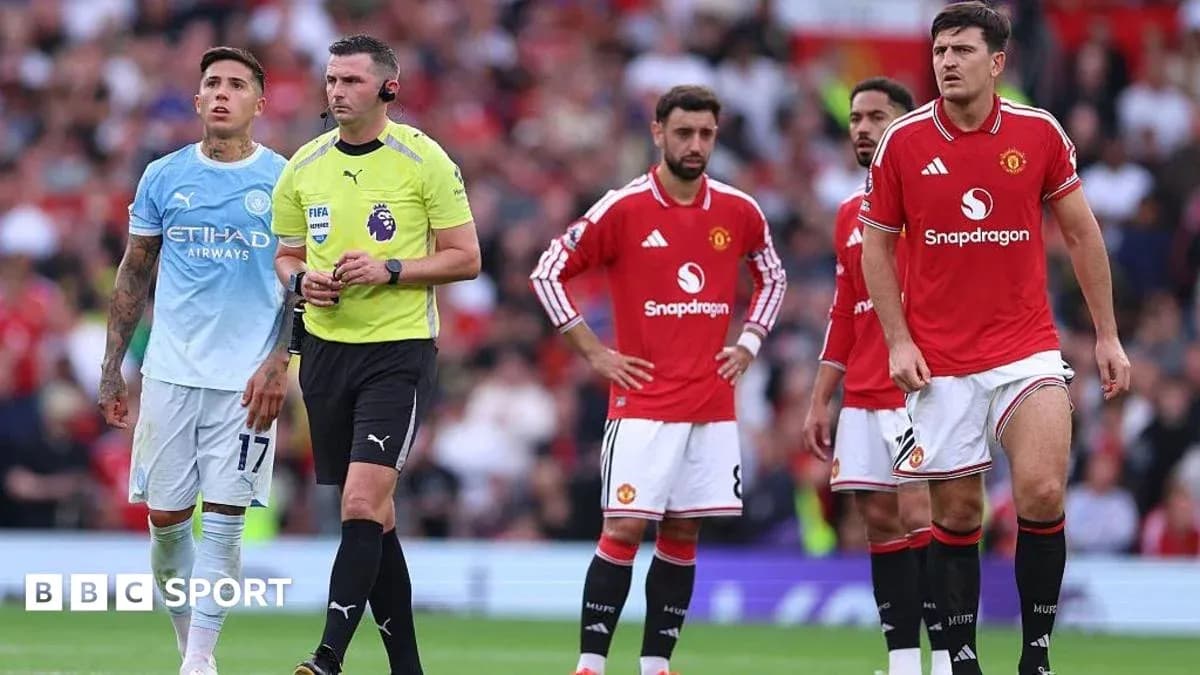
The words crackled through the headset of video assistant referee Matt Donohue as he hurtled through the review that would decide the Manchester derby. Seconds later, Erling Haaland’s goal stood, Manchester City had beaten Manchester United 1-0, and the Premier League had one of the most glaring VAR failures of the era on its hands.
Donohue was trying to be efficient. Instead, he and assistant VAR Blake Antrobus somehow missed Enzo Fernandez standing three yards offside before attempting to head the ball. One of the clearest, most basic checks in the VAR handbook simply never happened.
In a sport where refereeing has always lived in a goldfish bowl, VAR was supposed to help. It has only made the bowl brighter, louder, and far less forgiving.
When speed goes wrong
The Premier League set out this season with a clear instruction: make VAR faster. “More efficient application of VAR to reduce delays” was written in as a football principle. Fewer pauses, fewer boos, fewer minutes staring at a frozen screen.
Has that chase for speed finally run straight into a wall?
The urgency in Donohue’s voice told its own story.
“Let’s go, let’s go, let’s go, let’s go!”
This was not the calm, methodical dialogue you expect from a video official dissecting one of the biggest games of the season. It sounded rushed. Frantic. The exact opposite of the composed environment VAR is supposed to create.
Referees hear it constantly: from fans, from pundits, from radio phone-ins and columns. VAR has to be quicker. Long delays are intolerable. The Premier League’s stakeholders’ survey, which canvasses managers, coaches and supporters, hammered home the same point: speed, speed, speed.
That pressure is real. It is also no defence for missing an offside that should have been obvious.
City manager Enzo Maresca, who benefited from the mistake, still recognised the strain.
“To make a decision in 10, 20 seconds is not easy for them,” he said on Wednesday. “Sometimes they make mistakes. I make mistakes, players make mistakes. It’s part of our job.”
Howard Webb, the referees’ chief, has tried to respond to the demands. Reviews are quicker. The numbers prove it. VAR delays, including the referee’s announcement to the crowd, have dropped from an average of 46 seconds per game to 36 seconds this season.
Yet the other major VAR blunder this campaign – the failure to award Arsenal a penalty at Aston Villa – also came from an incident cleared too quickly.
The message is obvious. Speed helps, until it doesn’t.
The process that broke
The real damage on derby day started before the frantic countdown.
Donohue asked the replay operator to freeze the first replay at the moment Josko Gvardiol played the ball across. From there, he jumped straight into the semi-automated offside technology.
That is not how the system is supposed to work.
The VAR team should have watched the entire attacking sequence: the cross, the movement in the box, Haaland’s header, and crucially, Fernandez’s position and involvement. Only by seeing the full picture can a VAR understand who is active, who interferes, and where the offside line truly matters.
They didn’t. The penalty area chaos was only really examined once Donohue began rushing through the attacking phase. By that point, the review had narrowed to a single question: did Fernandez touch the ball? If he had, it would have created a new phase and left Haaland offside.
Everything else – including Fernandez’s original offside position – drifted out of focus.
Donohue has absorbed most of the criticism, but Antrobus’ role, or lack of it, was just as telling. The AVAR is supposed to be the safety net, the second pair of eyes, the voice that says: “Have we checked everything?”
His entire contribution to the review boiled down to “no, yeah” on whether Fernandez had made contact with the ball. One second later, Donohue declared: “Final decision is goal, check complete.”
That is not a system of checks and balances. That is a rubber stamp.
The shadow of a four‑minute delay
Antrobus’ recent history adds another layer. The only long VAR delay this season came in Brentford v Sunderland, when Dan Ballard’s goal was ruled out for a subjective offside against Kevin Danso. The delay lasted more than four minutes. Antrobus was AVAR that day as well and was heavily criticised in some quarters for the length of the stoppage.
Did that experience weigh on him in the Manchester derby? Did the memory of a four-minute review nudge him towards silence? No-one can say for sure.
The irony is sharp. In that Brentford game, Antrobus played a crucial role in guiding VAR Tim Wood to the correct offside call against Danso. The long delay produced the right decision. The lightning-quick review in the derby did not.
There is another layer of oversight too: the support VAR, who sits in the operations room next to the match hub at Stockley Park, empowered to step in on protocol. That official saw what was unfolding. No intervention came.
Even after the goal was awarded, there was a window. Between the ball crossing the line and the restart from kick-off, the decision could still have been rescued.
It wasn’t.
Specialists, training – and the limits of both
Pro Ref has poured money, time and training into VAR. The ambition is clear: a system that is both efficient and accurate. When a mistake of this scale lands, all that investment suddenly looks very small.
Calls to appoint VAR specialists have grown louder. Yet in Premier League terms, Donohue is exactly that. Three seasons ago, Pro Ref invited referees to put themselves forward as dedicated video officials. Candidates sat aptitude tests. Around 15 reached the final training stage. Ten have since worked as VARs in the Premier League.
Donohue is one of them. Sunday was his 65th match as a video official. His development has been strong enough to earn a place on the international list, including appointments to UEFA club competition qualifying ties in the summer.
He has made errors before; almost every VAR has. The job is brutally difficult. Across the last two seasons, only two VARs – Nick Hopton and Neil Davies, both products of the same accelerated programme – have a completely clean record on clear mistakes.
Even persuading referees to give up the whistle and move full-time into the VAR room is no guarantee. Lee Mason and Mike Dean, the Premier League’s only full-time VARs appointed after retirement, both lost their positions under Webb a few months into his tenure after a string of high-profile errors.
Look abroad and the picture barely changes. Spain’s La Liga and second division run with full-time VAR-only officials who never take charge on the pitch. The controversies keep coming. At the start of last season, a VAR there completely missed that the scorer of a goal was offside when the ball was played.
The model is different. The arguments are the same.
A football problem, not just a VAR problem
Pro Ref now faces uncomfortable questions. Why was a VAR in such a rush in one of the marquee fixtures of the calendar? Why did no-one in the chain – AVAR, support VAR, the wider operations team – hit the brakes?
Contrast that chaos with West Ham’s stoppage-time equaliser against Arsenal last season. That review dragged on for more than four minutes before the goal was ruled out. It was slow. It was painful. It was also right.
The game has become obsessed with speed. With killing the wait. With trimming every second off the stopwatch. When that obsession starts to undercut accuracy in matches of this magnitude, the problem stops belonging to one official or one replay operator.
It becomes something else: a question about what football really wants from VAR, and what it is willing to sacrifice to get it.