Tottenham Hotspur vs Everton: A Clash of Contrasting Trajectories
The evening closed over Tottenham Hotspur Stadium with a kind of uneasy silence. A 0–0 draw between Tottenham and Everton, finished in regular time under Darren England’s watch, felt less like a stalemate and more like an x-ray of two teams at very different stages of their development.
I. The Big Picture – contrasting trajectories
Following this result, the table tells a stark story. Tottenham sit 17th with 2 points from 4 matches, their goal difference at -5 after scoring 0 and conceding 5 overall. At home, they have played 2, drawn 1, lost 1, with 0 goals scored and 2 conceded. The numbers mirror the narrative: a side trying to reinvent itself under Roberto De Zerbi but still searching for any kind of cutting edge.
Everton, by contrast, leave London in a far more stable place. They are 8th with 6 points from 4 matches, unbeaten with 1 win and 3 draws. Overall, they have scored 5 and conceded 3 for a goal difference of +2. On their travels, they have now drawn both away games, with 1 goal scored and 1 conceded. The season’s early pattern is clear: David Moyes has built a compact, hard‑to‑beat unit, happy to accumulate points through control and pragmatism.
Both managers leaned into a shared 4‑2‑3‑1 shape, but with very different intentions. Tottenham’s version was about fluidity and rotations; Everton’s, about structure and discipline.
II. Tactical Voids – absences that shape identity
For Tottenham, the team sheet was as revealing as the scoreline. Dejan Kulusevski, Mykhailo Mudryk, Wilson Odobert and Xavi Simons were all listed as missing with knee or ankle injuries, while Richarlison was absent amid transfer negotiations. That is essentially an entire tier of ball-carrying, one‑v‑one, and penalty‑box threat stripped from the squad.
In their place, De Zerbi leaned on a front four of Sávio, Mateus Fernandes, Omar Marmoush and Dominic Solanke. It is a group that offers movement and work rate, but not yet the ruthless incision those absentees might provide. The result was a Tottenham side that could reach the final third but rarely puncture it, a pattern consistent with their season-long record: 0 goals in total, with an average of 0.0 goals for both at home and on their travels, and 4 matches in which they have failed to score.
Everton’s key absentee was Christian Norgaard, out through injury, depriving Moyes of an experienced screening presence in midfield. Yet the double pivot of James Garner and H. Armstrong held firm. Everton’s defensive record this campaign – 3 goals conceded in total, averaging 1.0 at home and 0.5 away – underpinned their approach: risk managed, spaces controlled, and the draw never far from their grasp.
Disciplinary trends added another layer. Tottenham’s yellow cards this season are weighted heavily towards the closing stages: 40.00% of their cautions have arrived between 76–90 minutes, with 20.00% in each of 0–15, 31–45 and 46–60. It suggests a team that grows increasingly frantic late on, chasing games they have failed to kill earlier. Everton’s bookings are more evenly spread, with notable spikes at 61–75 minutes (28.57%) and a steady trickle across the rest of the match. This is a side that can foul to break rhythm without losing structural control.
III. Key Matchups – Hunter vs Shield, Engine Room battles
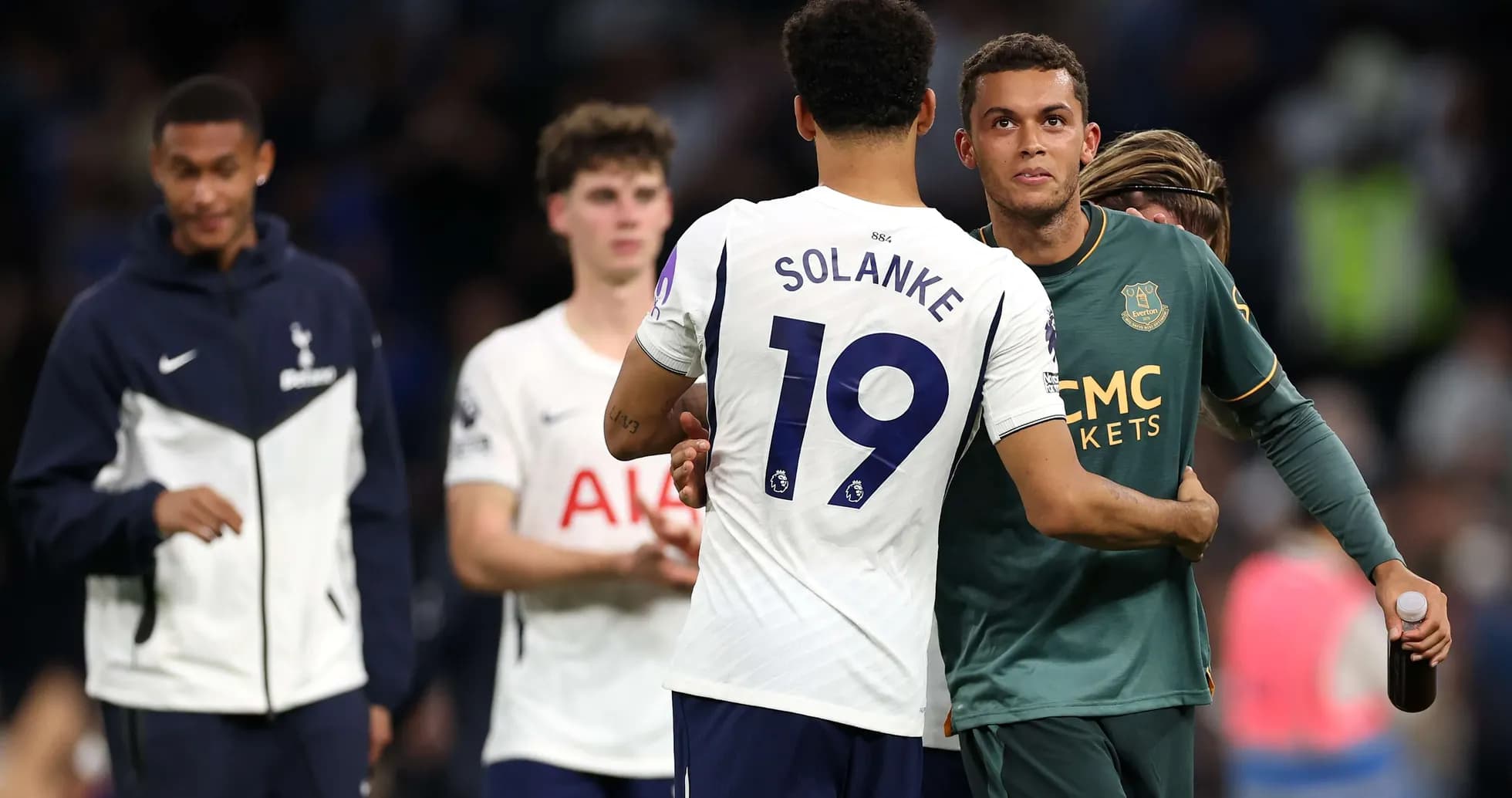
The “Hunter vs Shield” narrative for Tottenham is paradoxical: the hunter barely has teeth. With 0 goals in total, there is no established scorer to pin the story on, so the burden falls on Solanke as the nominal number nine. Against Everton, he worked the channels and tried to pin Jarrad Branthwaite and James Tarkowski, but he was feeding off a supply line still learning its patterns.
On the flanks, Sávio and Marmoush were tasked with replacing the verticality and creativity usually offered by Kulusevski, Mudryk, Odobert and Simons. Their movements between the lines were intelligent, yet without the final pass or shot that would tilt a game. Tottenham’s season-long average of 0.0 goals for at home underlines that their “hunter” is still an idea more than a reality.
Everton’s shield, by contrast, is very real. Branthwaite and Tarkowski anchored a back four that already reflects the team’s broader defensive metrics: 0.5 goals conceded on their travels, and 2 clean sheets in total this campaign. In front of them, Garner was the quiet metronome and enforcer. His league numbers – 4 appearances, 240 minutes, 128 passes completed with 3 key passes, 11 tackles and 2 interceptions – show why he is both a disciplinary focal point and a structural one. He has already collected 2 yellow cards this season and features among the league’s leaders in both yellow and red card charts, a sign of how often he operates at the edge of risk to maintain Everton’s compactness.
In the “Engine Room” duel, Rodrigo Bentancur and Sandro Tonali tried to impose De Zerbi’s short-passing, vertical-possession blueprint. They circulated the ball, stepped into half-spaces, and attempted to connect with Mateus Fernandes between the lines. But with Tottenham’s overall average of 1.3 goals conceded per match and no offensive output to relieve pressure, every turnover felt heavier. Everton’s midfield, led by Garner, could sit, absorb, and then push Barry, Tyrique George, K. Dewsbury-Hall and B. Johnson into counters that never needed to be reckless.
IV. Statistical Prognosis – what this draw really says
Following this result, the trajectories remain clear. Tottenham’s overall record – 0 wins, 2 draws, 2 defeats, 0 scored, 5 conceded – describes a team still in the laboratory phase. The 4‑2‑3‑1 is consistent (used in all 4 league matches), but without goals, the model is fragile. Their clean sheets (2 overall, split evenly between home and away) show that they can be solid in phases, yet the lack of threat means every defensive slip is potentially decisive.
Everton’s season, by contrast, feels built on stable foundations. They have used the same 4‑2‑3‑1 in all 4 matches, remained unbeaten, and balanced 5 goals scored with 3 conceded. Their away profile – 0.5 goals for and 0.5 against on their travels – speaks to a side that approaches road games with realism: do not lose first, win if the game opens.
In xG terms, this would likely have been a low‑margin contest, with Everton’s defensive solidity and Tottenham’s blunt attack conspiring to keep the scoreline blank. If anything, the underlying trends suggest that Everton’s current formula – disciplined midfield, robust centre-backs, and a cautious away plan – is sustainable across the season.
For Tottenham, the prognosis is more conditional. The structure is there: Bentancur and Tonali as a double pivot, Sávio and Marmoush attacking the half-spaces, Solanke leading the line, and a back four with Micky van de Ven and Andrew Robertson capable of building from deep. But until the missing attackers return and the front four find a way to translate territory into goals, every match will feel like this one: aesthetically promising in phases, statistically unforgiving at the final whistle.