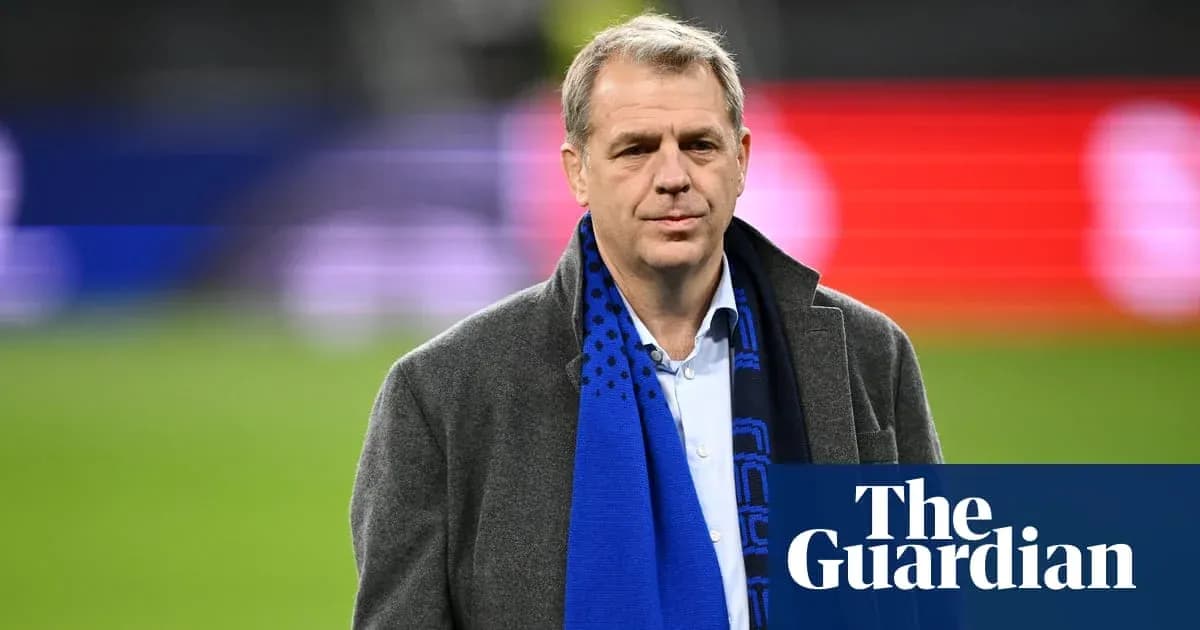
Todd Boehly's Departure Marks Shift in Chelsea's Ownership
Todd Boehly arrived at Chelsea as the loudest voice in the room. He leaves four years on as a footnote.
The American businessman, along with fellow investor Mark Walter, has been bought out of the BlueCo consortium, ending his formal role in the club’s ownership structure. On paper, it sounds seismic. In reality, the power had shifted away from him long ago.
Clearlake’s club now
Clearlake Capital, the US private equity firm fronted by Behdad Eghbali and José E Feliciano, was already running Chelsea. It held the majority stake and the real authority. Boehly, Walter and Swiss billionaire Hansjörg Wyss shared a 38.5% slice between them, but their influence had been fading almost from the moment the £2.5bn takeover from Roman Abramovich was completed in 2022.
Wednesday night’s confirmation that Clearlake now has full control simply formalised what was already happening behind the scenes. Eghbali has been calling the shots for some time, with Feliciano operating more quietly in the background.
The split has been brewing for two years. Friction inside the ownership group spilled into public view as relations between Boehly and Clearlake soured. Boehly grew disillusioned with the partnership and explored a way out on his terms. People close to him insisted he had investors lined up to back a full takeover. Inside Clearlake, those claims were met with rolling eyes.
Clearlake responded by looking at the opposite solution: buying him out. Another option floated was even more brutal. Boehly would step down as chair, accept a diluted governance role and effectively become a ceremonial figurehead.
Nobody pretended this was a warm relationship. Yet the stalemate dragged on. A truce of sorts followed, Clearlake pressed ahead with its own vision and Boehly drifted towards the margins.
From frontman to lightning rod
It was not always this way. At the beginning, Boehly was the face of the new Chelsea.
With senior football staff gone in the wake of Abramovich’s exit, he installed himself as interim sporting director. He strode into a world he barely knew and tried to run it. Agents liked him personally but questioned his grasp of the sport. Rival clubs sensed opportunity.
Chelsea burned through around £300m in that first summer window, much of it on players who never looked a fit. Raheem Sterling arrived on a £325,000-a-week deal that quickly became a cautionary tale. The chaos deepened when Thomas Tuchel was sacked early in the 2022-23 season and replaced by Graham Potter, whose tenure unravelled just as quickly.
The logic behind some of the recruitment was startlingly thin. Boehly later admitted he pushed to sign Marc Cucurella from Brighton after hearing Manchester City were interested. It was copycat strategy dressed up as ambition, and it backfired.
On the pitch, Chelsea stumbled. Off it, their new co-owner turned into a punchline. He became the symbol of excess and naivety – the man who floated the idea of a Premier League All-Star game at a business conference and confidently predicted Chelsea would beat Real Madrid 3-0 before a Champions League quarter-final in 2023. They did not.
Eghbali’s vision, Chelsea’s reset
Boehly has always maintained he never meant to stay that deeply involved, that he planned to step aside once specialists were in place. Either way, Chelsea’s model has been transformed since those early months.
The club has moved from one interim sporting director to a sprawling structure of five permanent figures: Paul Winstanley, Laurence Stewart, Sam Jewell, Joe Shields and Dave Fallows. The recruitment drive has shifted towards younger players on long, incentivised contracts, an attempt to build value and stability after the early scattergun spree.
Eghbali has driven that shift. His influence is everywhere, from the dugout to the dressing room. It has not been smooth. Under this ownership, Chelsea have reached the Champions League only once. Managers have spun through the revolving door at a rate that would be familiar to the Abramovich era, just without the trophies.
Inside Clearlake, the message is that lessons have finally landed. Last summer’s business is held up as evidence. Chelsea hired a serious head coach in Xabi Alonso and added more established talent to a squad that had been overloaded with potential but short on proven quality.
While that evolution took place, Boehly largely receded from view. The buyout talk faded until this past summer, when a different pressure point emerged: Walter’s need to liquidate assets to tackle financial issues in the US. The sale of his LA Lakers stake was a clear sign of where things were heading.
Now, both he and Boehly are out, reportedly with a modest profit on their Chelsea investment. Jonathan Goldstein, a close ally of Boehly’s, has also departed the board. Wyss, though, remains in the picture, having invested in a Clearlake vehicle.
Same power, new question
For all the noise around ownership change, the day-to-day reality at Cobham and Stamford Bridge remains the same. Operations, leadership, transfer strategy – all still under Clearlake’s control, all still driven by Eghbali and Feliciano.
The real pivot point lies elsewhere: the stadium.
Chelsea’s long-running search for a solution to their home ground problem is back at the top of the agenda. The Guardian revealed in September 2024 that the club were in talks over a potential move from Stamford Bridge to Earls Court. The Earls Court Development Committee has its own approved plans for the site, but that project has stalled.
Chelsea’s interest has not gone away. At the same time, they have not abandoned the more complex option of redeveloping Stamford Bridge, a route tangled in planning, cost and logistical hurdles.
Whatever route they choose, it will unfold without Todd Boehly anywhere near the controls. In a joint statement, Eghbali and Feliciano described him as someone who “will always be a part of the Chelsea story and family”.
Given how that story unfolded – the wild early spending, the missteps, the bruising lessons and the quiet exit – that feels like a generous reading of his legacy. The question now is whether Clearlake can turn the club he once fronted into the contender he promised, without him.