Thierno Barry Shines as Everton Wins Opening Match Against Crystal Palace
Thierno Barry walked slowly, deliberately, towards the touchline. With less than 15 minutes left and Everton cruising to an opening-day win over Crystal Palace, the announcement rang around Hill Dickinson Stadium: the match-winner was coming off, Beto coming on.
The reaction told its own story.
Barry, 23 and beaming, soaked in the ovation from the blue half of Merseyside. This was not polite applause. This was recognition – for the goal, for the graft, and for the journey it has taken to get here.
From drought to deliverer
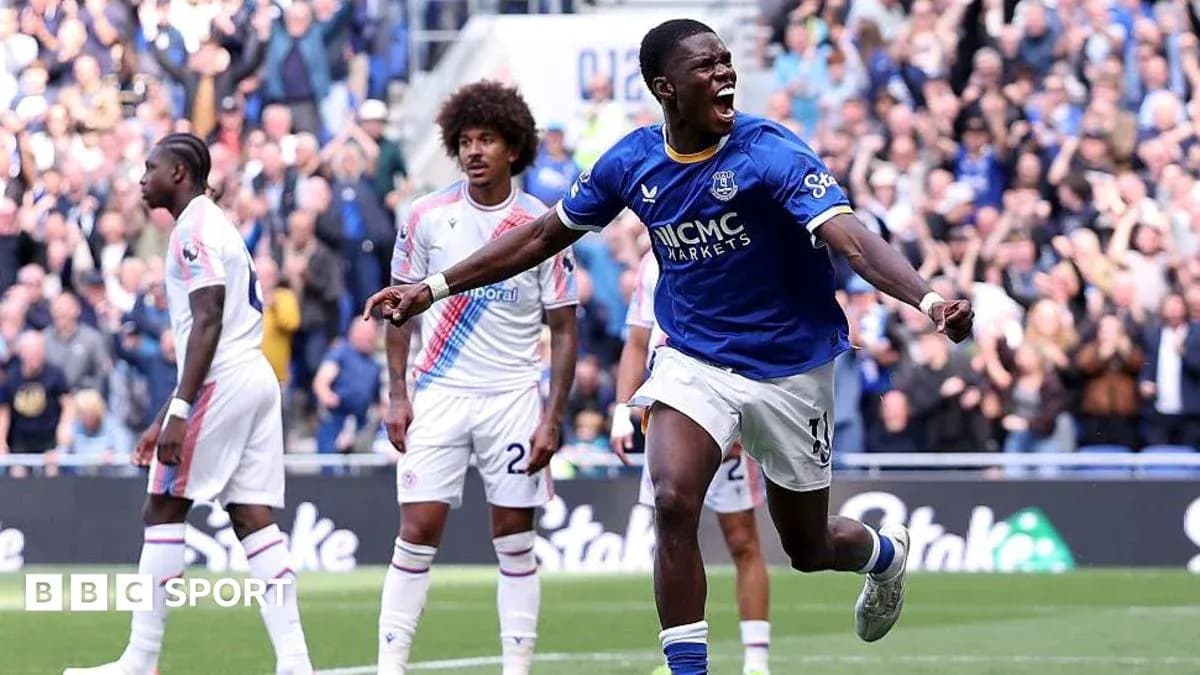
His big moment had come early in the second half. Everton led 1-0, the game still carrying that uneasy edge that has haunted the club in recent seasons. Then Iliman Ndiaye shaped his run, looked up and whipped in a cross of real quality.
Barry attacked it. No hesitation, no doubt. His header flew in, doubling Everton’s lead and all but killing Palace’s hopes of a fightback.
He wheeled away smiling, engulfed by teammates, the home crowd roaring their approval. It felt like a simple goal. It was anything but.
Because not long ago, the mood around Barry was very different.
Signed from Villarreal for £27m after an 11-goal La Liga season, he arrived last summer as a symbol of a new Everton – younger, hungrier, built for something more than survival. What followed was a brutal Premier League reality check: a 14-game goal drought, one league goal in his first 18 appearances, and patience thinning in the stands.
The fee, the expectations, the struggles of a club wrestling with a points deduction for breaching the Premier League’s Profit and Sustainability Rules – it all weighed heavily. Everton had spent years lurching from manager to manager, each one firefighting against relegation. Barry was never supposed to be the finished article. He was a project. But projects don’t always get time on Merseyside.
Then January came, and something shifted.
Barry’s season caught fire. By the end of the campaign, he had eight Premier League goals in 38 games. On paper, that return might not turn heads. In context, it mattered.
Half of those goals came after Jack Grealish, Everton’s creative heartbeat, suffered a season-ending injury in January. As others faded in the run-in, Barry found form. His eight goals came from an xG of 8.1, and his shot conversion rate of 21.1% sat just a fraction below Erling Haaland’s 21.4%. The numbers hinted at a striker starting to work things out.
Now, on the opening day of the new season, he looked like a man ready to lead the line, not just grow into it.
Moyes’ demands – and his belief
Down in the bowels of Hill Dickinson Stadium after the 2-0 win, David Moyes chose his words carefully. He has seen this before. Two decades ago, he helped shape a teenage Wayne Rooney into a phenomenon. He knows the difference between a good day and a complete forward.
"Look, strikers will probably be judged on their goals, so he can walk away and be really happy with it," Moyes said, acknowledging the decisive header.
But he made sure the spotlight didn’t fall solely on Barry.
"I thought it would be wrong not to mention the quality of the cross from Ndiaye. Thierno getting in the right spot was huge and scoring with a header was really big for us because it was an important time in the game."
The praise, though, came laced with challenge.
"I need his build-up play to be better," Moyes added. "I need him to be able to retain the ball for us so we can play into him more often.
"I want him to get in the right spaces, which he did today for the cross. He had a couple where the ball got played to him and he didn't quite deal with it with his feet.
"Sometimes he is out linking up when he doesn't need to be linking up. I think there is a lot to his game."
Those flaws had been visible even on a night when Barry scored the decisive goal. At times he drifted too wide, chasing involvement when Everton needed a focal point. On a few breaks, his first touch let him down, moves stalling just as Palace looked stretched.
For Moyes, that is the next step. The finishing is there. The movement in the box is improving. Now he wants a striker who can glue Everton’s attacks together, hold the ball, bring others into play, and give his side a platform higher up the pitch.
A striker with something to prove
When Everton’s recruitment team went hunting for a centre-forward last summer, they knew the constraints. The PSR punishment had bitten hard. The days of outmuscling rivals in the market were gone. They couldn’t buy the finished product.
So they gambled on potential.
Barry arrived knowing he was a work in progress, and Everton knew it too. The adaptation took longer than many wanted, but the second half of last season hinted at the payoff.
"I said last year that when you're a young striker coming in, it's not always easy," Moyes reflected. "I think he's come in with a really, really positive attitude this year.
"I think he's come back with something that has stirred him up a little bit more, as if he's got something to prove."
That edge has started to show. The movement for his goal against Palace – timing his run, trusting Ndiaye, attacking the space – was the mark of a forward beginning to understand Premier League tempo and punishment. Get there late, you miss it. Get there early, you’re marked. Get it right, you score.
Everton have needed a talisman up front for years, someone to carry the weight without buckling under it. On this evidence, Barry is edging closer to that role.
The roar that followed his substitution wasn’t just for a goal on opening day. It was for a striker who has ridden out the doubts, who now walks off to applause instead of questions.
Now comes the hard part: doing it again, and again, until this feels less like a turning point and more like the new normal at Everton.