Sunderland vs Manchester United: Tactical Analysis of a Goalless Draw
Sunderland and Manchester United played out a 0–0 at the Stadium of Light that was anything but passive. Across 90 minutes, Sunderland shaded possession (51%) and territory, generated the higher xG (1.25 to 0.62), and forced more saves from Senne Lammens than Robin Roefs had to make at the other end. Yet Manchester United, despite being pushed back for long spells, defended their box with discipline and survived a late wave of pressure to take a point that owed as much to structure as it did to last-ditch interventions.
Disciplinary Story
The disciplinary story was one-sided and must be stated precisely. All cards came for Manchester United, with Sunderland remaining card-free:
- 54' Mason Mount (Manchester United) — Foul
- 58' Joshua Zirkzee (Manchester United) — Foul
- 90+3' Matheus Cunha (Manchester United) — Simulation
That is three yellow cards for Manchester United, zero for Sunderland, total three.
First Half
The event timeline underlines how the game’s physical and tactical tone escalated after the break. The first half, with no bookings and no goals, was a controlled contest of structure and spacing rather than aggression. Sunderland’s 15 total shots (4 on target) versus United’s 11 (1 on target) already hinted at the hosts’ greater initiative, but United’s compactness in the box and Lammens’ handling kept the score level at 0–0 by half-time.
Second Half
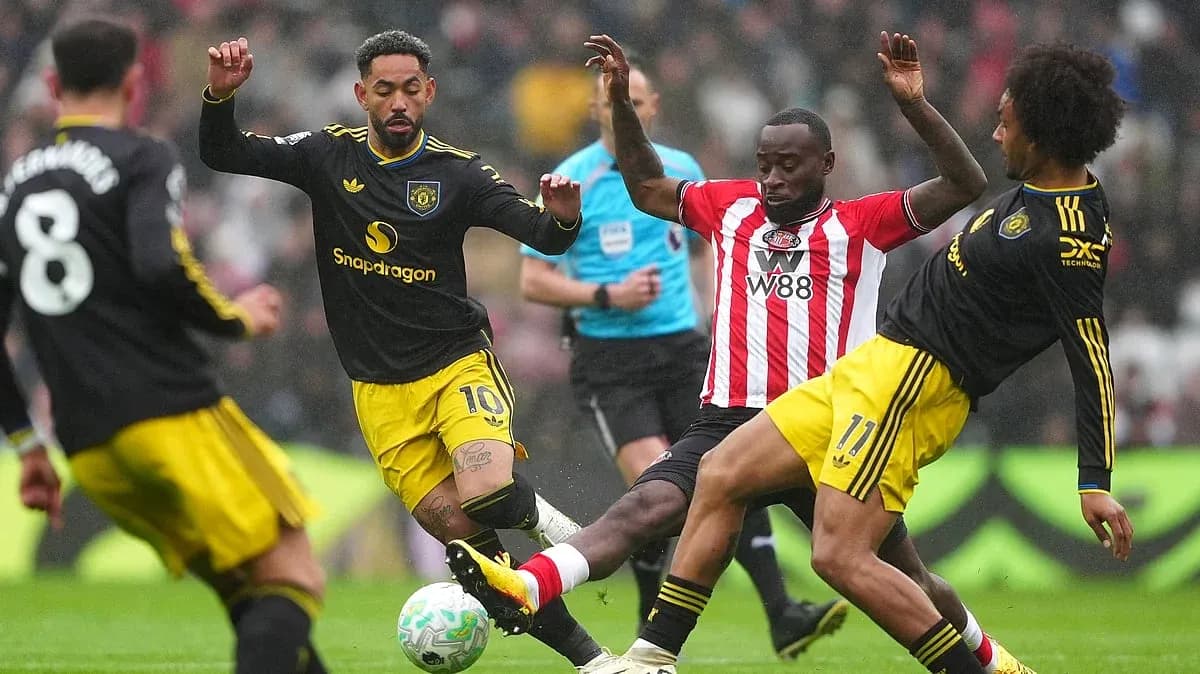
The second half opened with Sunderland continuing to probe between United’s lines, drawing more defensive actions from Michael Carrick’s side. The first flashpoint came on 54 minutes, when Mason Mount was booked for “Foul”, a signal that United’s midfield was starting to arrive late into duels as Sunderland’s circulation quickened through Granit Xhaka, Enzo Le Fée and Noah Sadiki. Four minutes later, Joshua Zirkzee joined him in the book, also for “Foul” at 58', reflecting the strain on United’s first defensive line as Sunderland’s back four stepped higher and the hosts tried to lock play in the visitors’ half.
On 65', Carrick made his first structural adjustment: Patrick Dorgu (IN) came on for Joshua Zirkzee (OUT). With Zirkzee already booked and United spending longer phases without the ball, this change tilted the front line from a focal-point striker to a more defensively secure, left-sided presence, likely to help Luke Shaw and Lisandro Martínez cope with Sunderland’s left-sided rotations.
At 75', Amad Diallo (OUT) made way for Bryan Mbeumo (IN), another move pointing towards vertical threat on the break rather than sustained possession. Mbeumo’s pace offered an outlet when Bruno Fernandes and Matheus Cunha could release him into the channels, but United still managed just a single shot on target all game, underlining how deep they were forced to defend.
Regis Le Bris responded on 79' to chase a winner: Nilson Angulo (IN) came on for Chemsdine Talbi (OUT), injecting fresh forward running against a United back line that had already absorbed a high volume of defensive actions. Sunderland’s late-game pattern became clearer: Robin Roefs and the back four of Lutsharel Geertruida, Nordi Mukiele, Omar Alderete and Reinildo Mandava held a high starting position, Xhaka and Sadiki recycled possession, while Angulo and Brian Brobbey looked to attack the space between Maguire and Martínez.
Stoppage Time
As stoppage time approached, the tension peaked. On 90+3', Matheus Cunha was booked for “Simulation”, a key detail: rather than a foul in Sunderland’s half, this was an attacking attempt to win a decision that the referee judged as an attempt to deceive. It deprived United of a potential late set-piece and encapsulated their frustration at the lack of clear chances. Just before that, Sunderland had made their final attacking change at 90': Eliezer Mayenda (IN) came on for Trai Hume (OUT), another sign that Le Bris was willing to trade some midfield stability for extra penalty-box presence in search of a late winner.
Tactical Standpoint
From a tactical standpoint, the statistical profile is stark. Sunderland’s 15 total shots to United’s 11, and especially their 4 shots on goal to United’s 1, show that Le Bris’ side controlled where and how the game was played. The 9 shots inside the box versus United’s 6 highlight Sunderland’s ability to arrive in advanced zones through layered possession rather than only long-range efforts. Their xG of 1.25, compared to United’s 0.62, confirms that the hosts fashioned the better quality of chances.
Roefs’ single save, against Lammens’ four, is crucial. It reveals that Sunderland’s defensive block — with Mukiele and Alderete central, Geertruida and Reinildo managing width — largely kept United’s attacks at arm’s length, forcing them into less dangerous positions. United’s identical goals prevented value (1.81) to Sunderland’s suggests that both keepers outperformed the quality of shots they faced, but the distribution of those shots, and the fact United had to rely more heavily on Lammens, points to Sunderland’s territorial advantage.
In possession, Sunderland’s 493 passes at 84% accuracy versus United’s 478 at 82% paint a picture of marginal but meaningful control. Sunderland’s slight possession edge (51% to 49%) understates their dominance in shot volume and xG, implying that when they had the ball, they were more purposeful in progressing and creating. Xhaka’s presence as a stabilizing pivot and Le Fée’s link play between the lines were central to this, allowing Brobbey to pin United’s centre-backs and open lanes for runners like Talbi and Hume before the changes.
Defensively, both sides recorded 12 fouls, but only United collected bookings — three yellows, all with explicitly defined reasons: two for “Foul” and one for “Simulation”. This asymmetry in discipline reflects not just refereeing thresholds but Sunderland’s cleaner defensive timing compared to United’s increasingly reactive challenges as the match wore on.
Ultimately, the 0–0 full-time score masks a game where Sunderland’s overall form on the day — in chance creation, xG and territorial pressure — was superior, while Manchester United’s defensive index, anchored by Lammens’ four saves and a disciplined, if sometimes desperate, block, was just high enough to escape with a point.