Sparta Praha's Tactical Evolution in 2-1 Win Over Lyon
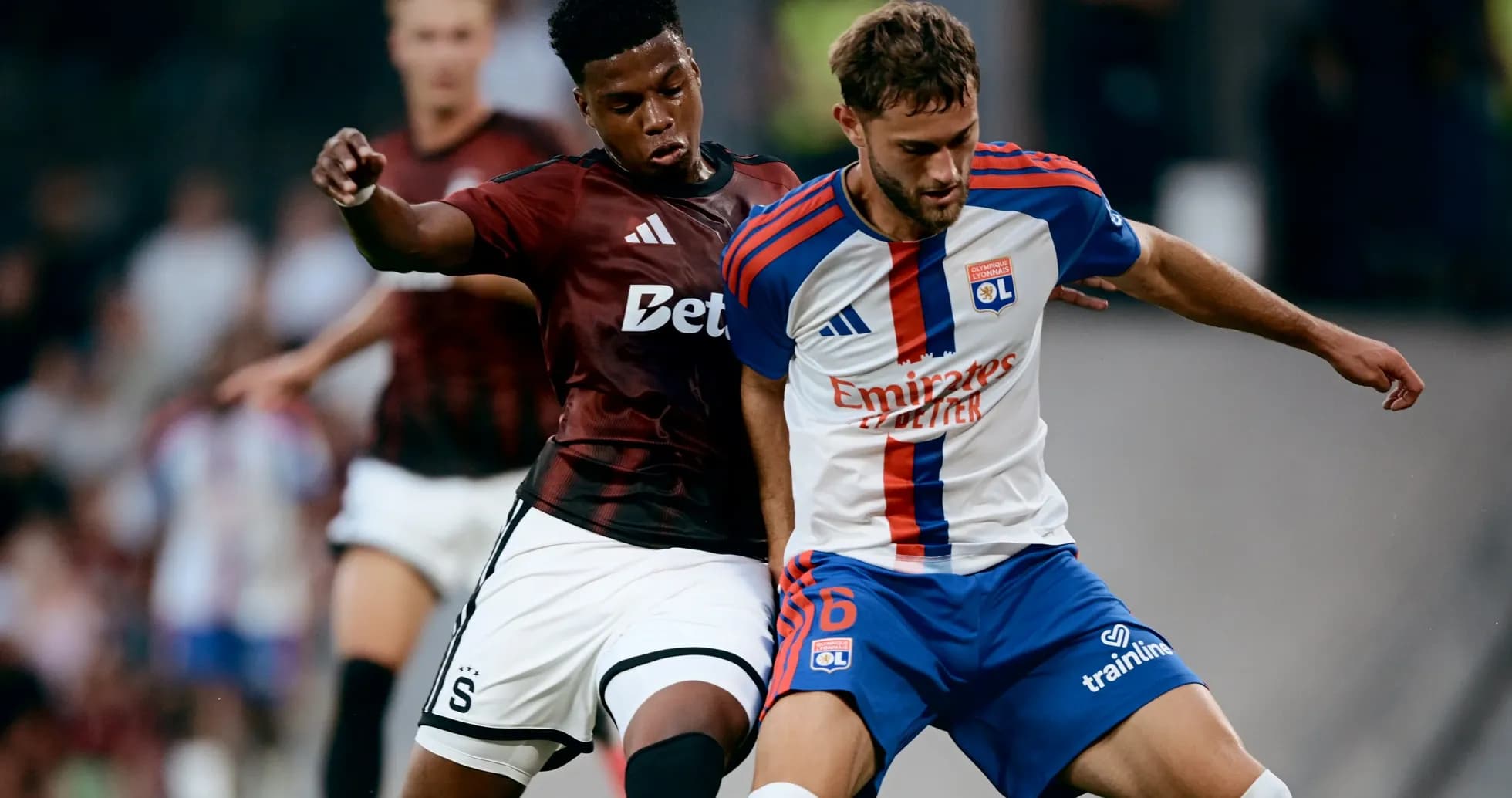
Sparta Praha’s 2-1 comeback win over Lyon at Pragues Letna Hill in the UEFA Champions League 3rd Qualifying Round was defined less by chaos than by a clear tactical evolution across the 90 minutes. The Czech side, in a 4-2-3-1, gradually bent the game toward their preferred structure, overcoming an own goal and a disallowed strike to overwhelm Lyon’s 3-4-3 in the second half. With 52% possession, sharper passing, and more control of central spaces, Sparta turned a 0-1 half-time deficit into a deserved 2-1 victory, while Lyon’s wing-based 3-4-3 never fully translated territorial promise into sustained threat.
First Half
Sparta’s 4-2-3-1 was built on a stable back four and a genuine double pivot. Full-backs M. Rynes on the left and M. Suchomel on the right provided width, but the structure was conservative in the first half: both were selective with forward runs, prioritising rest defence against Lyon’s front three. The double pivot of R. Macek and A. Irving gave Sparta a solid platform to recycle possession; their team completed 442 passes with 383 accurate (87%), a clear indicator of a measured, possession-based approach rather than direct chaos.
Ahead of them, the trio of J. Mercado, Adam Karabec and J. Alcocer operated in tight corridors between Lyon’s midfield and defence. Karabec, as the nominal No. 10, was central to Sparta’s pressing triggers, stepping onto Lyon’s deepest midfielder to prevent clean progression. J. Brunes, as the lone forward, worked the channels, trying to pin Lyon’s wide centre-backs and open pockets for late-arriving midfielders. Sparta’s shot profile – 9 total shots, 8 from inside the box – underlined a strategy focused on working the ball into high-value areas rather than speculative efforts.
Second Half
Lyon’s 3-4-3 under Paulo Fonseca was configured to exploit width and half-spaces. The back three of C. Mata, T. Tessmann and R. Kluivert spread across the pitch, with A. Maitland-Niles and M. Ouedraogo as advanced wing-backs. In possession, this often resembled a 3-2-5, with T. Morton and M. de Carvalho forming a double pivot behind a front line of Abner Vinicius, L. Openda and C. Tolisso. Lyon actually out-shot Sparta 11-9 and matched them for shots inside the box (8 each), showing that the structure did create opportunities, especially in transition and from wide overloads.
The turning point was the second half, where Sparta’s positional play sharpened and Lyon’s 3-4-3 began to fray under pressure. Sparta’s full-backs pushed higher, and the wingers tucked in more aggressively, forcing Lyon’s wing-backs deep and effectively pinning Lyon into a back five. This altered the passing lanes: Lyon’s double pivot found themselves outnumbered centrally by Sparta’s pivot plus Karabec, while the French side’s front three were increasingly isolated.
Set-Piece and Shot Data
Sparta’s attacking balance is reflected in the set-piece and wide data: 6 corner kicks to Lyon’s 9, but with better efficiency in open play. Sparta registered 3 shots on goal from only 9 attempts, with just 1 blocked shot, suggesting that their shot selection was relatively clean once they reached the box. Lyon, by contrast, had 11 shots but 4 blocked, indicating that many of their efforts came under heavier pressure as Sparta’s defensive block tightened.
Foul Count
Out of possession, Sparta’s foul count (11 fouls, 2 yellow cards) shows a willingness to break Lyon’s rhythm, especially once they were protecting the lead. The yellow cards – one for Karabec for “Argument” and another for Matěj Ryneš for “Foul” – underline a combative, occasionally emotional edge in midfield and at full-back. Lyon, with only 7 fouls and no bookings, defended more by position than by aggression, but that passivity in key duels allowed Sparta to establish territory in the second half.
Substitution Patterns
The substitution pattern from Brian Priske reinforced Sparta’s control rather than radically changing shape. At 75', S. Eneme (IN) came on for A. Irving (OUT), refreshing the double pivot with fresh legs to maintain intensity against Lyon’s midfield. Later, L. Haraslin (IN) replaced J. Alcocer (OUT) at 84', adding a more direct wide threat to exploit spaces as Lyon pushed forward. In the 85th minute, E. Singhateh (IN) came on for J. Brunes (OUT), and H. Sochurek (IN) replaced Adam Karabec (OUT), effectively rotating the attacking line to preserve pressing intensity and defensive work rate in the central channels. Finally, at 90+2', G. Kuol (IN) came on for J. Mercado (OUT), a late move aimed at adding pace for counter-attacks and fresh defensive energy on the flank.
Paulo Fonseca’s changes were more about chasing the game. At 75', M. Fofana (IN) came on for M. de Carvalho (OUT) and E. Nuamah (IN) for M. Ouedraogo (OUT), injecting more attacking profiles into the front line and wing roles. This tilted Lyon even more towards a 3-2-5 in possession, but it also exposed their flanks and half-spaces in defensive transition, spaces Sparta exploited with their second-half goals and subsequent counter-attacking threats.
Possession and Control
From a territorial and control standpoint, the possession split – 52% Sparta, 48% Lyon – combined with Sparta’s superior pass completion (87% to Lyon’s 82%) confirms that the home side imposed their rhythm for longer spells. Lyon’s 9 corners to Sparta’s 6 show that the visitors did have periods of pressure, particularly via wide play, but they lacked the central compactness and defensive stability to withstand Sparta’s second-half surge.
Defensive Structures
Defensively, both teams’ structures were tested. Sparta allowed 4 shots on goal and 11 total shots, but their block of four defenders plus double pivot generally forced Lyon into crowded central zones or pressured wide deliveries. Lyon’s back three plus wing-backs, meanwhile, conceded 8 shots inside the box from only 9 total, a sign that when Sparta did break through, they did so into very dangerous positions.
Overall, the tactical story is of a Sparta Praha side that used a clear 4-2-3-1 structure, controlled passing, and intelligent in-game adjustments to wrest control from Lyon’s 3-4-3. By tightening central spaces, pushing their full-backs higher in the second half, and refreshing their attacking midfield and forward line at the right moments, Sparta translated marginal statistical edges into a decisive territorial and qualitative advantage that underpinned their 2-1 comeback.