Spain's New World Order: From Arrogance to Measured Belief
There was a time when Spain walked into every tournament convinced the trophy already had their name etched on it. From 2008 to 2012, that arrogance felt justified. Euro, World Cup, Euro. La Roja didn’t just win; they rewrote the sport, leaving everyone else chasing red shirts and shadows.
Then it all collapsed. A decade of false dawns, early exits and awkward rebuilds forced a proud football nation to stare at its own reflection and swallow the humility it had long dodged.
Now, on the eve of the 2026 World Cup in North America, Spain arrive with something subtler and, perhaps, more dangerous: calm, measured belief.
Fresh from tearing through Euro 2024 – dispatching Croatia, Italy, Germany, France and England on their way to the title – Luis de la Fuente’s team no longer look like a side clinging to memories. They look like a machine that understands exactly what it is.
Spanish-American journalist and ITV World Cup presenter Semra Hunter sees a fundamental shift. The old “win or bust” hysteria that strangled previous generations has faded. In its place is a more adult relationship between stands and squad.
“I don't think it's that extreme anymore,” she says. Fans, she argues, learned the hard way after gorging on that golden era. “There was almost this level of confidence that we were untouchable. But things came crashing down very hard after 2012, and it was very painful.”
That pain bred scepticism. It peaked just before Euro 2024, when De la Fuente’s appointment drew scorn and shrugs. “Going into the Euros, fans were super critical of Luis de la Fuente. There was almost no hope,” Hunter recalls. The doubt became fuel. Spain stormed through the tournament, consistently the best team in it, and the mood flipped.
Now, trust is back. The bar remains high, but the threat is no longer: win or you’re failures. It’s more nuanced. More human. And it might be exactly what this group needs.
The fitness gamble on two electric wingers
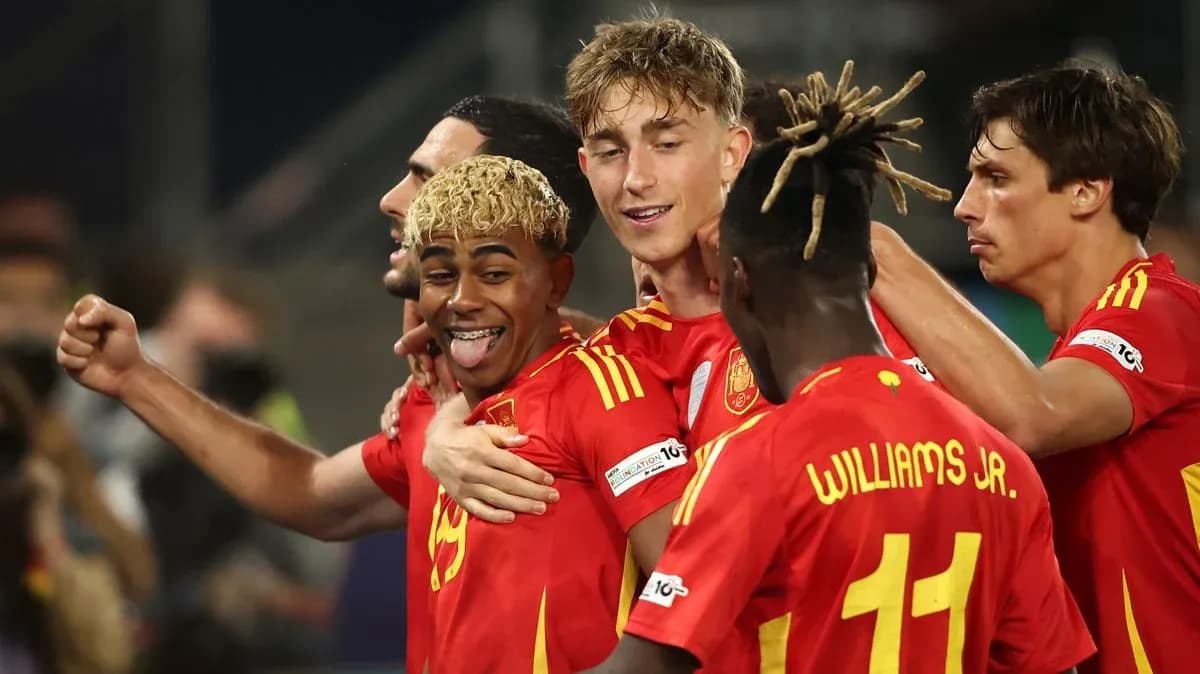
For all the structure and serenity, there is one storyline that keeps Spanish hearts in their mouths: the hamstrings of Lamine Yamal and Nico Williams.
Yamal, the Barcelona prodigy who already bends games to his will, suffered a hamstring injury in April. He is expected to make the World Cup, but nobody can say with certainty how sharp he will be when the ball rolls in the opening match.
“They are two of the most special, unique wingers in world football at the moment and they give Spain an edge they wouldn't have without them,” Hunter says. Yamal, in particular, offers chaos in the best sense. “He provides so much unpredictability; he's a destabilising force. We've even seen him starting to evolve into the Messi role a little bit, coming more inside. He's capable of conjuring up a moment of brilliance when the going gets tough.”
Williams, arguably Spain’s standout performer at Euro 2024, joined the injury list in May with a hamstring problem of his own. The early verdict is kinder. “Thankfully, that one doesn't seem to be as bad, and he should be back to fitness to start training,” Hunter notes.
Spain can function without them. The collective is strong enough. But if this team is to climb to the summit again, those two wide men at full throttle turn them from contenders into something close to inevitable.
“Spain can win without them because of the team's structure,” Hunter admits, “but they really need both at full tilt to go all the way.”
Midfield excess, and one painful absence
If the wings are a question mark, the middle of the pitch is a statement. Spain’s midfield remains a luxury most nations can barely imagine.
Rodri, the metronome and enforcer rolled into one, anchors everything. Around him swarm the Barcelona trio of Pedri, Gavi and Dani Olmo, Arsenal’s Martin Zubimendi and Mikel Merino, and PSG’s Fabian Ruiz. It is a department that feels almost unfair.
Yet in Hunter’s eyes, two names sit above the rest on De la Fuente’s team sheet.
“As long as Rodri and Pedri are fit and firing, they are non-negotiable starters,” she says. Around them, the options shift with the manager’s mood. “Gavi provides more of the bite, the aggression, and the physicality. Dani Olmo is someone who can break through the lines, score goals, and practically play as a forward.”
The depth takes a hit, though, with a significant late blow. Barcelona’s Fermin Lopez, who racked up 30 goal contributions this season, has been ruled out with a broken foot.
“Fermin Lopez is a big loss. He's somebody who probably could have been a breakout player for Spain, but he underwent surgery and won't make it in time,” Hunter explains.
Even so, Spain’s midfield cupboard is far from bare. Versatility is baked into the modern Spanish player. “Luckily, Spanish players are so versatile. Even with Martin Zubimendi acting as a direct, like-for-like backup for Rodri, Spain is completely spoiled for choice.”
The old wound that still hasn’t healed
Then comes the flaw Spain just can’t seem to shake.
For all the poetry in midfield, the country’s historic blind spot at centre forward remains glaring. It is not a new problem. It is simply one that refuses to go away.
“Our biggest weakness is so obvious for me – we haven't had a proper, lethal 'fox in the box' striker who can put balls away first touch since the days of David Villa and Fernando Torres,” Hunter says. “No disrespect to Alvaro Morata but Spain just doesn't produce that kind of player. It's all about midfielders.”
Real Sociedad’s Mikel Oyarzabal, the man who struck the winner against England in the Euro 2024 final, is expected to lead the line. He is clever, technically sound, and tactically reliable. What he does not do is terrify defenders in the way a classic No. 9 might.
Spain have built a system that spreads goals across the pitch, that leans on runners from deep and wide. It works, as recent history shows. But in the tightest World Cup nights, when one chance falls in a crowded box, that old question will return: who finishes it?
A nation of football philosophers
If Spain cannot churn out ruthless No. 9s, they have no such issue producing thinkers.
Their conveyor belt of elite managers – Pep Guardiola, Mikel Arteta, Unai Emery, Xabi Alonso, Andoni Iraola and more – springs from a culture that treats tactics as second nature rather than specialist knowledge.
“In Spain, football is a language,” Hunter says. From childhood, players are immersed in systems, patterns, positional play. “From a very young age, players learn about tactics. Everybody fancies themselves a football philosopher in Spain, really. There's so much romance about it.”
That romance travels. When Spanish managers arrive in the Premier League, they bring that tactical obsession with them. Many of them, Hunter points out, were already directing traffic long before they wore a suit on the touchline. “Players like Guardiola and Xabi Alonso were already managers on the pitch when they played.”
The philosophy is clear: the collective above all. “They focus on the collective, on being collaborative, on the whole being more important than the individual. They're very humble, they're hardworking people. And I think that is reflected in their management style – and the players' playing style too.”
It is no coincidence that this Spain side looks so cohesive. The ideas are in the water.
The path through North America
On paper, Spain’s group offers a gentle incline rather than a cliff face. They share it with Cape Verde, Saudi Arabia and a dangerous Uruguay side.
“They should get through relatively comfortably,” Hunter predicts. Cape Verde, making their debut, and an organised Saudi Arabia should not, in theory, derail a team of Spain’s quality.
Uruguay are another matter. “Uruguay will be the biggest test. They are intense, aggressive, streetwise, and technically more talented than people give them credit for. If they want to rough up Spain, they certainly can.”
Spain will expect to dominate the ball in all three games. The real exam will come when the match turns into a fight as well as a chess match. Hunter still expects them to impose themselves.
“I see them getting seven to nine points, topping the group and advancing. Quite honestly, I think they will make it all the way to the final.”
Pressed on the ultimate outcome, she doesn’t flinch.
“I think it's going to be Spain to win it.”
This is not the swaggering, untouchable Spain of a decade and a half ago. The entitlement has gone. In its place stands a side hardened by failure, powered by a new generation of thinkers and wingers, and held together by a midfield that can suffocate anyone.
They no longer assume the world belongs to them.
They are coming to take it back anyway.