South Korea's Tactical Masterclass in 2-1 Victory Over Czech Republic
South Korea’s 2-1 win over Czech Republic at Estadio Akron was a textbook example of how a well-drilled positional structure and superior technical execution can overturn a deficit. Both sides started in a mirrored 3-4-2-1, but South Korea’s control of space, tempo, and central overloads turned 62% possession and a 15–8 shot advantage into a deserved comeback in this World Cup group-stage opener.
First Half
After a cautious first half, Ladislav Krejčí’s header from a Vladimír Coufal cross on 59 minutes initially rewarded Czech Republic’s more direct approach. Yet South Korea’s response, built on patient circulation and targeted substitutions, flipped the match. Hwang In-beom’s equaliser and Oh Hyeon-gyu’s late winner were the logical outcome of a territorial stranglehold and superior xG (2.0 to 0.84), rather than isolated moments.
Structurally, Myung-Bo Hong’s 3-4-2-1 was aggressively tilted toward ball dominance. The back three of Gi-Hyuk Lee, Kim Min-jae, and Han-Beom Lee held an advanced line, compressing the pitch and allowing the wing-backs Young-woo Seol and Lee Tae-seok (before and after his substitution) to pin Czech Republic’s wide midfielders. With 542 total passes at 87% accuracy, South Korea constantly recycled possession, patiently moving the ball side to side to unbalance the Czech block.
Central to this was the double pivot of Hwang In-beom and Seung Ho Paik. They alternated dropping between centre-backs and stepping beyond the first Czech line, creating 3v2 and 4v3 situations in midfield. This superiority allowed Kang-in Lee and Jae-sung Lee, the two attacking midfielders, to receive between the lines and turn, forcing Tomáš Souček and Alexandr Sojka to defend facing their own goal rather than stepping out. South Korea’s 10 shots inside the box (from 15 total) underline how often they managed to progress into high-value zones, rather than settling for speculative efforts.
Czech Republic's Approach
In contrast, Miroslav Koubek’s Czech Republic, also in a 3-4-2-1, leaned into a more vertical and transitional identity. With only 323 passes at 71% accuracy and 38% possession, they accepted long spells without the ball, aiming to spring quickly through Pavel Šulc, Lukáš Provod, and Patrik Schick. The back three of Štěpán Chaloupek, Robin Hranáč, and Krejčí were compact but often pinned deep, which limited their ability to step in front of Son Heung-min and later Oh Hyeon-gyu.
Czech Republic’s attacking threat came mostly from wide and set-piece situations. Their 5 corner kicks to South Korea’s 4, despite far less possession, reflect a plan built on moments rather than sustained pressure. The opener on 59 minutes was emblematic: a well-timed run and aerial win from Krejčí off Coufal’s delivery, exploiting a rare lapse in South Korea’s box organisation. However, with only 8 total shots and 5 inside the box, Czech Republic struggled to generate consistent penetration.
Substitutions and Turning Points
The turning point tactically was the substitution wave around the hour mark. On 62 minutes, Hwang Hee-chan (IN) came on for Jae-sung Lee (OUT), adding more direct running and depth to South Korea’s front line. Czech Republic responded at 64 minutes with a triple change: Adam Hložek (IN) for Pavel Šulc (OUT), Tomáš Chorý (IN) for Patrik Schick (OUT), and Michal Sadílek (IN) for Lukáš Provod (OUT). While this injected fresh legs, it also briefly disrupted their defensive cohesion.
South Korea struck quickly. On 67 minutes, Hwang In-beom arrived from deep to finish after Kang-in Lee found him with a precise pass, the move reflecting exactly the pattern Hong’s structure seeks: inside-channel combinations, a late-arriving midfielder, and a shot from a central, high-xG location. The equaliser cemented Korean control and forced Czech Republic even deeper.
The decisive phase came between 69 and 80 minutes. Eom Ji-sung (IN) for Lee Tae-seok (OUT) and Oh Hyeon-gyu (IN) for Son Heung-min (OUT) at 69 minutes re-energised South Korea’s front line. Oh provided a more traditional penalty-box reference, pinning the Czech back three and opening pockets for Hwang In-beom to advance. Czech Republic briefly thought they had regained the lead on 77 minutes, but a potential goal by Tomáš Souček was disallowed by VAR for offside, a critical psychological blow just as they looked to exploit transition.
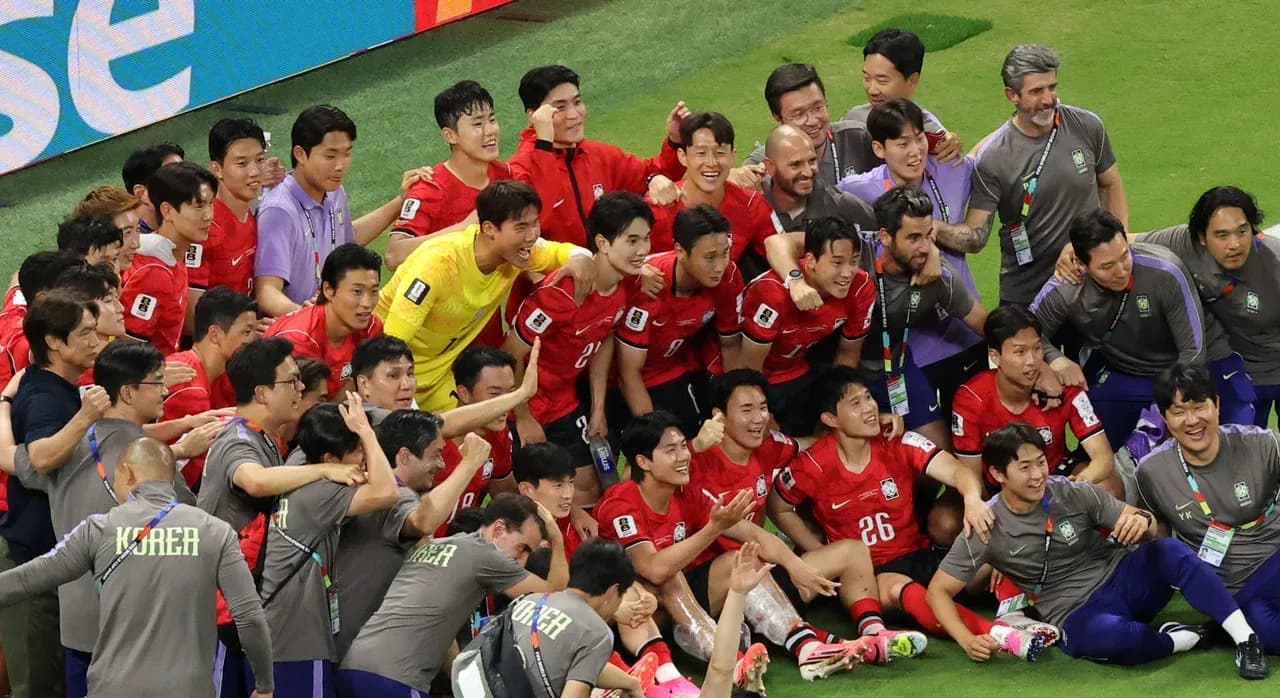
Three minutes later, South Korea completed the turnaround. On 80 minutes, Oh Hyeon-gyu finished after a combination involving Hwang In-beom, again highlighting the value of a central runner and a true striker occupying the last line. From there, Hong managed the game with further control substitutions: Kim Jin-gyu (IN) for Hwang In-beom (OUT) and Park Jin-seob (IN) for Paik Seung-Ho (OUT) at 84 minutes, reinforcing midfield stability. Czech Republic introduced Mojmír Chytil (IN) for Alexandr Sojka (OUT) at the same time, chasing a more chaotic, aerially focused endgame, but South Korea’s structure held.
Discipline and Defensive Control
Discipline and defensive control were also telling. South Korea committed only 9 fouls to Czech Republic’s 16, despite dominating territory, which speaks to their organisation and pressing timing. The lone card of the match came at 90+6 minutes: Lee Gi-Hyuk (South Korea) — Roughing, a late, isolated incident rather than a pattern of reckless defending. Both back threes, despite the goals conceded, generally protected central spaces well; the difference was South Korea’s ability to pin Czech Republic back and repeatedly reload attacks.
In goal, the statistics underline the balance of chances. Kim Seung-gyu (South Korea) made 3 saves, aligning closely with Czech Republic’s 4 shots on target and 0.84 xG, suggesting he was largely dealing with moderate-quality chances and that his defence limited truly clear looks. On the other side, Matěj Kovář (Czech Republic) registered 4 saves against 6 shots on target and 2.0 xG, with a goals prevented value of 0.02, indicating that South Korea’s finishing more or less matched the underlying quality of their chances.
The statistical verdict reinforces the tactical story. South Korea’s 62% possession, 542 passes at 87% accuracy, and 10 shots inside the box reflect a controlled, repeatable attacking process. Czech Republic’s 38% possession, 323 passes at 71%, and reliance on set plays and moments underscore a game plan built around resilience and opportunism. In a mirrored 3-4-2-1 battle, it was South Korea’s superior spacing, central overloads, and well-timed substitutions that turned structural dominance into a fully merited 2-1 victory.