Real Sociedad vs Valencia: Tactical Clash in La Liga's 3-4 Defeat
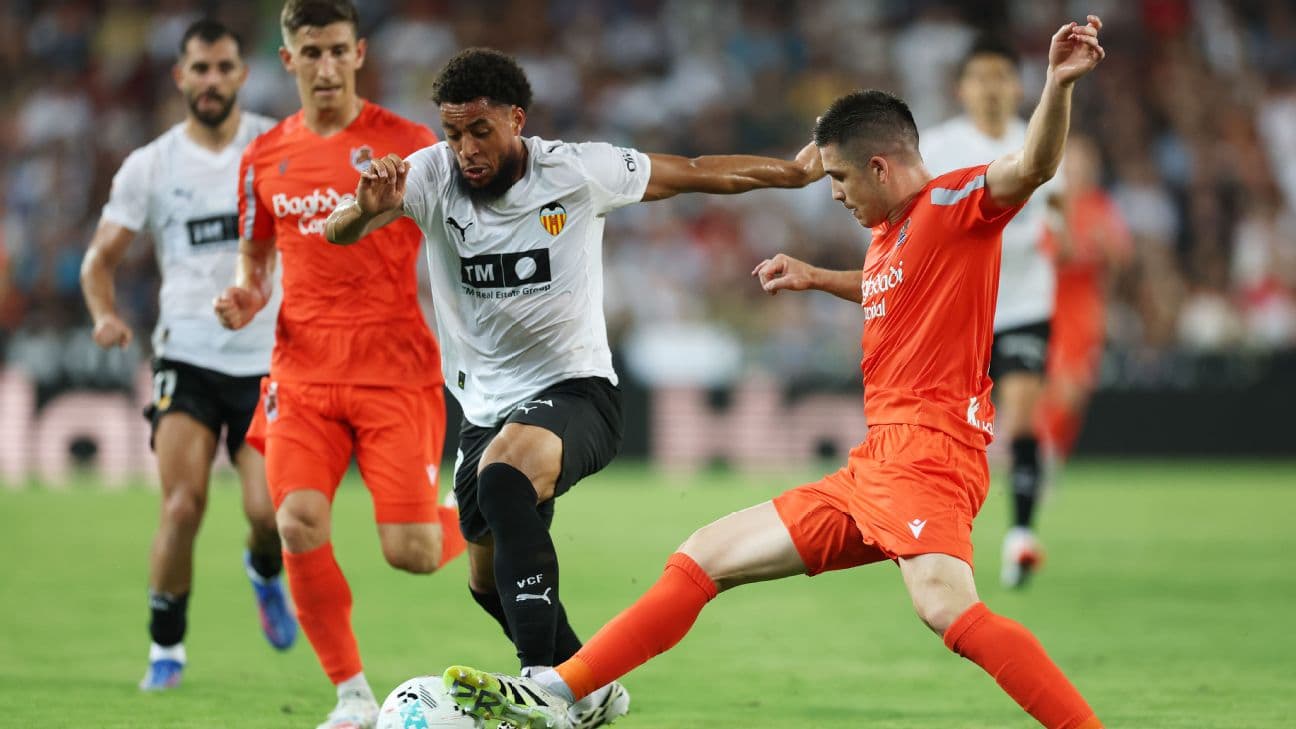
Real Sociedad’s 3-4 home defeat to Valencia at Reale Arena unfolded as a structural clash between possession control and vertical efficiency. In a match from La Liga’s Regular Season - 37, Pellegrino Matarazzo’s 4-2-3-1 built long spells of circulation and territorial pressure, but Carlos Corberan’s compact 4-4-2 punished every defensive looseness in transition and in the final minutes.
Executive Summary
Real Sociedad dominated the ball with 55% possession and a clear passing advantage (491 passes, 410 accurate, 84%), yet were repeatedly opened up by Valencia’s direct attacks and late-game ruthlessness. Valencia, with 45% possession and a more modest 412 passes (321 accurate, 78%), converted a higher volume of chances into four goals despite creating only 1.61 xG. Both goalkeepers underperformed their shot-stopping metrics, with each side recording -1.37 goals prevented, underlining a match where finishing quality and defensive fragility outweighed control phases. The halftime score of 1-2 to Valencia set the tone for a chaotic second half, in which Real Sociedad turned the game to 3-2 before a 10-man Valencia struck twice at 89' and 90' to win 3-4.
Scoring Sequence & Disciplinary Log
Goals (chronological, home score first):
- 3' A. Munoz (Real Sociedad) — assisted by A. Elustondo. An early pattern: full-back overlap and a cutback from the right, rewarding Sociedad’s initial territorial pressure (Real Sociedad 1-0 Valencia).
- 8' J. Guerra (Valencia) — assisted by D. Lopez. Valencia’s first incisive transition, with Guerra breaking from the second line to equalise (Real Sociedad 1-1 Valencia).
- 22' H. Duro (Valencia) — assisted by E. Comert. A set-piece or direct ball situation where Comert’s delivery found Duro, flipping the scoreline and exposing Real Sociedad’s central defensive spacing (Real Sociedad 1-2 Valencia).
- 60' C. Tarrega (Valencia) — Own Goal for Real Sociedad. Under sustained pressure, Tarrega turned the ball into his own net, reflecting Real Sociedad’s improved wide service and Valencia’s stress in their box (Real Sociedad 2-2 Valencia).
- 63' O. Oskarsson (Real Sociedad) — assisted by M. Oyarzabal. A classic centre-forward movement after Oyarzabal’s introduction, punishing a destabilised Valencia back line (Real Sociedad 3-2 Valencia).
- 89' G. Rodriguez (Valencia) — assisted by A. Almeida. With Valencia down to ten, Rodriguez arrived from midfield to equalise, exploiting Sociedad’s increasingly stretched rest defence (Real Sociedad 3-3 Valencia).
- 90' J. Guerra (Valencia) — assisted by T. Rendall. Guerra’s second, and Valencia’s winner, came immediately after, again from a direct pattern that bypassed Sociedad’s tiring structure (Real Sociedad 3-4 Valencia).
Disciplinary log (chronological, with reasons verbatim):
- 25' Arsen Zakharyan (Real Sociedad) — Foul
- 70' Eray Cömert (Valencia) — Professional foul last man
- 86' Beñat Turrientes (Real Sociedad) — Foul
- 88' Jon Martin (Real Sociedad) — Foul
- 88' Igor Zubeldia (Real Sociedad) — Foul
Totals: Real Sociedad: 4 yellow cards, Valencia: 0 yellow cards, 1 red card, Total: 5 cards. The red to Eray Cömert at 70' forced Valencia into a deep, emergency 4-4-1 that paradoxically sharpened their counter-attacking focus.
Tactical Breakdown & Personnel
Real Sociedad’s 4-2-3-1 was built around a high technical base in midfield. Beñat Turrientes and C. Soler formed the double pivot, responsible for first-phase progression and control. With 55% possession and superior passing volume, they successfully established Real Sociedad in Valencia’s half, funnelling play into the advanced trio of P. Marin, B. Mendez, and A. Zakharyan behind O. Oskarsson.
Full-backs A. Munoz and A. Elustondo were crucial to width and early penetration. The 3' opener, with Elustondo assisting Munoz, illustrated the asymmetry: both full-backs were encouraged to attack the last line, effectively creating a 2-3-5 in sustained possession. However, this aggressive positioning left large spaces either side of centre-backs Jon Martin and Igor Zubeldia. Valencia’s first two goals, at 8' and 22', came from exploiting these channels and the lack of immediate counter-press protection.
In goal, A. Remiro registered 2 saves but, with goals prevented at -1.37, he underperformed relative to shot quality faced. Valencia’s 6 shots on goal from 13 total shots (9 inside the box) translated into four goals, indicating that the defensive screen in front of Remiro allowed too many high-quality looks and that his interventions did not compensate.
Matarazzo’s triple substitution at 57' — L. Sucic (IN) came on for B. Mendez (OUT), M. Oyarzabal (IN) came on for A. Zakharyan (OUT), and S. Gomez (IN) came on for A. Munoz (OUT) — rebalanced the side. Oyarzabal immediately added craft between the lines, directly assisting Oskarsson’s 63' strike. S. Gomez at left-back offered more conservative positioning, but by then the game had already become stretched.
Valencia’s 4-4-2 under Carlos Corberan was defined by compactness and verticality. The back four of J. Vazquez, Eray Cömert, C. Tarrega, and U. Nunez initially held a medium block, with wide midfielders L. Rioja and F. Ugrinic tucking in to protect half-spaces. Double pivot G. Rodriguez and D. Lopez balanced screening duties with forward runs, especially Rodriguez, whose late 89' goal epitomised his box-arrival threat.
Up front, J. Guerra and H. Duro functioned as a split-striker pair: Duro attacking the last line and aerial balls, Guerra dropping into pockets to link and then attack the box. Their combination produced the 8' and 22' goals and later, after the red card and reshuffle, Guerra remained the key outlet, scoring again at 90'.
The dismissal of Eray Cömert for a “Professional foul last man” at 70' forced Corberan into a structural shift. Subsequent substitutions — U. Sadiq (IN) came on for H. Duro (OUT), T. Rendall (IN) came on for F. Ugrinic (OUT), Pepelu (IN) came on for D. Lopez (OUT), L. Ramazani (IN) came on for L. Rioja (OUT), and A. Almeida (IN) came on for U. Nunez (OUT) — gradually transformed Valencia into a low-block 4-4-1 with fresh legs in midfield. Pepelu and A. Almeida stabilised central zones, while T. Rendall and Ramazani provided energy on the flanks and in transition. It was this bench unit that engineered the late turnaround: Almeida assisted G. Rodriguez at 89', and Rendall assisted J. Guerra at 90'.
In goal, S. Dimitrievski made only 1 save and, like Remiro, posted -1.37 goals prevented. Real Sociedad’s 3 goals from 3 shots on target underline Valencia’s own defensive fragility, particularly after going down to ten men.
The Statistical Verdict
On xG, Valencia’s 1.61 versus Real Sociedad’s 1.14 suggests a marginal away advantage in chance quality, but not a four-goal explosion. The 3-4 scoreline is a product of clinical finishing, underperforming goalkeepers, and late-game structural collapse rather than sustained dominance. Real Sociedad’s 8 total shots (7 inside the box) and 3 shots on goal were converted at a very high rate, consistent with Dimitrievski’s negative goals prevented. However, Valencia’s 13 shots, 6 on target, and 9 inside the box reflect repeated access to dangerous central zones against a possession-oriented side that never fully controlled transitions.
Discipline tilted heavily towards Real Sociedad (4 yellow cards to Valencia’s 1 red), indicating frequent late or recovery “Foul” actions as they tried to halt counters. Despite being a man down, Valencia’s defensive index — measured by resilience under pressure and capacity to launch effective counters — ultimately outperformed Real Sociedad’s overall form with the ball. The match encapsulated a tactical paradox: Real Sociedad’s structural control and passing superiority were undone by Valencia’s superior game-state management, substitution impact, and ruthless exploitation of late defensive disorganisation.