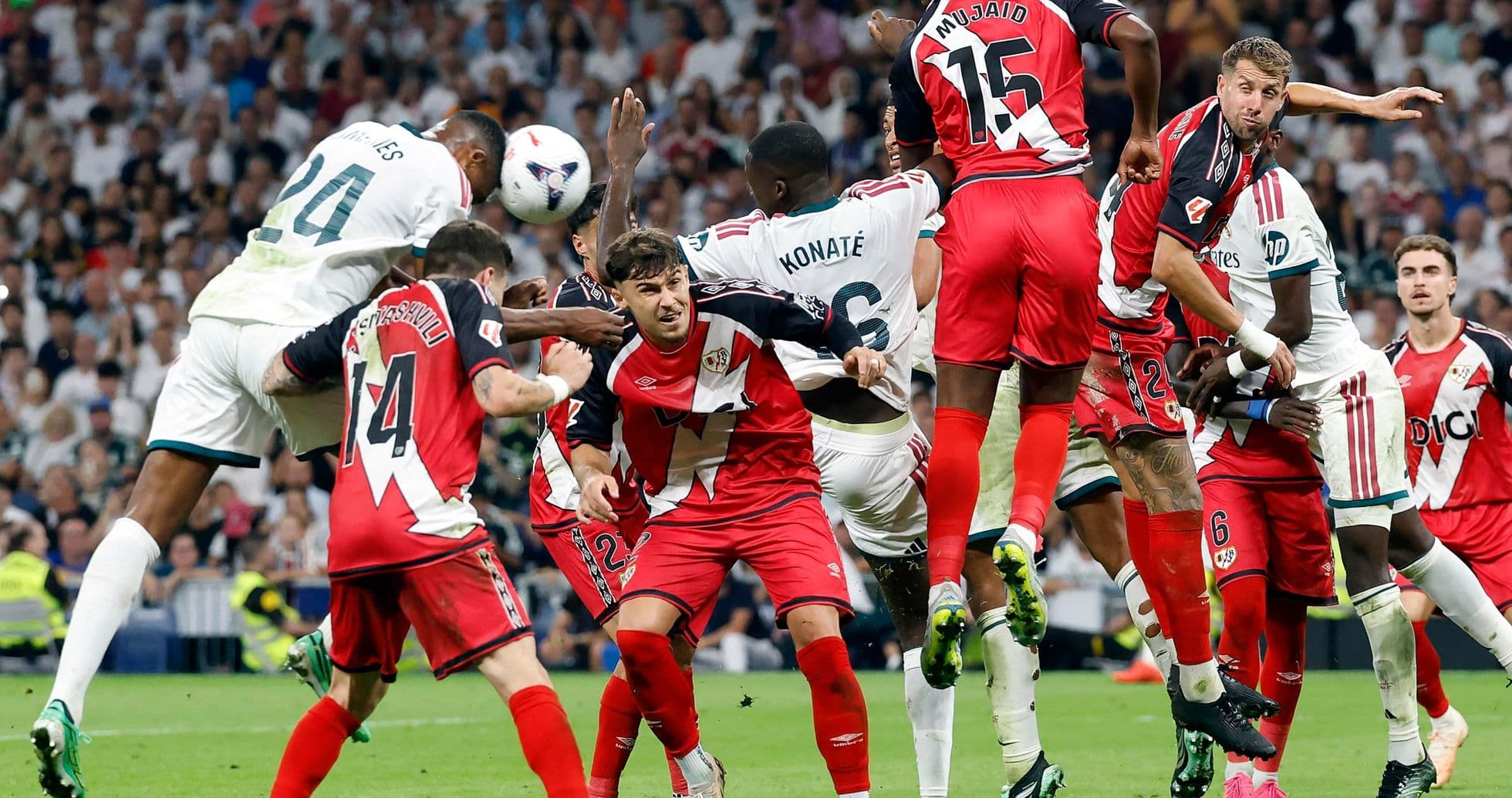
Real Madrid Dominates Rayo Vallecano in La Liga Clash
Under the Bernabéu lights, this Regular Season - 5 clash in La Liga brought together two sides whose seasons are already pulling in opposite directions. Real Madrid, sitting 2nd with 12 points and a goal difference of 10 (14 scored, 4 conceded overall), hosted a Rayo Vallecano team stranded in 16th on 4 points, their goal difference a stark -6 (8 scored, 14 conceded overall). The 4-1 full-time scoreline, after a 3-0 half-time lead, felt like the natural extension of the trajectories both clubs carried into the night.
I. The Big Picture – Structures and Seasonal DNA
Both managers mirrored each other on the whiteboard, each opting for a 4-2-3-1, but the similarity ended at the formation label.
Real Madrid’s season to this point has been defined by overwhelming attacking power at home. Heading into this game they had won all 3 home fixtures, scoring 12 and conceding just 2 at the Bernabéu, an average of 4.0 home goals for and 0.7 against. Their overall record of 4 wins and 1 defeat in 5 matches underlined a side that, when they click, simply run over opponents.
Rayo Vallecano arrived with a very different story. Overall they had 1 win, 1 draw and 3 defeats from 5, conceding 14 goals in total. Away from home they had lost all 3 matches, scoring 4 but shipping 11, an away average of 1.3 goals for and a punishing 3.7 against. This was a team that could punch in moments, but whose defensive structure on their travels had repeatedly collapsed under pressure.
Within that context, the lineups felt almost symbolic. José Mourinho fielded a star-studded Real Madrid XI: Thibaut Courtois behind a back four of Denzel Dumfries, Ibrahima Konaté, Antonio Rüdiger and Álvaro Fernández; a double pivot of Federico Valverde and Bernardo Silva; a line of three in Y. Diomande, Jude Bellingham and Vinícius Júnior supporting Kylian Mbappé as the lone striker. It was a 4-2-3-1 with the ball, but one that could morph quickly into a 2-3-5 in sustained possession.
Beñat San José matched the shape but not the firepower. Rayo’s 4-2-3-1 had E. Audero in goal; a back line of A. Rațiu, Florian Lejeune, P. Ciss and Adrià Pedrosa; a double pivot of G. Bouare and Unai López; G. Tsitaishvili, Pedro Díaz and Álvaro García behind Sergio Camello. It was a side built to counter and to lean heavily on the league’s joint-top scorer, Camello, who came into the game with 6 goals and 1 assist from 5 appearances, converting 10 of his 11 shots on target.
II. Tactical Voids – Absences and Discipline
Both squads were carrying notable absences that subtly reshaped their identities.
For Real Madrid, Eder Militao and F. Mendy were unavailable through hamstring and hip injuries respectively, while Rodrygo missed out with a knee injury. The consequence was a back line without its usual blend of recovery pace and left-sided balance, pushing Rüdiger and Konaté into central command and handing Álvaro Fernández the left-back role. Mourinho compensated by reinforcing control in midfield: Valverde’s energy and Bernardo Silva’s press resistance were vital to protecting that adjusted back four.
Rayo’s list was longer and more damaging. A. Batalla (broken calfbone), Luiz Felipe (hamstring), R. Nteka and J. Vertrouwd (muscle injuries) all weakened their depth, but the real tactical wounds came from suspensions: Fran Pérez and Jorge de Frutos both missed out due to red cards. De Frutos in particular had been a hard-running presence on the flank, while Fran Pérez’s dismissal earlier in the season embodied a Rayo side whose aggression sometimes spills over. I. Palazon was also out with a muscle injury, further stripping creativity from wide areas.
Disciplinary patterns this season only reinforced the likely script. Real Madrid’s yellow cards have been spread across phases, with a notable 25.00% of their cautions coming between 46-60 minutes and another 25.00% between 61-75, suggesting a side that intensifies the press after half-time. Rayo’s yellows, by contrast, cluster late: 40.00% between 61-75 and 30.00% between 76-90, with a red card spike at 76-90 as well (50.00% of their reds in that window). Under sustained pressure, this is a team that frays in the final third of matches.
III. Key Matchups – Hunter vs Shield, Engine Room Battles
The headline duel was always going to be Mbappé versus Rayo’s porous away defence. Mbappé entered the fixture with 6 league goals and 1 assist from 5 appearances, backed by 29 shots and 21 on target. He is not just prolific; he is relentless. Against an away unit conceding 3.7 goals per game, and whose heaviest defeat on their travels was 5-2, the French forward was the hunter let loose in ideal terrain.
Behind him, Bellingham formed the creative and physical axis of Madrid’s “engine room”. With 3 goals, 2 assists, 12 key passes and 8 tackles in 5 appearances, he arrived as both playmaker and enforcer between the lines. His duel with Unai López, Rayo’s top assister with 3 assists and 12 key passes, was central to the match’s rhythm. López is Rayo’s metronome, but also a defensive worker with 11 tackles and 4 blocks; his task was to disrupt Bellingham’s timing while still launching transitions for Camello.
On the flanks, Vinícius Júnior represented a constant destabilising force. With 3 assists, 1 goal, 12 key passes and 27 dribble attempts (11 successful), his role was to isolate Rațiu and Lejeune, forcing Rayo’s right side to choose between stepping out or sinking deep. Every time they dropped, the half-space opened for Bellingham; every time they stepped, Mbappé’s runs threatened the channel.
For Rayo, the counter-threat rested largely on Camello. His 6 goals from just 11 shots and 10 on target underline a ruthless efficiency. Up against Rüdiger and Konaté, he needed not volume but precision: sharp movement on the shoulder, attacking the space behind Madrid’s advanced full-backs, particularly if Dumfries surged forward and left Konaté exposed in wide cover.
IV. Statistical Prognosis – xG Hints and Defensive Reality
Even without explicit xG values, the season’s numbers pointed towards a lopsided shot-quality landscape. Real Madrid’s overall scoring rate of 2.8 goals per match, combined with 4.0 at home, suggested they consistently generate high-quality chances. Rayo’s concession rate of 2.8 goals per match overall, and 3.7 away, implied that opponents are not just shooting often but from dangerous zones.
Add Madrid’s penalty profile and the picture sharpens: they had earned 2 penalties this season, scoring 1 and missing 1, a 50.00% conversion rate that underlines how frequently their front line forces desperate defending in the box. Rayo, by contrast, had not yet taken a penalty, reflecting fewer deep incursions with bodies in the area.
Defensively, Madrid’s overall average of 0.8 goals conceded per game, and only 0.7 at home, framed Courtois and his back four as a robust shield. Rayo had yet to keep a clean sheet in any context, while Madrid had already registered 1 overall, at home, despite often committing numbers forward.
Put together, the statistical and tactical layers made a clear case. Real Madrid’s high-tempo, star-laden 4-2-3-1, anchored by Bellingham’s control and Mbappé’s cutting edge, was always likely to overwhelm a depleted Rayo side whose away defensive record is among the league’s most fragile. The 4-1 scoreline did not so much surprise as confirm the underlying trends: a title-chasing machine asserting itself at home, and a brave but outgunned Rayo side leaning heavily on Camello’s finishing to stay afloat.