Real Madrid Dominates Oviedo in 2-0 Victory at Estadio Santiago Bernabéu
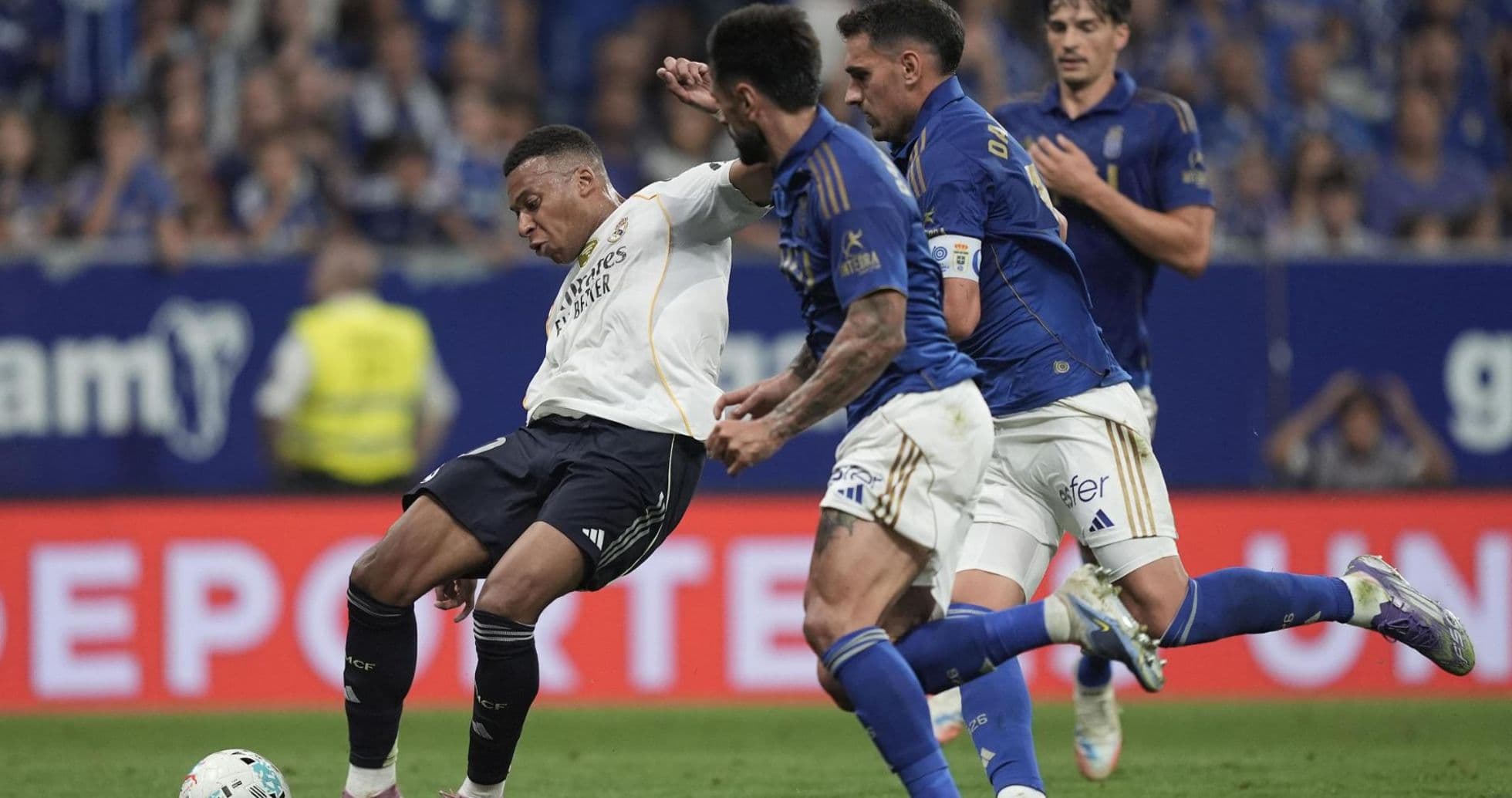
Real Madrid’s 2-0 win over Oviedo at Estadio Santiago Bernabéu was a methodical, control-heavy performance built on territorial dominance and a clear structural superiority in all phases. Within a 4-4-2 framework, Alvaro Arbeloa’s side used their technical edge and passing security to suffocate Oviedo’s 4-3-3, turning 65% possession and a 19–9 shot advantage into a largely stress-free evening in the run-in of the La Liga season.
I. Executive Summary
Across both halves, Real Madrid dictated tempo and zones of play, using a high technical back four and a ball-playing double pivot to progress cleanly through the thirds. The hosts’ 616 passes at 93% accuracy underpinned a patient, repeatable pattern: circulate, probe wide, then access the half-spaces for final-third combinations. Oviedo, limited to 35% possession and just one shot on target, relied on a compact mid-block and sporadic counters, but their 14 fouls and five corners reflected a reactive, survival-oriented plan rather than a balanced threat.
Goals from G. Garcia and J. Bellingham, each arriving from well-constructed moves, provided the scoreboard confirmation of a tactical control that was already evident in the underlying numbers (xG 1.46 vs 1.03).
II. Scoring Sequence & Disciplinary Log
Goal verification (2-0 Real Madrid, all goals listed):
- 44' G. Garcia (Real Madrid) — assisted by B. Diaz
- 80' J. Bellingham (Real Madrid) — assisted by K. Mbappe
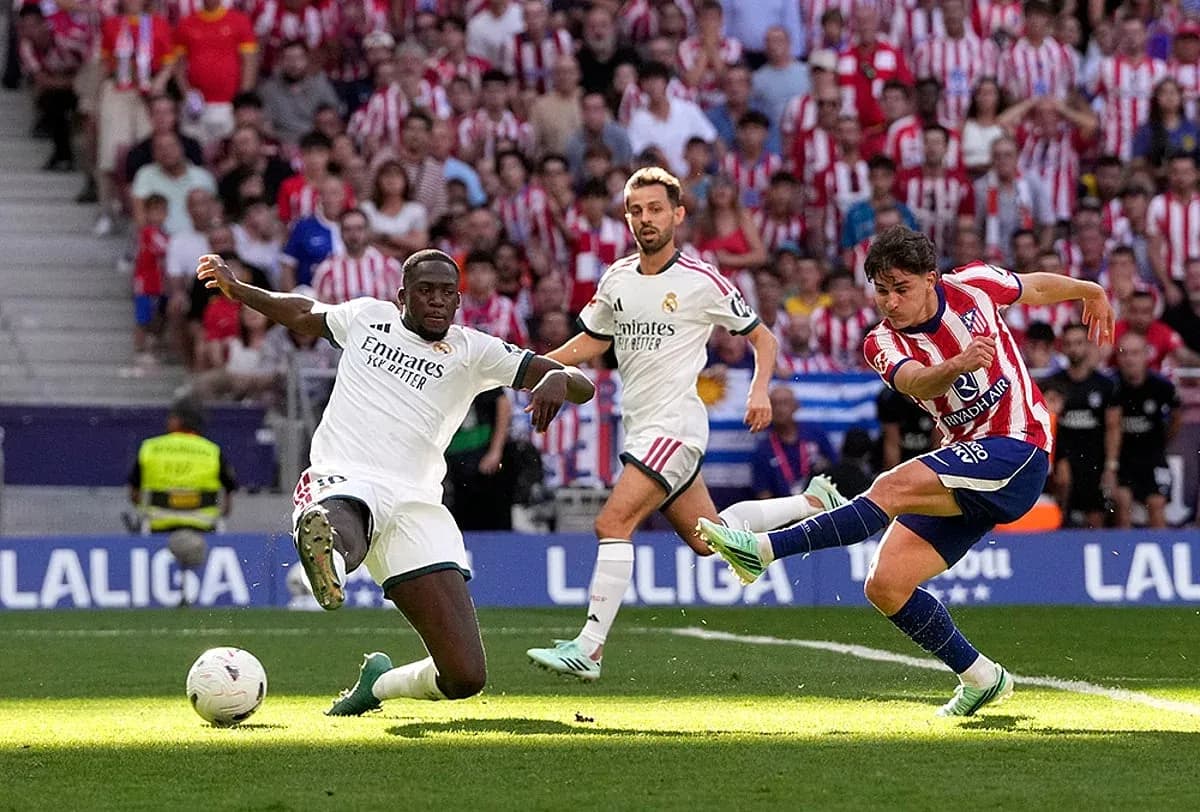
The first goal, at 44 minutes, crystallized Real Madrid’s dominance of the right half-space. With Oviedo’s 4-3-3 collapsing centrally to protect the box, B. Diaz drifted between the lines from his left-sided midfield berth, receiving in a pocket created by A. Carreras’ high, wide positioning. Diaz’s timing and angle of the final pass split Oviedo’s centre-backs, allowing G. Garcia, operating as the more mobile of the two forwards, to attack the space behind and finish clinically. The move was emblematic: patient recycling across the back, vertical injection through a creative midfielder, and a diagonal run from the striker.
The second goal, on 80 minutes, came after Arbeloa had refreshed his front line. K. Mbappe, introduced earlier for G. Garcia, offered a more explosive depth threat. As Oviedo’s block tired and lines stretched, Real Madrid found Mbappe between full-back and centre-back. Rather than driving himself, he drew defenders and slipped a well-weighted pass into J. Bellingham, arriving late from midfield. Bellingham’s finish sealed the 2-0 and showcased the advantage of adding a third-line runner against a retreating, increasingly disorganized Oviedo structure.
Disciplinary log:
No yellow or red cards were issued to either side.
- Real Madrid: Yellow Cards 0, Red Cards 0
- Oviedo: Yellow Cards 0, Red Cards 0
- Total cards: 0
III. Tactical Breakdown & Personnel
Real Madrid’s 4-4-2 was built on a high technical floor in the back line and central corridor. T. Courtois, with one save and 0.16 goals prevented, was largely protected by the structure in front of him. The back four of T. Alexander-Arnold, R. Asencio, D. Alaba and A. Carreras played aggressively high, compressing the pitch and enabling sustained pressure. Alexander-Arnold’s advanced positioning effectively turned the base shape into a 3-2-5 in possession: Asencio and Alaba stayed slightly narrower, Carreras provided width on the left, and Alexander-Arnold pushed high on the right to pin Oviedo’s winger.
In midfield, E. Camavinga and A. Tchouameni formed a double pivot that controlled central access. Their role was twofold: offer constant short options to recycle possession (feeding the 616 total passes, 570 accurate at 93%), and step out to counterpress immediately on loss, limiting Oviedo’s transitions. Wide, F. Mastantuono and B. Diaz (before his substitution) operated as hybrid interiors, frequently stepping inside to overload Oviedo’s three-man midfield. This created a 4v3 central advantage that Oviedo’s trio of N. Fonseca, S. Colombatto and A. Reina struggled to manage.
Up front, G. Garcia and Vinicius Junior offered complementary profiles. Garcia’s channel runs and willingness to receive in depth stretched Oviedo’s back four vertically, while Vinicius occupied and destabilized the left half-space, forcing N. Vidal and E. Bailly into constant decisions: follow him inside and leave the flank, or stay and concede central pockets. The 11 shots from inside the box underline how consistently Real Madrid were able to penetrate into high-value zones.
The substitution pattern sharpened, rather than disrupted, this structure. On 64', D. Carvajal (IN) came on for T. Alexander-Arnold (OUT), maintaining the aggressive right-back profile but adding slightly more defensive security against potential counters. Simultaneously, J. Bellingham (IN) came on for A. Tchouameni (OUT), tilting the midfield from a double pivot toward a more attack-minded central presence. This change directly fed into the second goal: Bellingham’s advanced positioning between the lines was something Oviedo had not faced in the first hour.
At 69', K. Mbappe (IN) came on for G. Garcia (OUT), swapping a hard-running nine for an elite transition forward. Mbappe’s presence forced Oviedo’s defensive line to drop a few metres, opening central pockets for Bellingham and the remaining midfielders. Later, at 77', C. Palacios (IN) replaced B. Diaz (OUT) and D. Yanez (IN) replaced F. Mastantuono (OUT), injecting fresh legs and preserving intensity in the press and wide combinations as Real Madrid saw out the game.
Oviedo’s 4-3-3 under Guillermo Almada Alves Jorge was designed to compress the middle and rely on counters through I. Chaira, F. Vinas and T. Fernandez. However, their 325 total passes (275 accurate, 85%) and just one shot on target show how rarely they escaped Madrid’s pressure. The double pivot of Camavinga and Tchouameni consistently screened passing lanes into Oviedo’s forwards, forcing long balls that Alaba and Asencio dealt with comfortably.
When Oviedo adjusted via substitutions — S. Cazorla (IN) for I. Chaira (OUT) at 54', H. Hassan (IN) for T. Fernandez (OUT) at 69', L. Ahijado (IN) for N. Vidal (OUT) and P. Agudin (IN) for N. Fonseca (OUT) at 79' — the intention was to add creativity and fresh running. Yet by then, Real Madrid’s control of rhythm and territory meant these changes had limited structural impact. Oviedo’s xG of 1.03 suggests a couple of half-chances, but Courtois’ calm handling and the compact defensive line ensured none became game-changing moments.
IV. The Statistical Verdict
The statistical profile aligns cleanly with the tactical story. Real Madrid’s 65% possession, 19 total shots (7 on goal) and 11 efforts inside the box reflect a side that not only controlled the ball but translated that control into sustained penalty-area occupation. Their xG of 1.46 versus two actual goals indicates clinical but not wildly overperforming finishing; the margin was earned through volume and quality of chances rather than pure efficiency.
Oviedo’s 9 shots, with only one on target, and 35% possession underscore their reactive approach. An xG of 1.03 hints at a couple of meaningful openings, likely from set pieces (five corners) or rare broken-field situations, but their inability to consistently connect passes under pressure (325 passes vs Madrid’s 616) left them too stretched to mount sustained attacks. Defensively, A. Escandell’s five saves and 0.16 goals prevented kept the scoreline respectable, but the structural imbalance — Madrid’s central overloads, wide superiority and refreshed attacking depth — made the 2-0 outcome a faithful reflection of a match Madrid controlled from first whistle to last.