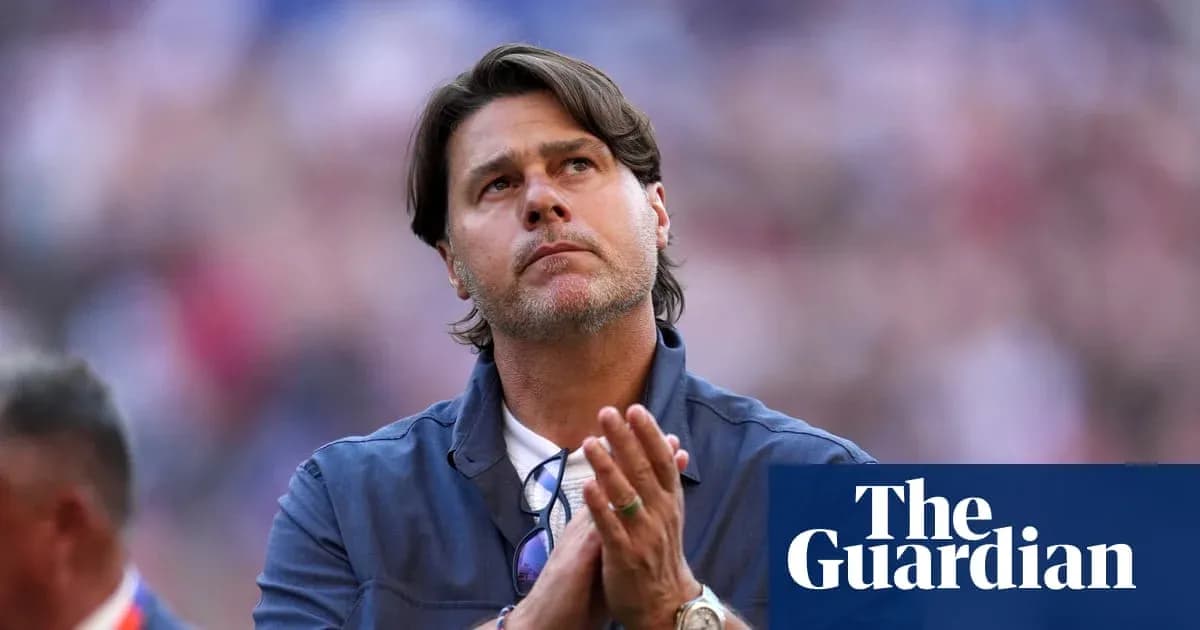
Pochettino Takes Charge of US Soccer's Future
Two months after the World Cup ended in a thud for the US men’s national team, Mauricio Pochettino is already deep into the next chapter.
The crash-out still lingers. It has to. A home World Cup, a golden generation, and an early exit that cut through all the hype. But the Argentine, hired in 2024 as a supposed short-term solution, is now being asked to do something far bigger than manage a tournament cycle. He’s been handed the keys to the wider project.
US Soccer tied him down to a new deal in August, shifting him from “big-name coach for a home World Cup” to something closer to architect-in-chief. The short-term hire is now the long-term bet.
Pochettino, the builder
Pochettino has framed his decision to stay as more than a coaching job. It’s a chance, in his words, to “have a lasting impact on the sport in the country that has welcomed us so warmly – and for that impact to extend beyond results on the field.”
The federation clearly agrees. When US Soccer announced the extension, it came with a notable twist: Pochettino will play a central role in youth development, coaching education and how the national teams connect with the professional game. He’ll advise on league collaboration and help shape the broader structure of the sport in the country.
That sort of sweeping influence isn’t unusual in some football nations. In the US, it is. No previous men’s coach has been invited this far into the engine room of the program.
He won’t be easing into it, either. US Soccer is in the middle of a major restructuring, including two new director roles overseeing the men’s and women’s senior and youth setups. Pochettino said he has already made it clear he’s willing to be involved in that hiring process – with one caveat, delivered with a laugh: “but it can’t [just] be my guy.”
Then his tone sharpened.
“This is the future of the USA,” Pochettino said. “We want to try to perform in the World Cup and to create something special with the fans. And now it’s about being a part of the legacy that the federation wants to create – becoming one of the most powerful countries in soccer. That is a dream, no? It’s amazing. If we can be part of that, we are so excited and so happy.”
The friendlies coming up – Peru, Chile, Mexico and Canada in late September and early October – will offer the first look at how he intends to reset. They matter, but only as early steps. The real assignment is heavier: qualify for the 2030 World Cup and drag the entire program closer to the elite.
And that’s before the Olympics and a possible Copa América even arrive.
Olympic horizon and a crowded 2028
The US will host the Los Angeles Olympics in 2028, a tournament that already looms large in federation planning. It’s widely reported that the men’s team could also feature in the Copa América that same summer, a brutal but tantalizing double. For Pochettino, it means another major stage on home soil, another test of how deep the talent pool really is and how quickly he can knit together a coherent identity across age groups.
The job description is starting to sound less like “national team coach” and more like “custodian of an era.”
A call for Balogun
The summer transfer window brought little drama for the USMNT core. A few moves stood out – Gio Reyna to Strasbourg, Sebastian Berhalter to Middlesbrough, Zavier Gozo jumping from MLS to Crystal Palace – but most of the squad stayed put.
Folarin Balogun did too. Not by choice.
The Monaco striker, fresh off a breakout World Cup, looked set for a big Premier League move. Everton pushed late, talks advanced, and then it all collapsed on deadline day. The club cited a potential fitness issue. Monaco and Balogun disputed that assessment. The deal died anyway.
Pochettino has seen this before. Players stuck between clubs, reputations questioned, confidence rattled. On Monday, he made it clear he intends to reach out to the 25-year-old.
“Yes, it’s difficult because you cannot influence that decision,” Pochettino said. “You need to support what they are doing with the people making the decisions. In some special cases, like Flo’s, I will call in the next few days. I wanted to give him a little bit of space after that situation in Everton. I want to know from him what happened.”
He didn’t sugarcoat Balogun’s importance.
“We are always offering our support, and that’s it. I think he’s an important player for us, he was an important player in the World Cup and I hope that he can find being in Monaco, or in another place, his best place to perform in the best way.”
For a US side that still leans heavily on Balogun’s cutting edge in the box, his club stability over the next year will be watched as closely as any tactical tweak Pochettino makes.
The dual-national chessboard
If the long-term project is to turn the US into “one of the most powerful countries in soccer,” the dual-national market remains one of its sharpest tools.
Pochettino kept his cards close when asked about the 26-man roster he’ll call into camp later this month. One name is already off the table: Augsburg center-back Noahkai Banks.
The 19-year-old German-American has not yet chosen between the two countries and will not join the US this window. He has said he hopes to decide by “the next international break, or at the latest by the international break after next.” In Germany, reports say new national team coach Jürgen Klopp has already scouted him in person.
That’s the level of competition now. The US is no longer battling only for MLS-based prospects or fringe European players. It’s going head-to-head with giants for top-tier dual nationals.
“We are in contact with all the potential dual nationals,” Pochettino said. “I think it’s important for us, of course, because that is the human connection that is so important.”
He referenced Banks directly.
“Even if they, like in that case, Noki, didn’t change his mind and is waiting still, no decision, and of course we cannot consider him for the next camp … But the organization is working with all the dual nationals and players with the possibility to make a decision. That human connection is important because if one day they feel that they can defend and they want to fight and to be part of our national team … Of course, if they deserve it, and we consider that they deserve to be involved, of course we are going to call [them up].”
The message is clear: the door is open, but it won’t be held open forever. Talent must be matched by commitment, and then by performance.
A new cycle, a bigger stage
Four friendlies in the fall won’t erase the memory of the World Cup exit. They aren’t meant to. They’re the first brushstrokes of something larger.
Pochettino now sits at the center of that picture – not just as the man on the touchline, but as a driving force behind how the US identifies, develops and educates its players and coaches. The federation has nailed its colors to his mast.
World Cup qualification, Los Angeles 2028, a potential Copa América, a generation of dual nationals weighing their futures: it all converges on this cycle.
The US asked Pochettino to stay. Now the question is simple: can he turn a restless, wounded program into the powerful force he keeps talking about – and how quickly will the world find out?