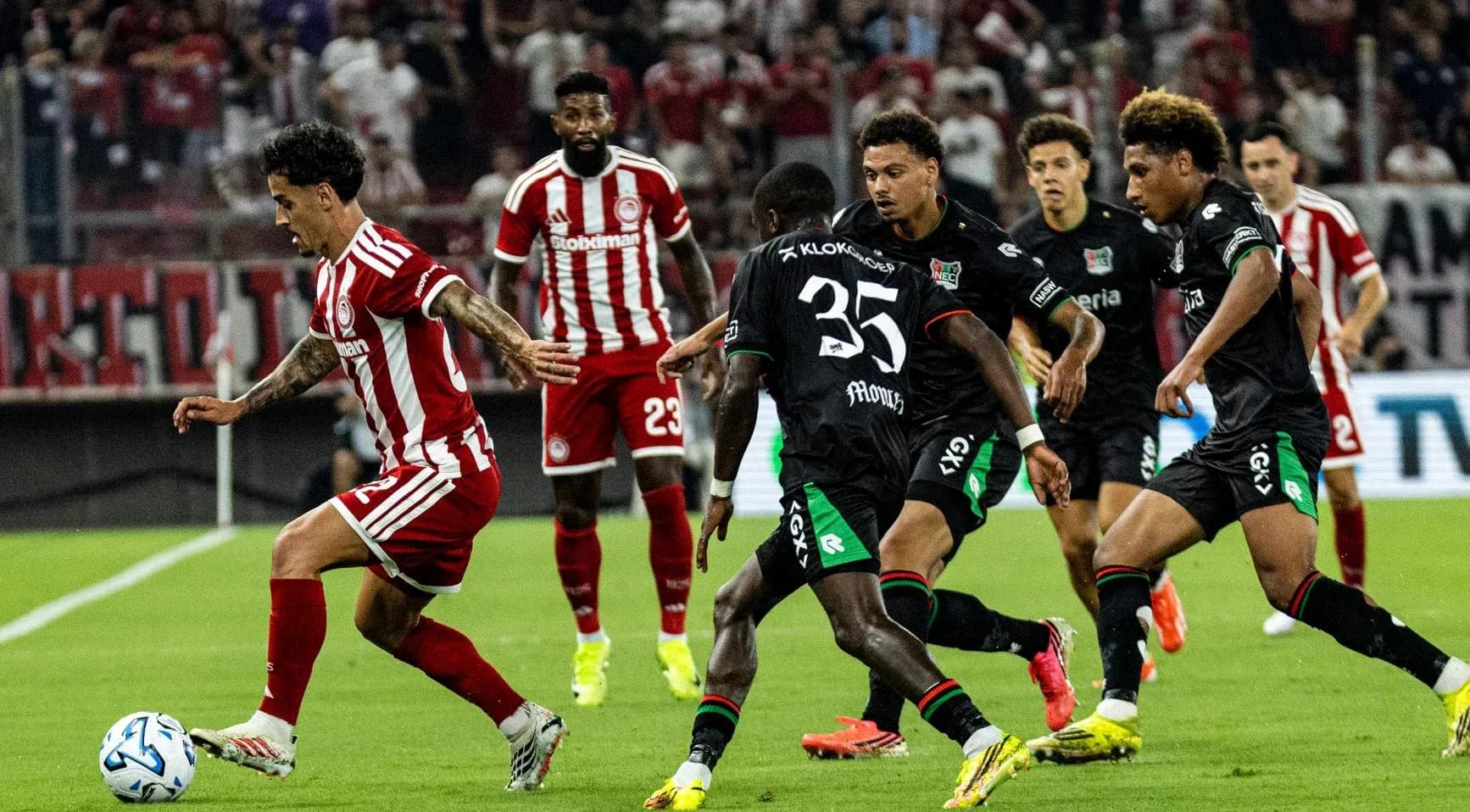
Olympiakos Piraeus vs NEC Nijmegen: A Tactical Stalemate in UEFA Qualifiers
Olympiakos Piraeus and NEC Nijmegen produced a tactically tight 0-0 in the 3rd Qualifying Round of the UEFA Champions League at Georgios Karaiskakis Stadium, a match defined more by structural discipline than by penalty-box chaos. Olympiakos had the territorial edge and a slight statistical advantage, but NEC’s compact 3-4-2-1 and strong defensive duels turned it into a stalemate where both sides’ attacking plans were repeatedly funneled into low-yield zones.
Olympiakos set up in a 4-2-3-1 under Luis Mendilibar Jose, with B. Popovic in goal behind a back four of M. Saliakas, P. Retsos, D. Carmo and B. Onyemaechi. The double pivot of D. Garcia and C. Mouzakitis was tasked with both screening transitions and initiating build-up, while the line of three — Rodinei, Chiquinho and J. Roca — worked off central striker A. El Kaabi. The structure was clearly geared towards wide overloads and half-space combinations, using Rodinei and J. Roca to step inside while the full-backs advanced.
Possession figures underline that intention: Olympiakos had 54% of the ball, completing 394 passes with 264 accurate (67%). They tried to control tempo and circulate through the double pivot before finding the No.10 and wide creators. However, NEC’s 3-4-2-1 under Dick Schreuder, with G. Crettaz in goal and a back three of T. Storm, P. Sandler and D. Fonville, proved difficult to disorganise. The wing-backs S. Ouaissa and C. Bischoff, supported inside by J. Monteiro and D. Nejasmic, created a horizontally compact block that narrowed the central lanes where Chiquinho and Roca wanted to receive.
The shooting profile shows how both defensive systems forced each other into imperfect looks. Olympiakos took 12 total shots, with 5 on goal, 5 off target and 2 blocked. Only 5 of those efforts came from inside the box, indicating that NEC’s back three and double screen were generally successful in protecting the danger area. NEC actually generated 13 shots, 4 on goal, 5 off target and 4 blocked, with 7 attempts from inside the box. Their threat came less from sustained possession (46% of the ball, 348 passes, 254 accurate at 73%) and more from well-timed forward breaks when Olympiakos’ full-backs were advanced.
In goal, both keepers were decisive in preserving the clean sheet. B. Popovic (Olympiakos Piraeus) made 4 saves, reflecting NEC’s ability to carve out a handful of clear sights on goal despite being second in possession. G. Crettaz (NEC Nijmegen) responded with 5 saves, a figure that underlines Olympiakos’ territorial pressure and the volume of work NEC’s last line had to absorb. Crucially, the saves numbers do not mirror the opponent’s shots on target perfectly, which suggests phases where blocks and defensive interventions altered shooting angles before the ball reached the keeper.
Mendilibar’s in-game management was proactive. At 46', G. Martins (IN) came on for J. Roca (OUT), a clear attempt to add more line-breaking passing and creativity between the lines. At 56', Jota Silva (IN) replaced Chiquinho (OUT), while L. Pirola (IN) came in for D. Carmo (OUT) in the same minute, reshaping the left side of the defence and adding fresh legs in the attacking band. A minute later, at 57', P. Maffeo (IN) came on for M. Saliakas (OUT), refreshing the right flank and potentially offering more overlapping energy. By 64', Z. Smajlovic (IN) replaced P. Retsos (OUT), completing a near-total rebuild of the central defensive pairing during the second half. This wave of changes points to a dual objective: maintain a high defensive line with fresh centre-backs able to defend large spaces, and push the full-backs even higher to pin NEC’s wing-backs.
NEC’s substitutions were more about energy management and preserving structure while keeping a counter-attacking edge. At 70', E. Mor (IN) came on for S. Ouaissa (OUT) and B. Pereira (IN) for T. Storm (OUT), a pair of changes that refreshed the right flank and introduced a more direct dribbler in Mor to exploit spaces behind Olympiakos’ aggressive full-backs. At 74', D. Tadic (IN) replaced B. Linssen (OUT) and I. Hansen-Aaroen (IN) came on for P. Sandler (OUT), adding technical quality between the lines and shifting some responsibility for first-phase build-up to fresher legs. Finally, at 90', W. T. Willumsson (IN) replaced J. Monteiro (OUT), a late adjustment to add a new runner and pressing presence in midfield for the final moments.
Discipline also had tactical implications. Olympiakos collected 2 yellow cards, NEC 1, total 3. The sequence was:
- 11' David Carmo (Olympiakos Piraeus) — Foul
- 67' Dani García (Olympiakos Piraeus) — Foul
- 90+1' Willum Thor Willumsson (NEC Nijmegen) — Foul
Carmo’s early booking limited how aggressively he could step out of the line to challenge NEC’s forwards, which may partly explain Mendilibar’s decision to withdraw him by 56' for L. Pirola. Dani García’s caution at 67' came in a phase where Olympiakos were trying to sustain pressure; from that point, his ability to make tactical fouls in transition was reduced, giving NEC slightly more room to break through midfield. Willumsson’s late yellow at 90+1' for a Foul was symptomatic of NEC’s commitment to disrupting any final Olympiakos surges and protecting their point.
Statistically, the match reads as a finely balanced tactical contest. Olympiakos’ 5 corner kicks to NEC’s 2 underline the home side’s greater territorial pressure, but NEC’s 16 fouls to Olympiakos’ 11 show how willing the visitors were to use physical interventions to break rhythm. Offside figures (Olympiakos 2, NEC 6) highlight NEC’s more vertical approach and repeated attempts to attack the depth behind a high home back line.
Without explicit xG data, the shot and location split is the best proxy: NEC’s 7 shots inside the box versus Olympiakos’ 5 suggest that, despite having less of the ball, the Dutch side managed to engineer slightly more central, close-range looks. Conversely, Olympiakos’ 7 shots from outside the box reflect both NEC’s compact defending and the home side’s difficulty in consistently accessing A. El Kaabi in dangerous zones.
In sum, Olympiakos imposed more of the play but could not translate structural dominance into high-value chances often enough, while NEC executed a disciplined, compact 3-4-2-1 that conceded territory but not space between the posts. The 0-0 at Georgios Karaiskakis Stadium was less a sign of attacking poverty than of two well-drilled defensive systems and goalkeepers, B. Popovic (Olympiakos Piraeus) and G. Crettaz (NEC Nijmegen), executing their roles with precision.