Nottingham Forest vs Tottenham: A Tactical Stalemate
Under grey Nottingham skies at the City Ground, this felt less like “Round 3” of a long Premier League season and more like an early test of nerve. Nottingham Forest and Tottenham both arrived winless, both searching for identity, and both carrying the weight of slow starts. Ninety minutes later, the 0-0 scoreline underlined the story of two attacks still trying to find themselves – but the patterns, and the personnel, told us plenty about where each side is heading.
Forest came in 16th, with 2 points from 3 matches and a goal difference of -1, built on 2 goals scored and 3 conceded overall. At home they had yet to score, with 0 goals for and 1 against across 2 games, but on their travels they had shown more bite, scoring 2 and conceding 2 in a single away outing. Tottenham, down in 18th with 1 point and a goal difference of -5, were even more starkly defined: 0 goals scored in total, 5 conceded, and a blunt edge that no amount of possession could disguise. At home they had lost 0-2; away they had drawn once and lost once, conceding 3 times and still failing to find the net.
Nottingham Forest’s Formation
Oliver Glasner’s Forest leaned fully into their seasonal identity: a 3-4-2-1 that has started all three league matches. Matz Sels anchored a back three of Jair, Nikola Milenković and Murillo – a compact, aggressive line designed less to dominate the ball and more to compress the central lane. Ahead of them, the wing-backs and double pivot formed Forest’s true engine. On the right, Neco Williams offered width and early crossing; on the left, Ola Aina, listed as a midfielder here but effectively a wide defender, provided vertical running and defensive bite. Inside, Xaver Schlager and James McAtee were tasked with threading the needle between protection and progression.
Further forward, the structure tilted around Morgan Gibbs-White. Already among the league’s top assist contributors with 1 goal and 1 assist in 3 appearances, he has fashioned 7 shots (2 on target) and 81 passes at 82% accuracy. He is Forest’s creative compass, blending 8 attempted dribbles with 4 successful to destabilise blocks between the lines. Alongside him, Dan Ndoye worked as a hybrid runner, stretching the half-spaces and pressing Tottenham’s first build-up line. Liam Delap, the lone striker, was asked to occupy centre-backs and attack the box, especially in transition – a logical choice for a side that, overall, averages 0.7 goals per game but 2.0 on their travels, hinting at a counter-attacking ceiling still to be unlocked at home.
Defensive Strategy
Defensively, Forest’s season profile framed this match as a controlled risk. Overall they concede 1.0 goal per game, but only 0.5 at home; they had already kept 1 clean sheet in total and failed to score twice, both at the City Ground. Their yellow-card timing is revealing: 50.00% of their cautions arrive between 46-60 minutes, with 16.67% in each of the 16-30, 31-45 and 76-90 windows. This is a team that tends to ramp up physical intensity right after half-time, then again late on – phases where a back three and combative wing-backs like Aina, who has already collected 2 yellows and sits high on the disciplinary charts, walk a fine line between aggression and overreach.
Tottenham’s Formation
On the other side, Roberto De Zerbi’s Tottenham lined up in a 4-2-3-1 that has also been their default this season. A. Kinský started in goal behind a back four of Pedro Porro, Jan Paul van Hecke, Micky van de Ven and Destiny Udogie. In theory, this is a line built for proactive defending and high starting positions; in practice, a side that has conceded 5 goals in 3 matches overall – 2.0 per game at home, 1.5 away – still looks unsure when space opens up behind them.
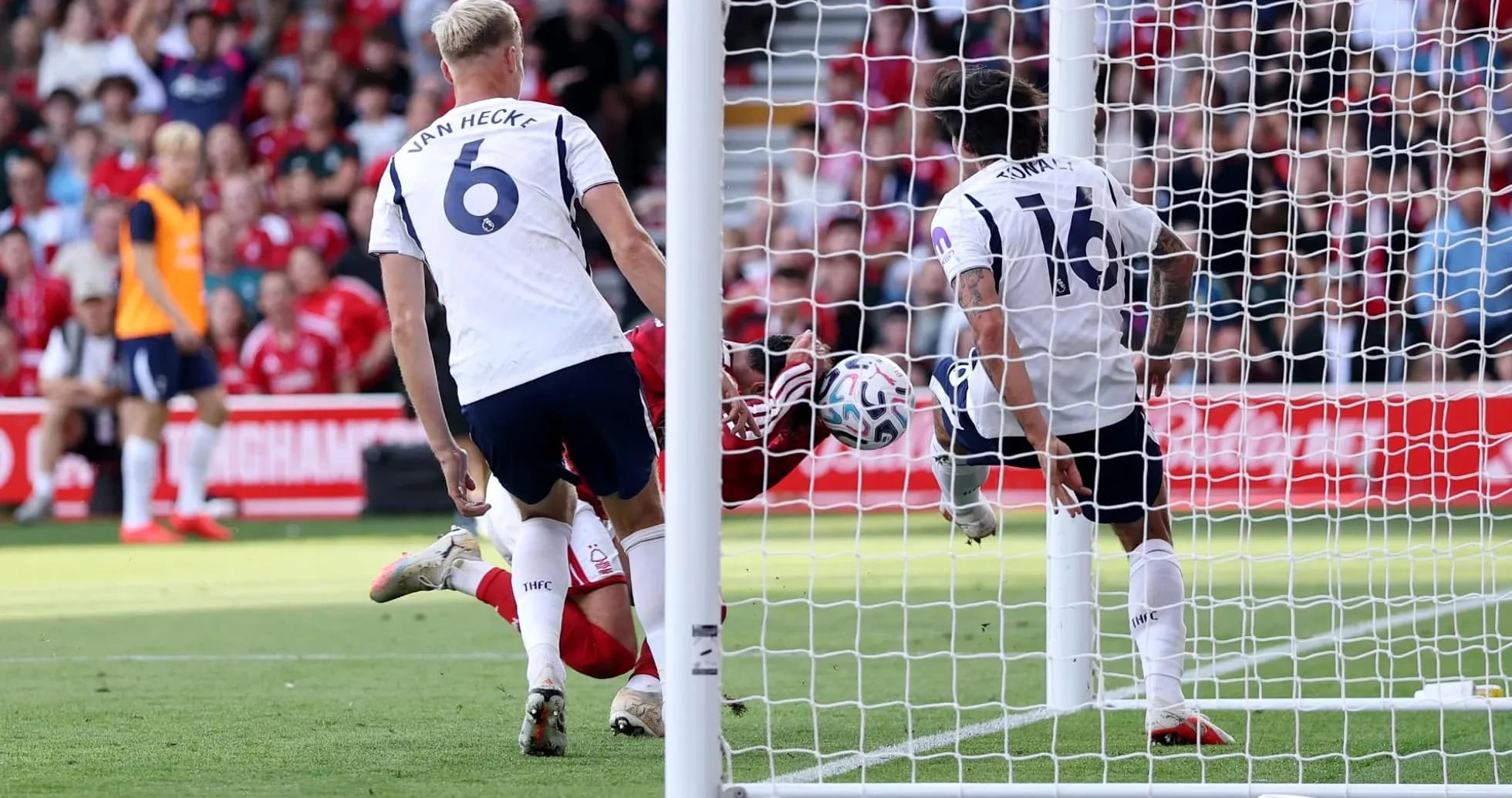
The double pivot of Rodrigo Bentancur and Sandro Tonali should be Tottenham’s metronome, but the absence of key creative figures higher up the pitch forced them into more conservative patterns. Dejan Kulusevski, James Maddison, W. Odobert and Xavi Simons were all listed as missing with knee issues or a knock, stripping Tottenham of their usual line-breaking and final-third craft. Instead, Savio, Conor Gallagher and Mathys Tel formed the attacking midfield trio behind Omar Marmoush.
Gallagher’s role as an “engine room” connector was crucial: his pressing and box-to-box running attempted to bridge the gap between a cautious double pivot and an isolated Marmoush. Savio and Tel, both capable of direct running, were asked to attack the channels, but the numbers tell the bigger story: Tottenham have yet to score this season, with 0.0 goals per game at home and away, and have failed to score in all 3 matches. Even with 1 clean sheet overall, this is a side where the defensive structure is not yet being rewarded by any cutting edge.
Discipline and Tactical Picture
Discipline added another layer to the tactical picture. Tottenham’s yellow cards are evenly spread: 25.00% in each of the 0-15, 31-45, 46-60 and 76-90 minute bands. That distribution points to a team that struggles to manage game states smoothly, often needing tactical fouls at the start, just before the break, early in the second half and late on. Udogie and Mateus Fernandes, both among the league’s more card-prone players, embody that edge – high-intensity defenders who can be drawn into duels in wide areas.
Matchup Analysis
In the “Hunter vs Shield” matchup, Forest’s attack – modest in volume but efficient away from home – met a Tottenham defence that leaks 1.7 goals per game overall. Yet the absences for Spurs flipped the narrative: without Kulusevski and Maddison, their own “hunters” were blunted, leaving Marmoush to wrestle alone with a well-drilled back three. Forest’s “shield”, conceding just 0.5 per game at home, held firm.
In midfield, the “Engine Room” battle between Gibbs-White and Schlager on one side and Bentancur and Tonali on the other was finely balanced. Gibbs-White’s ability to receive under pressure and carry the ball into the final third repeatedly asked questions of Tottenham’s double pivot, while Bentancur and Tonali sought to slow transitions and funnel play wide, away from Delap’s runs and Ndoye’s surges.
From a statistical prognosis perspective, this stalemate fits the underlying numbers. Forest are a side that grinds, with low-scoring games and a solid defensive base at home; Tottenham, for now, are defined by sterile control and a misfiring attack. With Forest’s penalties this season converted perfectly – 1 scored from 1 taken, none missed – and Tottenham yet to even earn a spot-kick, the margins in tight matches like this will likely continue to hinge on set-pieces and discipline.
Following this result, both managers will see different truths. Glasner can point to another clean sheet at the City Ground and a defensive platform that looks sustainable. De Zerbi, meanwhile, must solve an attacking puzzle that injuries have complicated but not excused. The shapes are clear, the roles are defined; what both squads now need is end product to match their tactical sketches.