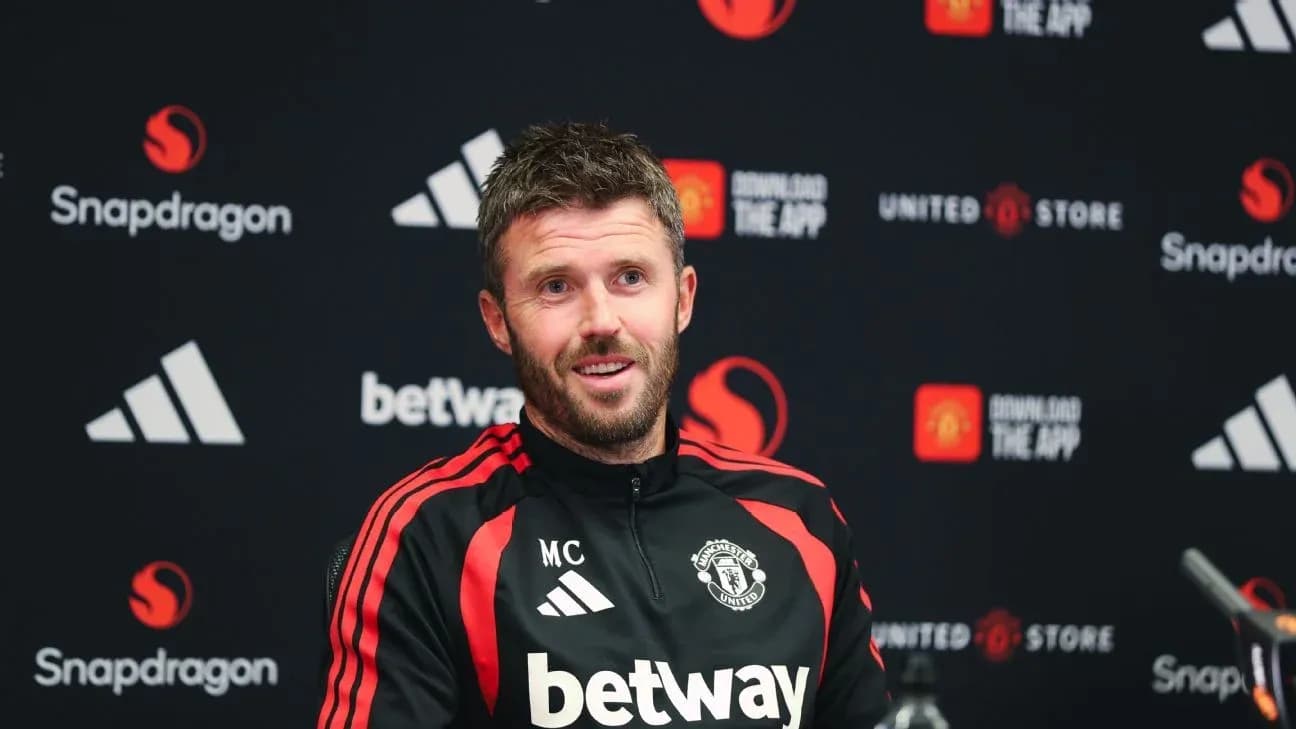
Michael Carrick Aims for Champions League Return at Manchester United
Michael Carrick knows exactly what the summit looks like. He lived there for a decade in a Manchester United shirt. Now he is trying to drag the club back up the mountain as its manager, one careful step at a time.
The target is clear. Champions League football again, as a minimum. A genuine title push, as soon as this squad is ready to sustain it.
Carrick, a five-time Premier League winner, was part of United’s last title-winning side in 2013. Thirteen years on, he is under no illusions about the size of the task.
He calls it a “jump” to turn this group into champions immediately. He refuses to call it impossible.
United, who want to celebrate their 150th anniversary in 2028 with a 21st league crown, are trying to build towards that moment, not talk it into existence. Carrick, confirmed as permanent head coach in May after steering the club to third last season in difficult circumstances, is fixed on evolution rather than slogans.
“We want to evolve as a team,” he said before Saturday’s lunchtime trip to promoted Hull.
The word “evolve” matters here. This is not a reset, not a revolution. It is a manager who sees enough in his dressing room to believe in growth.
He looks first to the youngsters.
“We’ve got a lot of younger players in the group that we want to help move forward individually, which collectively will move us in a good direction.”
Winning, he insists, is not just an outcome. It’s a habit. Last season’s run, the grind of putting results together, has given his players a taste of that.
“The experiences that they’ve had, the habit in getting used to feeling what it’s like to win a number of games is huge,” Carrick said. “It’s huge for players at this club to feel it and know what it takes, first of all, and what you’ve got to put into it to get out the other end.”
The ambition is laid out without fuss.
“Yeah, we want to be finishing in the Champions League again without doubt. It’s a challenge, it’s a big challenge. There’s a lot of teams fighting for that position and we managed to do that last season and we’ve got to aim to do the same and then keep pushing on through the season to see how it develops.”
He breaks the campaign down into phases: start strong, survive and thrive through the winter, finish with power. Put it all together and see where they land.
“We want to start strong, we want to get through the winter months and we want to be strong and we want to finish strong,” he said. “So it’s putting it all together and then see where we end up but we’re going into it with a lot of encouragement.”
If United are to turn encouragement into something more concrete, the midfield will decide how far they go.
Casemiro, the dominant presence of recent seasons, has gone. Manuel Ugarte is sidelined. The spine has been disturbed. United have moved quickly to reshape it, bringing in Youri Tielemans and Andrey Santos, and working on a £70 million deal for Brighton’s Carlos Baleba, sources say.
This is Carrick’s territory. Few understand the demands of a United midfield better than a man who patrolled it for years at Old Trafford. He talks about balance, about structure, about the unseen work that allows the flair players to shine.
He likes what he sees.
United, he says, already have a “really good balance” in the squad and are trying to add quality without losing that mix.
On the importance of a strong midfield, Carrick is unequivocal.
“I think it gives you the foundation of the team,” he said. “I think the foundation of the team is important to be consistent, to be consistent through one game from start to finish, to be consistent over a period of time.”
Everything, in his mind, runs through the centre of the pitch.
“I think you need a solid foundation through the middle of the team and trying putting it together and getting that balance.”
History backs him up. The great sides, he points out, have always had a powerful core.
“If you look at all the top teams over the years, all the great teams over the years, the spine of the team is really strong, so we’re conscious of that and I think we’ve got a good spine of the team right now.”
The job is far from done. Carrick knows that. But he sounds like a coach who believes the platform is finally there.
“We can keep improving as we go in different ways and coaching and helping the boys and developing them, and I think we’re in a good place.”
The question now is simple, and ruthless: is “a good place” enough in a league where standing still means falling behind?