Mexico's Tactical Superiority in 2-0 Victory over South Africa
Mexico’s 2-0 win over South Africa at Estadio Azteca was a controlled, methodical performance built on structural superiority in possession and intelligent exploitation of the extra space created by South Africa’s indiscipline. Javier Aguirre’s 4-1-4-1 consistently outplayed Hugo Broos’ 5-3-2, turning territorial dominance and circulation quality into a steady accumulation of chances that ultimately matched the underlying numbers: 1.41 xG to 0.07.
Mexico’s positional play was clear from the outset. In the 4-1-4-1, Erik Lira anchored beneath a very aggressive line of four attacking midfielders: Roberto Alvarado wide right, Brian Gutiérrez and Álvaro Fidalgo operating between the lines, and Julián Quiñones starting from the left but frequently moving inside. This structure created a stable 3-2 base in build-up: the full-backs Jesú́s Gallardo and Israel Reyes pushed high, while Lira dropped alongside the centre-backs César Montes and Johan Vásquez to outnumber South Africa’s front two.
Against South Africa’s 5-3-2 block, this numerical superiority in the first line was decisive. Mexico used short circulation and vertical passes into the half-spaces to unbalance the visitors. The opening goal at 9' captured the plan perfectly: Lira, positioned as the single pivot, found space to receive and then play forward, feeding Quiñones, who had drifted inside from the left. With South Africa’s wing-back line pinned and the midfield three stretched, Quiñones finished to cap a well-constructed central overload, assisted directly by Lira.
Out of possession, Mexico pressed selectively rather than constantly. The front five stepped onto South Africa’s first pass, aiming to force play wide and then trap near the touchline. The visitors, with only 335 passes and 39% possession, rarely established sustained sequences. When they did break, Lira’s screening in front of Montes and Vásquez was key in protecting the central corridor, limiting South Africa to just three shots in total and only one from inside the box.
South Africa’s 5-3-2, on paper designed to provide defensive density, instead became a passive, deep block under constant pressure. The wing-backs, Khuliso Mudau and Aubrey Modiba, were pinned back by Mexico’s wide midfielders, leaving the front two, Iqraam Rayners and Lyle Foster, isolated. The midfield trio of Teboho Mokoena, Siphephelo Sithole and Jayden Adams struggled to get out to the ball while also tracking Mexico’s interior runners. Fouls were a natural consequence: 11 in total, with Mokoena booked at 17' for a “Foul” as he tried to halt one of Mexico’s many central progressions.
The game’s tactical balance tilted further on 49' when Sithole was sent off for a “Professional foul last man.” Reduced to ten, South Africa were forced into an even lower 5-3-1 shape, sacrificing any meaningful counter-attacking threat. Broos reacted with a double substitution: Thalente Mbatha (IN) came on for Lyle Foster (OUT) at 56', and Themba Zwane (IN) came on for Jayden Adams (OUT) at 61'. The intent was to add fresh legs and ball security in midfield, but numerically and territorially South Africa remained under siege.
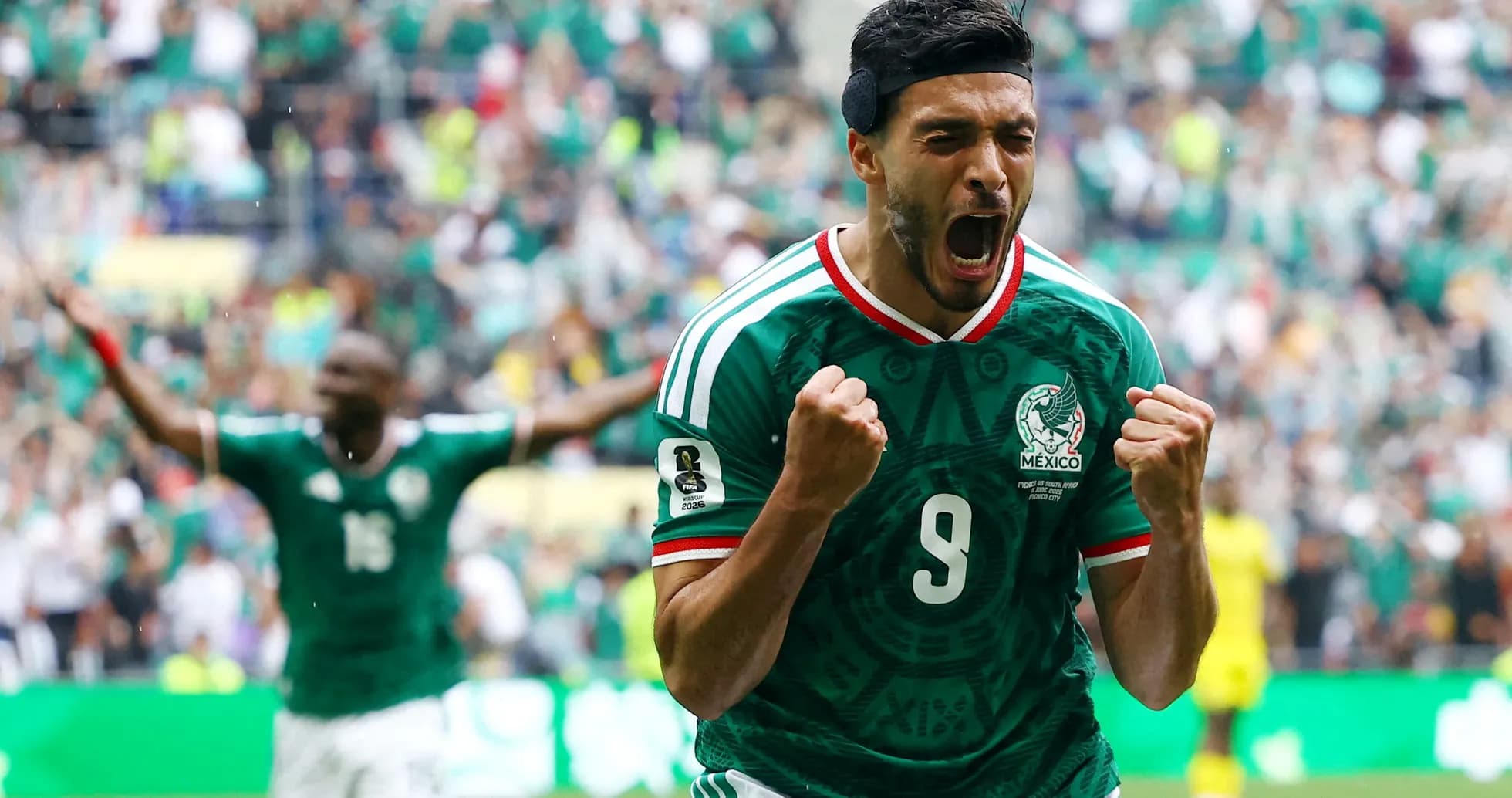
Aguirre’s in-game management was both proactive and aligned with the tactical picture. At 66', he introduced Gilberto Mora (IN) for Álvaro Fidalgo (OUT) and Luis Chávez (IN) for Brian Gutiérrez (OUT), refreshing the central lanes without altering the 4-1-4-1 structure. The impact was immediate: at 67', Mexico converted their dominance into a second goal. Roberto Alvarado, still operating from the right side, provided the assist for Raúl Jiménez, whose movement as the lone forward had been stretching South Africa’s back five all evening. Jiménez’s finish for 2-0 rewarded Mexico’s sustained pressure and varied attacking patterns.
From there, Mexico managed the game with a blend of control and rotation. At 76', Armando González (IN) came on for Raúl Jiménez (OUT), and Edson Álvarez (IN) replaced Erik Lira (OUT), adding fresh defensive presence in midfield while preserving the single-pivot structure. Later, at 79', Alexis Vega (IN) came on for Julián Quiñones (OUT), maintaining a like-for-like wide threat. These changes ensured Mexico kept their intensity without compromising positional discipline.
South Africa, chasing a deficit with ten men, attempted to inject pace and directness. At 77', Oswin Appollis (IN) replaced Aubrey Modiba (OUT), and Evidence Makgopa (IN) came on for Iqraam Rayners (OUT), effectively shifting emphasis toward more vertical, transitional attacks from deeper zones. However, with only 0.07 xG generated and just two shots on target, their offensive structure never truly threatened.
Discipline further undermined South Africa’s late-game prospects. Nkosinathi Sibisi was booked at 74' for a “Foul,” a symptom of a back line continually exposed by Mexico’s rotations. Then, after a VAR intervention labelled “Card upgrade” involving Themba Zwane at 82', the midfielder was shown a straight red card at 84' for “Violent conduct,” leaving South Africa with nine men. Mexico’s own back line was not entirely unscathed: Brian Gutiérrez had earlier received a yellow card at 23' for “Foul,” and in added time César Montes was dismissed at 90+2' for a “Professional foul last man,” a rare moment where Mexico’s high line was caught and forced into emergency defending.
Statistically, the pattern underpins the tactical story. Mexico’s 61% possession and 520 passes, with 467 accurate (90%), reflect a side comfortable circulating and probing against a deep block. Sixteen total shots, nine from inside the box, and 1.41 xG show a steady creation of quality opportunities rather than speculative efforts. South Africa’s 335 passes, 272 accurate (81%), and just three total shots illustrate how thoroughly they were contained.
In goal, Raúl Rangel (Mexico) made 2 saves, mirroring the limited threat he faced, while Ronwen Williams (South Africa) also registered 2 saves, but behind a defence that conceded 16 shots and was repeatedly forced into last-ditch interventions rather than a controlled block. The negative goals prevented figures for both teams underline that finishing slightly outpaced the underlying shot-stopping numbers, but tactically the match was decided long before the fine margins of goalkeeping: Mexico’s structural superiority, disciplined pressing, and intelligent use of the extra man after Sithole’s dismissal made the 2-0 scoreline a logical outcome of their plan.