Mauricio Pochettino's World Cup Journey and Future Ambitions
Mauricio Pochettino walks into the room like a man who has finally had a chance to breathe. Hugs, jokes, stories about the summer. The usual warmth. Only his summer has not been usual at all.
The Argentine has just taken the USA to the last 16 of a home World Cup, their run ending in a bruising defeat to Belgium. On paper, that’s the headline. In reality, it barely scratches the surface of a chaotic, political, oddly glamorous few weeks that turned a coach into a national figure and, briefly, a style icon.
World Cup chaos, Trump and Balogun
Managing at a World Cup is one thing. Managing at a World Cup on home soil, with Donald Trump hovering over everything, is something else entirely.
Pochettino chooses his words carefully when the subject of the former President comes up, highlighting the support and backing the team received. The circus around it? He lets that hang in the air.
The Folarin Balogun saga cut through the tournament like a political subplot. A suspension, then a suspension of that suspension, and accusations of “politics and manipulation” swirling around a knockout tie with Belgium. Pochettino understood the anger, but insists his own role was simple: shut out the noise.
“If you pay attention to the noise, you become crazy,” he has said of that period. When FIFA’s letter arrived the day before the game confirming Balogun was available, the decision, he says, was “straightforward”. He played.
The World Cup, though, did more than test his ability to manage a storm. It sharpened his sense of detail.
“We are much better coaches now,” he insists, talking about himself and long-time assistant Jesus Perez. The tournament, the short preparation windows, the need to get messages across to players who do not live together day in, day out like a club squad, all left their mark. Every small decision felt magnified. Every detail had to land.
“Everything needs to be perfect,” he says, and you believe he has replayed every training drill and every substitution in his head a dozen times.
Balogun’s future and a coach who gives space
Balogun’s name has been back in the headlines, this time for club reasons. His proposed move from Monaco to Everton collapsed late on Deadline Day. Pochettino has not called him yet. That is deliberate.
He knows how hard that kind of near-miss can hit a player. The USA boss wants to give him space to process it, even if he admits he would have liked to see the forward in the Premier League. For now, Balogun stays in Monaco. Pochettino just hopes his striker finds his rhythm again and arrives at the next international window in a good place.
The touchline suit that took off
This World Cup wasn’t only about tactics and politics. It was also, improbably, about fashion.
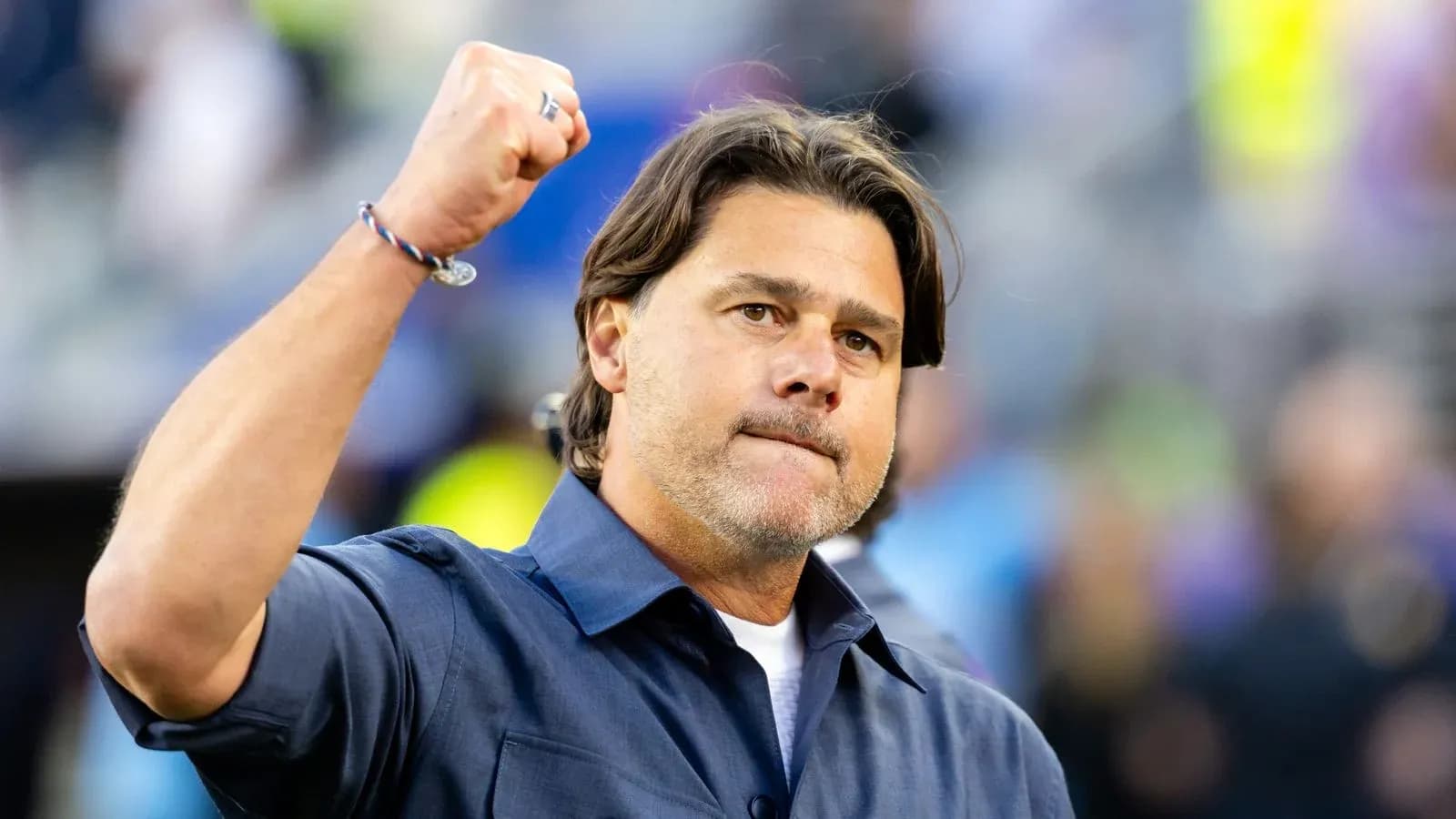
Pochettino’s navy touchline look – sharp, clean, understated – took on a life of its own. It spawned its own headlines. It even sent Wayne Rooney to the shops.
“I saw him. He looked good on him, like a top coach,” Pochettino laughs, clearly amused by the idea that his outfit became a talking point in its own right.
It capped a summer that had everything: drama, controversy, a knockout run, presidential involvement, and a manager whose jacket suddenly trended.
Four more years with the USA – but unfinished business in England
As the rest of the football world moved on from the World Cup, the rumour mill spun into action. Pochettino was linked with a string of club jobs. AC Milan were mentioned. Tottenham, inevitably, were mentioned. A return to the Premier League felt like a matter of time.
Then came the twist. Pochettino signed a new four-year deal with the USA, committing himself through to 2030. For a man who made his name in club football, six years away from the week-to-week grind feels like a long stretch.
Is his Premier League story over? He doesn’t see it that way at all.
“I have the ambition,” he says. “My dream now is to be in the USA for four years, but after that, why not? We are still young, and I think coming back is always my goal; to win the Premier League, to be in the Premier League and to build a project with the possibility of winning.
“I love the football here. I think to have the chance again is one of my wishes and I hope that happens.”
The message is clear: this is a pause, not a farewell.
Spurs, the call that never really came
Eighteen months or so ago, Pochettino spoke openly about wanting to return to Spurs one day. Since then, Tottenham have lived through more turbulence. Ange Postecoglou arrived with fanfare, then departed. Thomas Frank and Igor Tudor came and went as the club drifted dangerously close to the drop.
The question hangs there: did the phone ring? Did Tottenham ever truly ask him to come back and rescue them?
“Always I say, one day, why not?” he replies when asked about a return in general.
Pressed on whether it was close this time, he is more blunt. “People talk and maybe we receive some approach, but it never was close.” Not this time, then.
AC Milan? Other clubs? Interest was there, he admits, but he and his staff shut the door before anything developed.
“We were not open during the World Cup to talk with different clubs that were interested,” he says. Were there clubs interested? “Yes, always,” he answers, almost casually. “Yes, always have different, you know, options.”
Did any of them tempt him? “We never gave the opportunity to be close. We always closed the door before it got close.”
The World Cup, and the USA project, came first.
Spurs’ spending spree and a wry smile
Talk turns back to Tottenham and what they have become. It is never dull at Spurs, and Pochettino knows it.
“They are investing like other clubs,” he notes, pointing to a clear change of strategy after a couple of difficult seasons. Tottenham are now paying big money for players who already know the Premier League, rather than trying to polish rougher diamonds.
It is hard not to think back to Pochettino’s own era, when he came agonisingly close to glory in the league and in Europe while spending a fraction of what is going out the door now. Asked what he might have done with £300m to spend, he offers a mischievous smile and pretends not to understand what that figure even means.
Will this new approach work? He refuses to make grand predictions.
“You never know,” he says. “We need time to see if that works or not.
“Like in all the games, when you make a decision like a coach that can work well or not. I think it’s a different strategy and a different way to operate. I always wish the best for Tottenham because it’s in my heart.”
The affection for the club is still there, even if the paths have diverged.
Chelsea, Xabi Alonso and the new direction
Across London, Chelsea have also shifted course since Pochettino’s spell in charge two years ago. The title on the door has changed from head coach to manager. The transfer policy has shifted too, with the club now targeting Premier League-ready players rather than long-term projects under Xabi Alonso.
Pochettino avoids direct comparisons between his time and the current setup, but he recognises the intent.
Buying proven players, he says, naturally raises expectations. “Buying players like this you can expect to fight, to be a contender for the Premier League.”
Chelsea’s defeat to Arsenal has already delivered a jolt of reality, yet Pochettino urges patience for Alonso.
“Of course they are disappointed after the defeat against Arsenal, but I think we need to give time to Xabi’s first season after three games in the Premier League,” he says.
The same, he adds, goes for Tottenham’s new-look side. New ideas, new squads, new pressures. They all need time.
Arsenal and Arteta at the top of the tree
For all the focus on Spurs and Chelsea, Pochettino is clear about who sets the standard right now.
For him, Arsenal are out in front.
“Mikel [Arteta] is the best coach in the Premier League today,” he says. He believes Arteta knows exactly what he needs to do, and that beating Arsenal over a season will be “tough”.
It is a striking admission from a former Spurs manager and Chelsea coach, but also a blunt assessment of the landscape he hopes to re-enter one day.
For now, Pochettino belongs to the USA: to the World Cup lessons, the political storms, the touchline suits and the next four years of building. But his gaze keeps drifting back towards England, towards a league he still wants to conquer.
The Premier League has moved on. The question is simple: when he finally comes back, will it be ready for him – or will he be ready to bend it to his will?