Manchester United's Struggles: Carrick and Wilcox Under Fire
The boos came first. Then the silence.
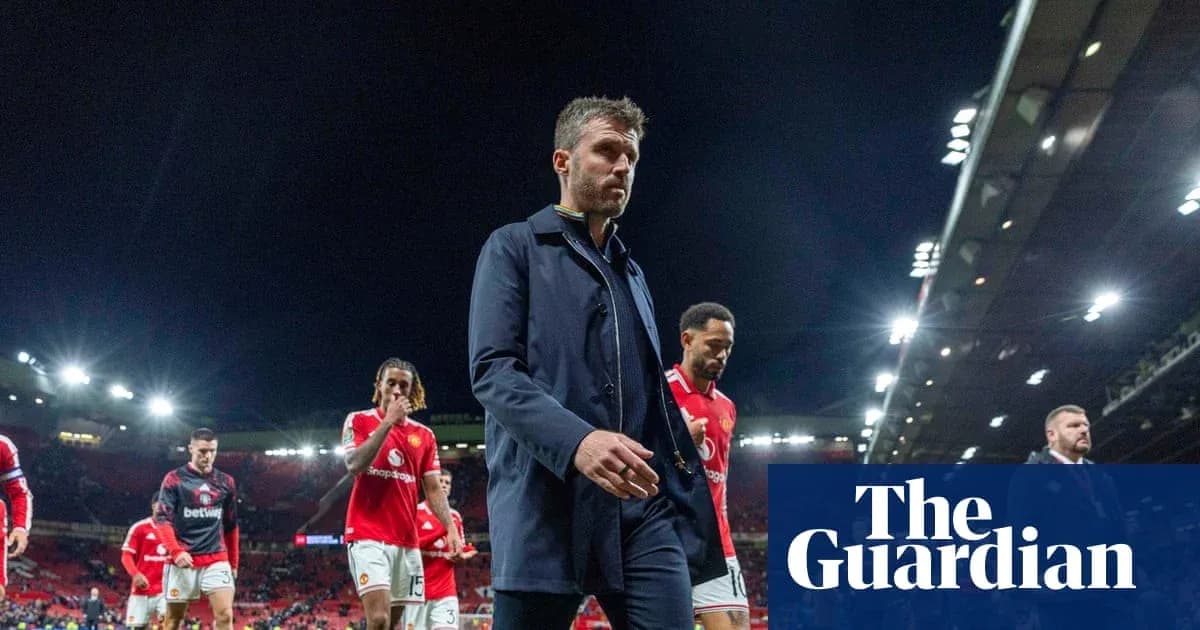
As Manchester United slid out of the Carabao Cup on Wednesday, Old Trafford’s reaction told its own story: anger at the night, apathy about the era. Michael Carrick, expression fixed and solemn, walked towards the tunnel as the obvious target. His players followed, heads down. Above them, in the directors’ box, Jason Wilcox cut an equally unhappy figure. But the director of football, and those above him, cannot keep ducking the noise.
Supporters understand the transaction. They pay, they watch, they judge. They see Carrick and his squad fronting up for interviews, fronting sponsor events, fronting the club’s image. So they let them have it. Yet this crisis is not the work of one man on the touchline.
Carrick only returned in January. Others have been shaping United’s long-term strategy for years, with the head coach slotted into a structure he does not control. The pressure on him is real, though, and Sunday’s trip to Fulham already feels like a fault line. Lose there and the temperature spikes again.
United’s fanbase is not naïve. The protests against the Glazer family and Sir Jim Ratcliffe are regular, loud and pointed. They know 90 minutes is only one part of the story, that not every misstep belongs to the coach or the players. The boos are for the performance. The indifference is for the project.
It stings all the more because United are back in the Champions League, yet were outspent in the summer by promoted clubs. Years of financial mismanagement have caught up. The margin for error in the market has shrunk to almost nothing.
That reality was laid bare against Brighton. Two goals up inside 10 minutes, United somehow still contrived to “deservedly” lose a game they barely participated in for the remaining 80. That is not just a bad night; it is a warning flare. Carrick does not need telling.
Brighton, heavily rotated, still rolled out a vibrant, globally sourced squad, the product of sharp scouting and joined-up recruitment. This summer alone they bought from seven different countries. United? Four signings, all from fellow Premier League clubs. Safety over imagination. Familiarity over adventure.
It jars with the fact that last summer’s most successful addition, in value and reliability, was Senne Lammens from Royal Antwerp. The club’s best bit of business came from looking beyond their own backyard, yet the lesson has not stuck.
Carrick and Wilcox will only be fairly judged when Carlos Baleba, the priciest of the three summer signings, is finally available. On paper, his athleticism should address United’s chronic lack of mobility in midfield. Targeting that area made sense after Casemiro’s departure and Manuel Ugarte’s struggles. But it was never the only weakness.
Inside the club, there was acceptance that the squad needed broader surgery. The market activity did not reflect that. Three midfielders, £155m, and glaring issues elsewhere left untouched. It looked narrow at the time. It looks naïve now.
Buying domestically rarely offers value, but it does cut adaptation time. Even so, given the shortage at left-back and Joshua Zirkzee’s limitations up front, diverting some of the £50m spent on Andrey Santos towards a cheaper midfield option and reinforcements elsewhere might have served the team better. Someone, somewhere, decided against that. Someone should now explain why.
Instead, Carrick must improvise. Luke Shaw’s injury lay-off, widely anticipated, has forced a scramble for a plan B. The head coach stands in front of the cameras and answers for it. Those who built the squad stay largely out of sight.
Wilcox has not been completely invisible. On 30 October 2025, after three straight wins, he sat down with the club’s in-house media and outlined the long-term vision. Two months later, Ruben Amorim was sacked and that plan lay in pieces. Since then, Wilcox’s public voice has all but vanished, beyond the formal statements that accompany dismissals.
Across Europe, sporting directors routinely explain strategy and setbacks in front of the press. In the Premier League, that culture has never really taken hold. At United, with the team sitting 13th, the silence feels louder by the week.
Wilcox arrived from Southampton in 2024, initially as technical director, and played a part in the decision to keep Erik ten Hag after an eighth-placed finish. Ten Hag did not survive the start of the following season. Amorim came in from Sporting with a philosophy that never truly matched the players at his disposal, and without the funds for the overhaul his system demanded. United finished 15th and lost a limp Europa League final to Tottenham.
Fourteen months later, Amorim went the way of Ten Hag. Wilcox, though, retained the trust of the hierarchy and another chance to get it right.
Carrick cannot be shielded. This United side are underperforming. Heavy wins over promoted Ipswich and Azerbaijan’s Sabah have padded the scorelines but not the argument. The league form is the real measure, and it is not flattering.
Seven goals conceded in four Premier League games tells its own story. Against Brighton, the central defensive partnership of Leny Yoro and Ayden Heaven veered close to chaotic. Up front, the attack has lacked cohesion, patterns, threat. It looks like a collection of individuals rather than a constructed unit.
Wilcox’s reputation was forged at Manchester City, where his work as head of academy drew widespread praise. Those who dealt with him there spoke highly of his eye for talent and suitability for that level of responsibility. At United, higher up the chain, the scrutiny has sharpened. The margin for missteps has vanished.
If JJ Gabriel leaves, many supporters will bristle. On that front, at least, Wilcox can point to his efforts. He has pushed hard to keep the teenager, engaging with the player’s inner circle in an attempt to secure his future at Old Trafford.
Yet the broader picture remains. Power at United carries weight, but only one figure seems to feel its full force. Ten Hag and Amorim have already paid with their jobs. Others, central to the club’s direction, remain in place.
Carrick and Wilcox are tied to the same results, the same table, the same restless fanbase. Right now, though, it feels like only one of them will truly suffer the consequences if this slide continues.