Liverpool and Nottingham Forest Share Points in Tactical Stalemate
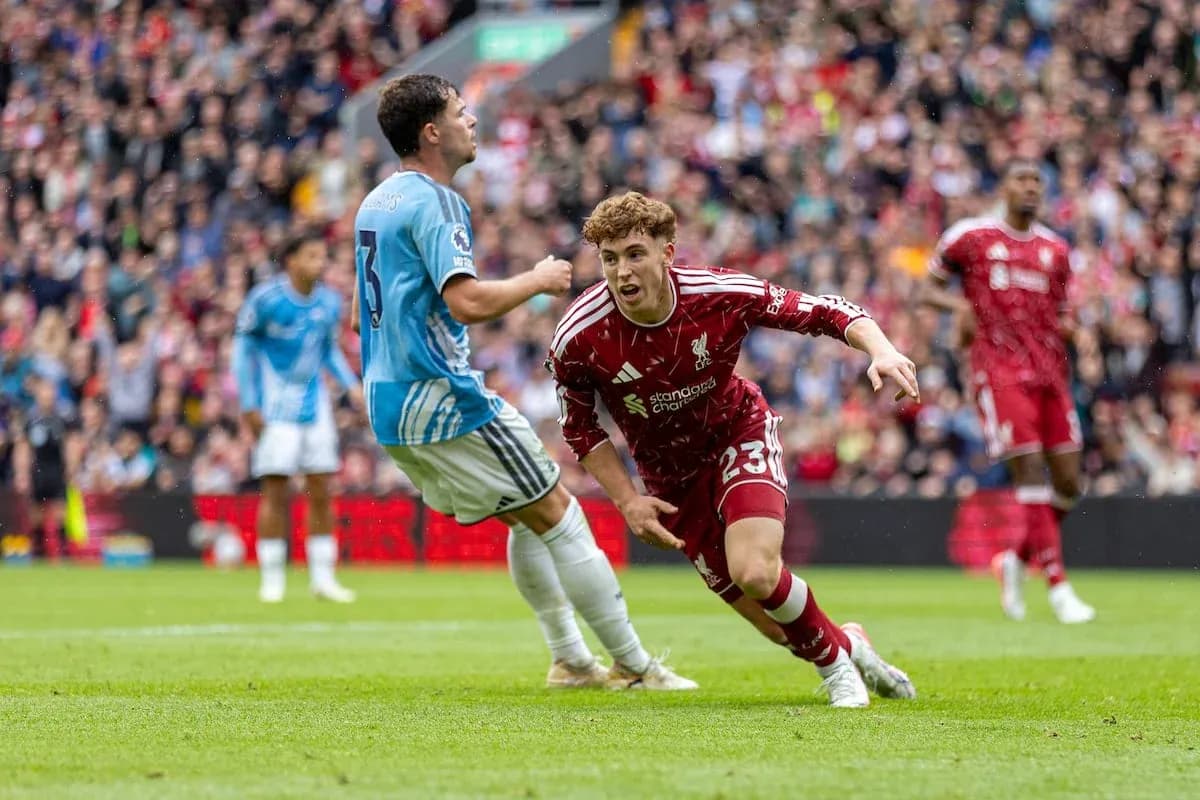
Anfield’s first league matinee of the season ended with the scoreboard locked at 2–2, and yet the story underneath felt anything but static. In the second round of the Premier League, Liverpool and Nottingham Forest walked off with a point apiece, but the tactical imprints on this early‑season draw were sharply defined.
I. The Big Picture – Two Projects Still Forming
Heading into this game, Liverpool were 13th, their goal difference exactly balanced at 0 after scoring 4 and conceding 4 overall. At Anfield they had already drawn once, 2–2, and this second straight stalemate under Andoni Iraola only deepened the sense of a side still learning its new patterns. The numbers underline the duality: overall they averaged 2.0 goals for and 2.0 against, had yet to keep a clean sheet, but had also failed to draw a blank in front of goal. This is a team built to trade punches.
Nottingham Forest arrived in 15th, with 1 point and a goal difference of −1 (2 scored, 3 conceded overall). On their travels, Oliver Glasner’s side had already shown they could land blows, scoring 2 and conceding 2 away, mirroring their broader profile: an away average of 2.0 goals for and 2.0 against, but no clean sheets and one overall game without scoring, which came at home. Forest’s season so far has been about volatility rather than control.
The formations reflected those identities. Liverpool stayed loyal to Iraola’s 4‑2‑3‑1: Alisson behind a back four of Jeremie Frimpong, J. Jacquet, Virgil van Dijk and Milos Kerkez; a double pivot of Dominik Szoboszlai and Alexis Mac Allister; an advanced line of Cody Gakpo, Florian Wirtz and Víctor Muñoz supporting Alexander Isak. Forest set up in Glasner’s trademark 3‑4‑2‑1: Matz Sels protected by a back three of Cunha, Nikola Milenkovic and Murillo; a wide midfield line of Ola Aina, Xaver Schlager, James McAtee and Neco Williams; with Morgan Gibbs‑White and Dan Ndoye floating behind Igor Jesus.
II. Tactical Voids – Who Was Missing, and What That Meant
Liverpool’s squad sheet carried a long list of absentees. Stefan Bajcetic, Conor Bradley, Federico Chiesa, Hugo Ekitike, Harvey Elliott, Joe Gomez and G. Leoni were all ruled out. The knock‑on effect was structural. Without Gomez, Iraola had no natural, defensive‑minded full‑back alternative, which pushed Frimpong and Kerkez into even more expansive roles and made the high back line more exposed in transition. The absence of Chiesa and Ekitike narrowed the attacking variety on the bench, putting extra creative burden on Gakpo, Wirtz and Muñoz.
For Forest, the loss of Ibrahima Sangaré to a calf injury removed their most natural ball‑winner in front of the back three, while N. Savona’s knee issue further thinned the options in central areas. In Sangaré’s absence, Schlager had to shoulder more of the destructive work, and McAtee was drawn deeper than ideal at times, slightly blunting Forest’s ability to spring quickly from midfield.
Disciplinary trends from the opening weeks also shaped the emotional temperature of the contest. Liverpool had already taken a flurry of yellows in concentrated bursts: 28.57% of their cautions between 16–30 minutes, another 28.57% between 46–60, and the same share in the 76–90 window. That pattern hinted at a side that presses aggressively early in each half and again in the closing stages, often walking the line with the referee. Forest’s bookings were more compressed into the middle of games: 25.00% of their yellows between 16–30, another 25.00% between 31–45, and a hefty 50.00% between 46–60, suggesting a team that tends to foul when the tempo spikes after the interval.
III. Key Matchups – Hunter vs Shield, and the Engine Room
The headline duel was Liverpool’s multi‑headed attack against a Forest defence still trying to find stability. Overall, Liverpool had scored 4 goals in 2 league games, all from open play or standard situations, with their single penalty this season converted for a perfect 100.00% record from the spot. Gakpo, Isak and Muñoz each arrived with 1 league goal; Gakpo added 1 assist, while Wirtz and Ryan Gravenberch had also contributed a goal pass apiece.
On Forest’s side of the ledger, the defence had conceded 3 overall, with 1 at home and 2 away. The back three of Murillo, Milenkovic and Cunha were tasked with absorbing a front four that rotates relentlessly. Isak’s 5 shots and 3 on target across the season, combined with his 7 duels won from 14, made him the classic “Hunter” in this matchup: a centre‑forward who can both pin and spin. Milenkovic’s aerial presence and Murillo’s front‑foot aggression were Forest’s “Shield”, but without Sangaré screening, the gaps between the lines were always liable to open.
In the half‑spaces, the duel between Muñoz and Aina down Liverpool’s left side was decisive. Aina, already on 2 yellow cards this season and among the league’s most frequently booked, is an assertive defender and an important carrier: 7 dribbles attempted, 4 successful, and 4 key passes from 58 total passes. Muñoz, meanwhile, had 1 goal, 1 blocked shot and 3 interceptions in his early‑season profile, as well as 5 dribble attempts and 4 fouls drawn. The collision of Aina’s aggression and Muñoz’s constant probing gave that flank a crackling, high‑risk energy.
In the “Engine Room”, Szoboszlai and Mac Allister faced Schlager and McAtee. Liverpool’s double pivot had to both feed the front four and protect a back line that has yet to keep a clean sheet. Wirtz, operating as the advanced connector, had already produced 1 assist from 85 passes at 81% accuracy, plus 4 tackles and 2 successful dribbles. Across from him, Gibbs‑White was Forest’s creative heartbeat: 1 goal, 1 assist, 57 passes at 82% accuracy, 8 dribble attempts with 4 successful, and 21 duels contested, 10 won. His ability to receive between the lines and turn under pressure asked constant questions of Szoboszlai’s defensive discipline and Jacquet’s willingness to step out.
IV. Statistical Prognosis – A Draw That Fits the Numbers
Following this result, the table simply confirmed what the eye suggested. Liverpool, still unbeaten but winless, now have 2 points from 2 games, 4 goals scored and 4 conceded overall, keeping their goal difference at 0. Forest sit on 1 point with 2 goals for and 3 against, goal difference −1, their away profile (2 scored, 2 conceded) looking more expansive than their home form.
The season‑to‑date metrics frame the 2–2 as almost inevitable. Liverpool’s overall averages of 2.0 goals for and 2.0 against, combined with Forest’s overall averages of 1.0 scored and 1.5 conceded, point toward a game in which both sides would find the net and neither would close the door. Both teams have yet to record a clean sheet; both have already converted 1 penalty each with 100.00% success and no misses.
Defensively, Liverpool’s inability to shut games down, even at Anfield where they have now conceded 2 in each of their home fixtures, remains the central concern. Forest, meanwhile, can take encouragement from scoring twice on their travels again, reinforcing the idea that Glasner’s 3‑4‑2‑1 is built to exploit space in transition rather than dominate territory.
From a tactical perspective, the “Hunter vs Shield” battle finished honours even. Isak and Gakpo continued to justify their billing as early‑season threats, while Murillo and Milenkovic did just enough, with help from Sels, to prevent the game tipping into an Anfield onslaught. In midfield, Gibbs‑White’s influence matched Wirtz’s in key moments, and Schlager’s work rate partly compensated for Sangaré’s absence.
The statistical prognosis from here is clear. Unless Liverpool can translate their attacking fluency into more control without the ball, they will remain a high‑variance side trading in wild scorelines. Forest, for their part, look set to live on the edge in away games: dangerous enough to score, but too open to consistently protect leads. At Anfield, a 2–2 draw felt like the purest expression of both teams’ current identities.