Liverpool and Chelsea Share Points in Tactical Stalemate
Liverpool and Chelsea shared a 1–1 draw at Anfield in Round 36 of the Premier League, a match that was tactically tight and statistically even. Liverpool struck early through Ryan Gravenberch, but Chelsea grew into the contest and levelled before the break via Enzo Fernández. From there it became a game of small adjustments: Chelsea controlled a touch more of the ball, Liverpool threatened slightly more in volume, and both sides ultimately lacked the penalty-box precision to tilt the contest. The second half featured a disallowed Cole Palmer goal, a flurry of late cards, and conservative substitution patterns that underlined how much both coaches wanted to avoid defeat.
I. Executive Summary
Liverpool started with a dynamic, high-energy midfield and an aggressive right side built around Jeremie Frimpong and Rio Ngumoha, looking to attack Chelsea’s full-back zones early. Calum McFarlane’s Chelsea, with João Pedro as the central forward and Cole Palmer roaming between the lines, sought to build patiently through Moisés Caicedo and Enzo Fernández, trusting their technical superiority in tight spaces. The 1–1 scoreline at half-time reflected that balance: Liverpool’s more direct early pressure versus Chelsea’s growing territorial control.
II. Scoring Sequence & Disciplinary Log
Liverpool’s opener came at 6'. Ryan Gravenberch broke forward from midfield and finished after being supplied by Rio Ngumoha, a move that encapsulated Liverpool’s plan to exploit transitions and vertical runs from their interiors.
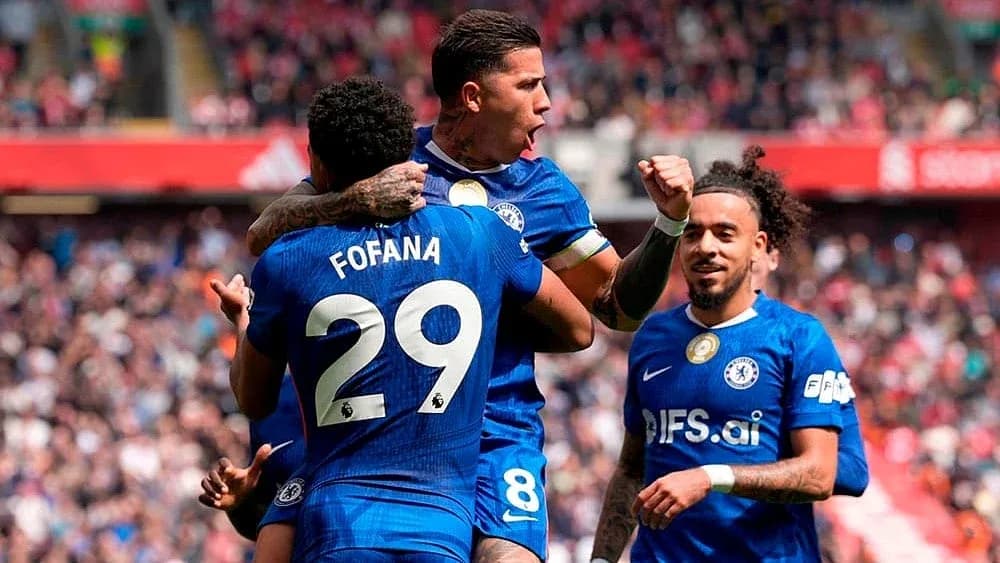
Chelsea equalised at 35'. Enzo Fernández, arriving from midfield, struck to make it 1–1, with no assist credited. The goal was a product of Chelsea’s increasing ability to pin Liverpool back and find second balls around the box.
The key turning point in the second half arrived at 50', when Cole Palmer had a goal cancelled by VAR (“Goal cancelled”). This underlined Chelsea’s capacity to slice through Liverpool’s structure when Palmer drifted into central pockets, even if the move did not stand on the scoreboard.
- 63' Andrey Santos (OUT) — Reece James (IN) (Chelsea): Reece James (IN) came on for Andrey Santos (OUT), adding more thrust on the right flank.
- 67' Jorrel Hato (Chelsea) — Yellow Card — Foul
- 67' Rio Ngumoha (OUT) — Alexander Isak (IN) (Liverpool): Alexander Isak (IN) came on for Rio Ngumoha (OUT), shifting Liverpool to a more classic centre-forward profile and freeing Cody Gakpo to roam more.
- 73' Enzo Fernández (Chelsea) — Yellow Card — Foul
- 77' Cody Gakpo (OUT) — Federico Chiesa (IN) (Liverpool): Federico Chiesa (IN) came on for Cody Gakpo (OUT), giving Liverpool a more direct, wide-running threat.
- 77' Ibrahima Konaté (OUT) — Joe Gomez (IN) (Liverpool): Joe Gomez (IN) came on for Ibrahima Konaté (OUT), a like-for-like defensive change, possibly fitness or load-management driven.
- 83' Marc Cucurella (Chelsea) — Yellow Card — Foul
- 88' Joe Gomez (Liverpool) — Yellow Card — Argument
- 89' Moisés Caicedo (Chelsea) — Yellow Card — Handball
- 90+4' Alexis Mac Allister (Liverpool) — Yellow Card — Persistent fouling
Card verification: Liverpool received 2 yellow cards (Joe Gomez, Alexis Mac Allister); Chelsea received 4 yellow cards (Jorrel Hato, Enzo Fernández, Marc Cucurella, Moisés Caicedo). Total: 6.
III. Tactical Breakdown & Personnel
Arne Slot’s starting structure, though not explicitly given as a formation, functionally resembled a back four of Curtis Jones, Ibrahima Konaté, Virgil van Dijk and Miloš Kerkez in front of Giorgi Mamardashvili. Ahead of them, Ryan Gravenberch and Alexis Mac Allister formed the central axis, with Jeremie Frimpong and Dominik Szoboszlai providing width and half-space occupation, Rio Ngumoha floating as an advanced midfielder, and Cody Gakpo leading the line.
The early goal reflected this design: Gravenberch’s licence to break lines from midfield, Ngumoha’s ability to receive between the lines and release runners, and Gakpo’s presence pinning Chelsea’s centre-backs. Liverpool’s 8 total shots (3 on target) from just 0.56 xG shows that many of their attempts were either low-value or taken under pressure, despite good territorial moments.
Out of possession, Liverpool pressed in waves but not recklessly. Frimpong and Ngumoha stepped high to trap Chelsea’s first pass into midfield, with Mac Allister and Gravenberch shuttling to close Enzo Fernández and Moisés Caicedo. The cost of this approach was occasional exposure in front of the back line, which Chelsea began to exploit as the half wore on.
Chelsea’s base structure had Filip Jørgensen in goal behind a back four of Malo Gusto, Wesley Fofana, Levi Colwill and Jorrel Hato. In midfield, Andrey Santos, Moisés Caicedo and Enzo Fernández formed a technically strong trio, with Cole Palmer and Marc Cucurella operating as advanced midfielders supporting João Pedro.
Early on, Chelsea were slightly passive, allowing Liverpool’s midfield to dictate. But as Caicedo and Enzo found their rhythm, Chelsea’s possession (52%) became more purposeful. Enzo’s goal at 35' came from that shift: Chelsea pushed higher, pinned Liverpool deeper, and Enzo attacked the space at the edge of the box.
The disallowed Cole Palmer goal at 50' was the clearest expression of Chelsea’s attacking concept: Palmer drifting centrally, combining with João Pedro, and exploiting the half-spaces behind Liverpool’s midfield. Although VAR cancelled it, tactically it signalled that Chelsea had solved some of Liverpool’s pressing puzzles.
The introduction of Reece James for Andrey Santos at 63' rebalanced Chelsea’s right side, adding overlapping threat and better delivery from deep. However, Chelsea’s shot volume remained modest (6 total, 3 on target, 0.5 xG), indicating that while they controlled phases of possession, they struggled to convert that into clear-cut chances inside the box.
For Liverpool, the double change at 77' was significant. Alexander Isak’s entry for Ngumoha gave Liverpool a more traditional striker, with Gakpo moving off the front line before being replaced by Federico Chiesa. Chiesa’s presence suggested a late-game plan to attack space behind Chelsea’s full-backs on the counter. Yet, with both teams wary of losing, the game became more fragmented, culminating in a series of late cards that reflected rising tension more than tactical chaos.
Defensively, both goalkeepers were relatively protected: Mamardashvili and Jørgensen each made 2 saves. The identical negative “goals prevented” value (-0.49 for both) indicates that each conceded roughly what the chances suggested and did not produce high-impact, xG-defying stops.
Joe Gomez’s late booking for “Argument” at 88' shows how emotionally charged the closing stages became, particularly as Liverpool tried to push without overcommitting. Alexis Mac Allister’s yellow for “Persistent fouling” at 90+4' underlined his role as Liverpool’s primary disruptor in midfield, repeatedly stepping in to break Chelsea’s rhythm.
IV. The Statistical Verdict
The numbers underline just how finely balanced this match was. Chelsea edged possession 52% to 48% and completed more passes (515 to 473) at a slightly higher accuracy (87% to 84%), reflecting their more controlled, circulation-based approach. Liverpool, meanwhile, generated more shots (8 vs 6) and corners (5 vs 2), consistent with a side looking to attack quicker and exploit transitions.
Expected goals were almost identical: 0.56 for Liverpool, 0.5 for Chelsea. That parity, combined with both keepers making 2 saves and both teams committing 17 fouls, points to a contest of small margins rather than clear dominance. Disciplinary data diverged more: Chelsea collected 4 yellow cards to Liverpool’s 2, with reasons ranging from “Foul” (Hato, Enzo Fernández, Marc Cucurella) to “Handball” (Moisés Caicedo), while Liverpool’s cautions were for “Argument” (Joe Gomez) and “Persistent fouling” (Alexis Mac Allister).
In summary, Liverpool’s more vertical, transition-focused approach and Chelsea’s controlled possession effectively cancelled each other out. The 1–1 draw, the near-identical xG, and the shared defensive solidity all suggest a match where tactical plans were sound but neither side found the extra layer of creativity or risk-taking needed to claim all three points.