Levski Sofia vs AEK Athens: Tactical Analysis of Goalless Champions League Clash
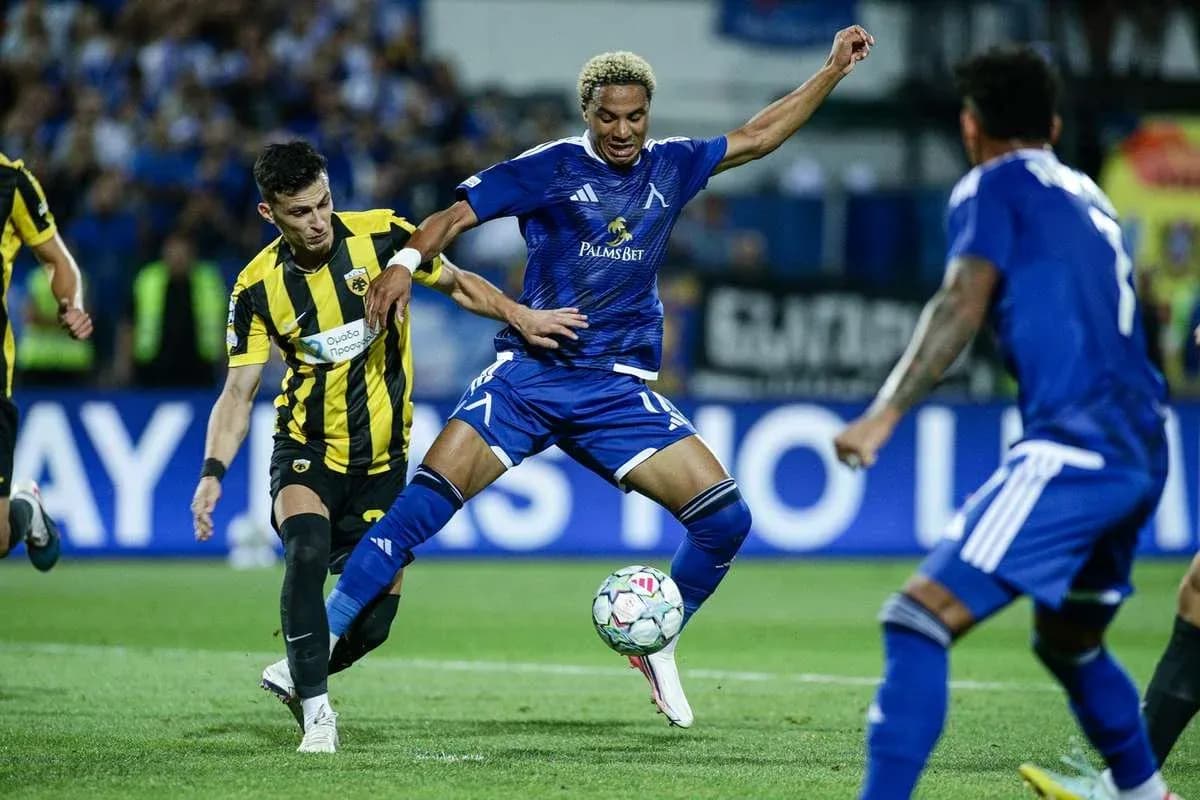
Levski Sofia and AEK Athens FC produced a goalless but tactically dense Champions League Play-offs first leg at Georgi Asparuhov Stadium, where structure and control clearly outweighed risk. The 0-0 scoreline reflected two well-organised teams more intent on preserving stability than opening up the tie, with Levski using a 4-2-3-1 to dominate phases of possession and AEK responding with a compact 4-4-2 geared towards defensive discipline and transition threats.
Levski’s 4-2-3-1, under Julio Velazquez, was built around controlled circulation and patient territory gain. Their 52% share of the ball, supported by 485 passes and an impressive 428 accurate (88%), shows a side comfortable progressing through structured build-up rather than forcing direct play. The double pivot of M. Moubarik and Maicon provided the platform: one dropping closer to the centre-backs to assist first phase, the other stepping into the half-spaces to connect with the three advanced midfielders. This allowed Levski to consistently access the middle and final third, reflected in their 15 total shots and a clear territorial edge.
The attacking band of A. Oko-Flex, Serginho and Everton Bala behind Reinaldo was tasked with rotating between the lines and pulling AEK’s midfield four out of shape. Levski’s shot profile underlines that they were able to create reasonable shooting opportunities but without clear, high-quality breakthroughs: 6 shots inside the box versus 9 from outside, with only 3 on target and 4 blocked. AEK’s back four, anchored by H. Moukoudi and F. Relvas, stayed narrow and compact, funnelling Levski’s attacks into congested central zones where blocks and crowding reduced the danger of those efforts.
AEK’s 4-4-2 under Marko Nikolic had a different logic: concede small possession margins (48%) but maintain structural integrity and look to break through the front two. With 453 passes and 394 accurate (87%), they were not a purely reactive side; instead, they alternated between low-to-mid block phases and more assertive pressing triggers, especially when Levski’s full-backs advanced simultaneously. Their attacking output — 12 total shots, 5 inside the box, but just 1 on target — reveals a team that reached dangerous zones but often shot under pressure or from suboptimal angles, again pointing to both sides’ solid defensive organisation.
The goalkeepers were protected well. S. Vutsov (Levski Sofia) faced very little direct threat, needing to make only 1 save across the 90 minutes, evidence of how effectively Levski’s back four plus double pivot controlled AEK’s final actions. On the other side, T. Strakosha (AEK Athens FC) was the busier of the two, registering 3 saves. That differential mirrors the flow: Levski were more proactive and spent longer in AEK’s half, but AEK’s defensive block forced most efforts into low-probability zones, allowing Strakosha to deal cleanly with what did reach him.
Substitutions in the second half subtly altered the tactical picture without breaking the deadlock. At 57', AEK freshened both midfield and attack: L. Majer (OUT) was replaced by P. Mantalos (IN), adding more playmaking craft and control in central areas, while L. Jovic (OUT) made way for B. Varga (IN), giving AEK a more mobile, depth-seeking forward to threaten behind Levski’s line. These changes signalled Nikolic’s intent to improve AEK’s ball retention and counter-attacking precision.
Levski’s response came on 67', with J. Perea (IN) replacing A. Oko-Flex (OUT). Perea offered more verticality and penalty-box presence from the second line, trying to convert Levski’s territorial advantage into more incisive final-third runs. The double change on 79' — M. Soula (IN) for Everton Bala (OUT) and A. Mitkov (IN) for Reinaldo (OUT) — reconfigured the front unit: fresh legs in wide and central zones, more direct running, and an attempt to sustain pressure against an AEK side increasingly content with the draw.
AEK’s own double substitution on 81' — M. Gacinovic (IN) for A. Koita (OUT) and O. Zubkov (IN) for Zini (OUT) — further emphasised technical security and transitional threat from wide areas. Gacinovic added ball-carrying and press resistance, while Zubkov brought pace and directness on the flank, aiming to exploit any late-game looseness in Levski’s structure.
Levski’s final defensive adjustments in the closing minutes — S. Hevertton (IN) for A. Neves (OUT) at 88' and S. Stoyanchov (IN) for Maicon (OUT) at 89' — hinted at a pragmatic shift: keep the clean sheet, maintain control of rest defence, and avoid conceding a late away goal that would heavily tilt the tie. With no cards shown and fouls relatively low on Levski’s side (8, versus AEK’s 17), the hosts managed to defend assertively without losing composure, while AEK’s higher foul count underlined the physical cost of repeatedly breaking Levski’s rhythm.
Statistically, the match paints a picture of marginal but clear Levski superiority in control and volume, set against AEK’s resilience and game management. Levski led in shots (15–12), shots on goal (3–1), blocked shots (4–2) and possession (52%–48%), and also in passing volume and accuracy. Yet AEK’s compact 4-4-2, aided by timely substitutions and disciplined defending, ensured that this superiority did not translate into clear chances or goals.
With expected goals and goals prevented data absent, the clearest read is structural rather than purely analytical: Levski’s 4-2-3-1 successfully imposed tempo and territory at Georgi Asparuhov Stadium, but AEK’s defensive organisation and slightly more direct attacking approach in 4-4-2 kept the tie finely balanced at 0-0 heading into the second leg.