Dinamo Zagreb and Viking Play to Tactical 2-2 Draw in UEFA Champions League
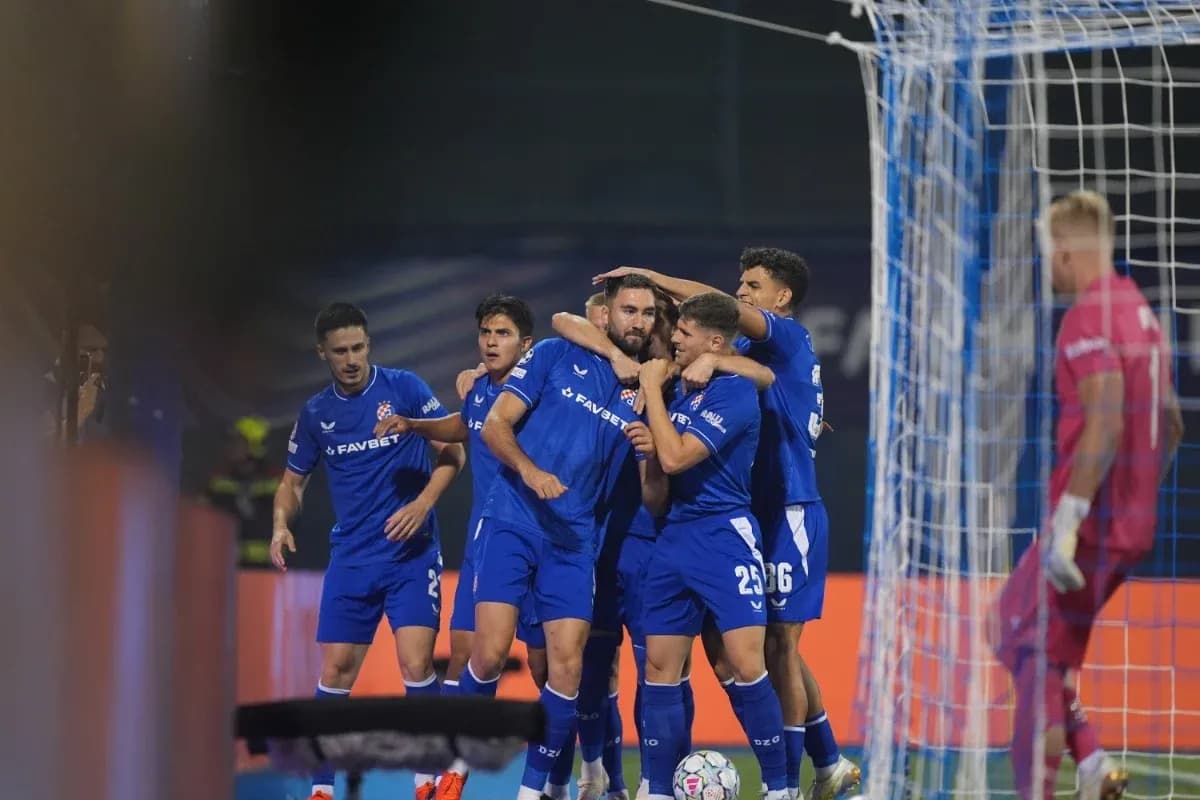
Dinamo Zagreb and Viking produced a tactically rich 2-2 draw at Stadion Maksimir in this UEFA Champions League Play-offs tie, a match defined by Dinamo’s territorial dominance and Viking’s ruthless efficiency in transition. Dinamo built a 2-0 lead inside ten minutes but were pegged back before half-time, and despite sustained second-half pressure, they could not turn control into a decisive advantage.
Team Formations
Dinamo lined up in a 4-1-4-1 under Mario Kovacevic, with J. Misic anchoring in front of the back four and a fluid band of four behind lone striker D. Beljo. Viking, coached by Bjarte Aarsheim, opted for a 4-3-3 that morphed into a compact 4-5-1 without the ball, relying on quick vertical attacks through P. Christiansen and Z. Tripic.
Statistical Profile
The statistical profile underlines Dinamo’s proactive approach: 60% possession, 544 passes with 438 accurate (81%), and a massive shot volume of 23 attempts, including 17 from inside the box and 7 blocked. Their structure in the 4-1-4-1 allowed sustained occupation of Viking’s half. Misic’s single-pivot role freed the advanced midfield line of M. Lisica, L. Stojkovic, M. Zajc and M. Orsic to rotate between half-spaces and wide channels, while full-backs M. Perez Vinlof and M. Valincic pushed high to pin Viking’s wingers.
The opening phase showed this plan at its best. Early, aggressive field positioning and counter-pressing created repeated entries into the box, leading to the 6' and 10' goals. With 9 corners to Viking’s 3 and only 1 offside, Dinamo’s attacking game was more about sustained positional pressure than risky runs in behind. The 12 fouls committed were the cost of repeatedly trying to win the ball back high and disrupt Viking’s transitions.
Viking’s 40% possession and just 6 total shots (5 inside the box) illustrate a reactive, efficiency-driven game plan. They accepted long spells without the ball, keeping their 4-3-3 narrow in midfield with J. Bell and K. Askildsen screening central zones and forcing Dinamo wide. When they did break, they attacked directly into the spaces behind Dinamo’s advanced full-backs. Both Viking goals, from Christiansen and Tripic, fit this pattern: quick, incisive use of the ball after regains, with T. Moi providing the final pass on both occasions before his withdrawal at 58'.
Goalkeeping Performance
In goal, I. Nevistic (Dinamo Zagreb) was statistically underemployed, making 1 save. That low number, against 3 Viking shots on goal, reflects how often Viking’s attacks ended in clear, decisive actions rather than speculative efforts, and how exposed Dinamo could be when their high defensive line was broken. At the other end, A. Ostbo (Viking) made 2 saves, but that figure sits behind a huge defensive workload: 7 blocked shots and a compact box defence that repeatedly got bodies in front of attempts rather than relying solely on the goalkeeper.
Discipline and Game Management
Discipline and game management also shaped the tactical story. Viking committed 10 fouls to Dinamo’s 12 and saw Joe Bell booked for “Foul” at 65', a reflection of his role in disrupting Dinamo’s central circulation. Dinamo’s yellow card went to Moris Valinčić, also for “Foul” at 83', a late-phase incident that underlined how their full-backs were often left to defend large spaces in transition as they chased a winner.
Substitution Patterns
The substitution patterns reinforced each coach’s intentions. For Viking, the 58' change of T. Moi (OUT) for S. Kvia-Egeskog (IN) slightly rebalanced the front line, prioritising fresh legs and defensive coverage over the creative risk that Moi represented after his two assists. The double change at 72'—H. Heggheim (OUT) for S. Bjorshol (IN) and K. Haugen (OUT) for H. J. Haugen (IN)—suggested a focus on shoring up the flanks and preserving the draw under growing pressure.
Dinamo’s changes were aimed squarely at adding creativity and attacking punch. At 60', M. Zajc (OUT) for L. Kacavenda (IN) injected a more vertical, line-breaking profile between the lines. The 68' double switch—L. Stojkovic (OUT) for R. Mudrazija (IN) and M. Lisica (OUT) for A. Hoxha (IN)—recalibrated the midfield, with fresh runners and a slightly more direct threat around Beljo. The 84' moves, M. Valincic (OUT) for N. Galesic (IN) and M. Orsic (OUT) for S. Prevljak (IN), showed Kovacevic’s willingness to risk defensive stability to add an extra penalty-box presence and aerial option.
Final Analysis
Statistically, Dinamo’s profile is that of a side that controlled territory and tempo but lacked the final layer of efficiency. Four shots on goal from 23 attempts is a low conversion of volume into clear chances, particularly given 17 efforts from inside the box. The 81% pass accuracy on 544 passes indicates a well-structured possession game, but Viking’s compactness forced many of those passes into low-risk zones, and their 7 blocked shots show how often Dinamo’s efforts were taken under pressure.
Viking’s 371 passes with 272 accurate (73%) and only 6 shots underline their pragmatic approach. They were selective in when to play, preferring to keep their shape and wait for moments to exploit Dinamo’s advanced full-backs and stretched rest defence. With only 0 blocked shots, they tended to shoot when the chance was already relatively clear.
In the context of a two-legged Play-offs tie, this 2-2 at Stadion Maksimir leaves the tactical battle finely poised. Dinamo Zagreb proved they can impose structure and volume; Viking showed they can survive long defensive spells and punish in transition. The second leg will hinge on whether Dinamo can turn their possession and shot dominance into higher-quality, on-target chances, and whether Viking can again be as clinical with far fewer attacking phases.