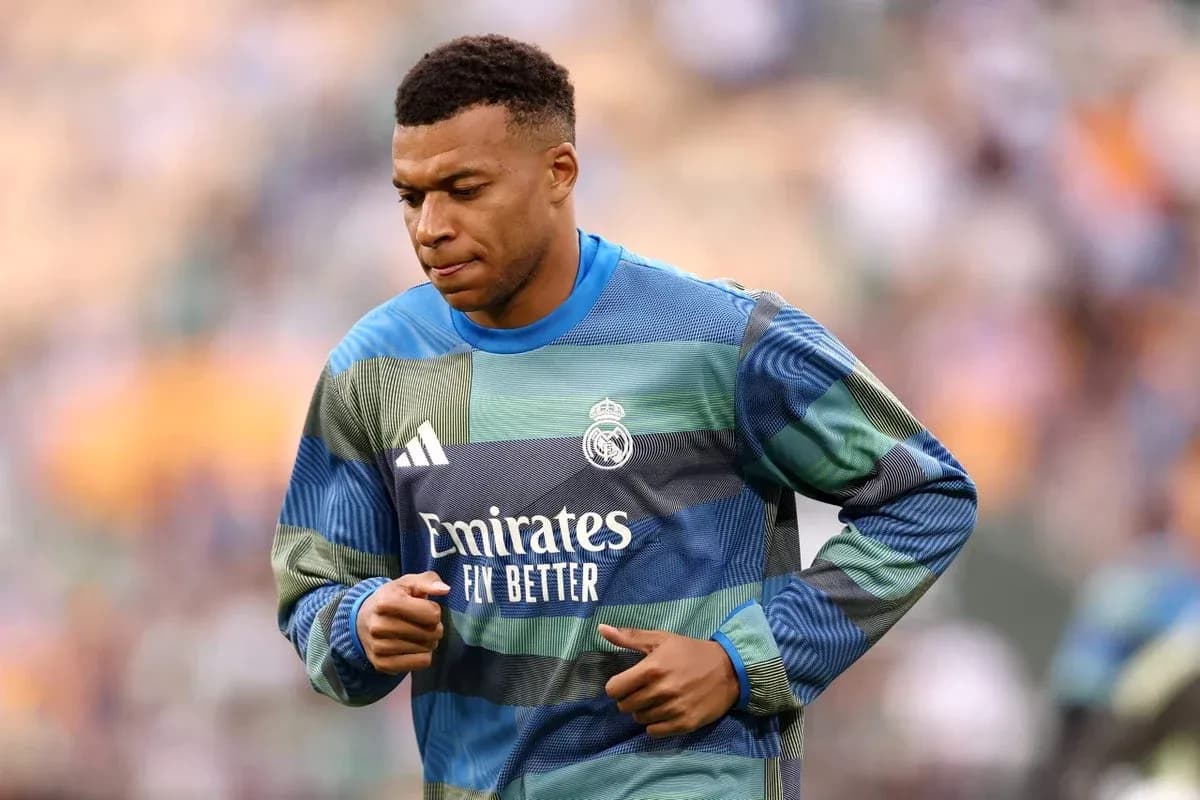
Kylian Mbappe at Real Madrid: Goals vs Team Dynamics
In the bowels of the Bernabeu, the words stare every player in the face before they climb the steps to the light.
“No player is as good as all of you together.”
Alfredo Di Stefano’s line was meant as a hymn to the collective. Right now, it reads like an accusation.
Real Madrid are drifting towards the end of a second straight season without a major trophy. The crowd has grown restless, the whistles sharper, the patience thinner. Vinicius Junior, Jude Bellingham, Kylian Mbappe — nobody has been spared. Even Florentino Perez, architect of the galactico era and the man who pursued Mbappe for years, has felt the anger.
A training-ground fight between Aurelien Tchouameni and Federico Valverde last week dragged the tension into public view. The atmosphere around the club feels heavy. And in the middle of it all, the debate keeps circling back to one man.
Kylian Mbappe
The signing that was supposed to cement Madrid’s dominance. The star who arrived on a free transfer in June 2024, with a huge signing fee and even bigger expectations.
Two years on, the question hangs in the air: has this journey been worth it?
The numbers say yes. The noise says no.
Strip everything back to goals and Mbappe’s record is brutal.
Since he pulled on the white shirt, no one has scored more for Madrid in La Liga and the Champions League. Seventy-seven goals. A Golden Boot in the 2024–25 league season. Fifteen goals in this year’s Champions League alone, a tally that leaves him within touching distance of Cristiano Ronaldo’s record of 17 from 2013–14.
In the quarter-final defeat to Bayern Munich last month, when Madrid fell short, Mbappe did not. Two goals across the tie, one of the few players who hit the level the club expects on European nights.
The data backs up the eye test. He has scored almost twice as many goals as any team-mate since joining. He absorbs most of Madrid’s attacking chances and still overperforms his expected goals by seven. He is not just finishing what falls his way; he is elevating it.
Yet at the Bernabeu, that has not been enough.
In the first home game after the Bayern exit, the boos rained down. Mbappe was singled out alongside others, a symbol of what some fans see as a broken project. The criticism has not stopped at the white line.
There was the row on the training pitch with a member of Carlo Ancelotti’s staff before the trip to Real Betis on April 24, an incident that, according to sources, deepened the bad mood around the place. There was the trip to Italy with his partner while he recovered from injury, a choice that annoyed people internally and fed into the narrative of a star detached from the grind.
His camp responded with a statement insisting that “a portion of the criticism is based on an over-interpretation of elements related to a recovery period strictly supervised by the club, and does not reflect the reality of Kylian’s commitment and daily work for the team.”
The words did little to cool the debate. Because at Madrid, numbers are never the whole story.
The case against: a superstar who bends the team out of shape
When Mbappe’s signing from Paris Saint-Germain edged towards completion two years ago, there were already warning signs inside Valdebebas.
A member of Ancelotti’s staff pointed to his off-the-ball metrics. The lack of defensive work was “remarkable”, they said. That wasn’t praise.
The concern back then was simple: how do you keep the team balanced when you add a player who does so little without the ball? It sounded pessimistic in the summer of 2024, when Madrid had just won La Liga and a 15th Champions League, with Bellingham and Vinicius Jr in full flight.
Now it looks like a fair prediction.
Across his La Liga and Champions League appearances, Mbappe has posted the fewest tackles, interceptions and ball recoveries per 90 minutes of any Madrid player. Not just low numbers — the lowest.
More telling is his ranking for “true” tackle attempts, the combined total of tackles won, tackles lost and fouls committed. It’s a simple measure: how often does a player even try to win the ball back?
In La Liga this season, among 461 outfield players, Mbappe sits 461st. Last. Around 0.6 attempts per game.
For a pure finisher in a certain type of team, that can be absorbed. For a side built around multiple attacking stars, it becomes a problem.
When Mbappe shares the pitch with Vinicius Jr, Bellingham and Rodrygo, Madrid tilt heavily towards the front. Someone has to do the ugly work. Too often, it is not him.
Then there is the positional riddle with Vinicius Jr.
Both are dominant from the left. Both like to receive wide, drive inside, own that channel. The touchmaps tell the story: Mbappe and Vinicius drift to the same zones, want the same spaces, make similar movements.
There have been flashes — quick combinations, devastating bursts — but nothing like the natural, almost telepathic connection Vinicius once had with Rodrygo. Instead, Madrid often look cramped on that flank, two superstars stepping on each other’s toes.
That raises uncomfortable questions. Who decided two left-sided, ball-hungry forwards could be a long-term solution? How much is the team sacrificing to feed one man’s goals?
The numbers on the scoreboard are not definitive in Mbappe’s favour either. Madrid scored 87 league goals in 2023–24, before he arrived, in a season when Bellingham floated as a false nine and Joselu came off the bench as a traditional target man. No clear attacking reference, yet more league goals than the 78 of last season or the 70 they have so far this campaign, with three games left.
Mbappe’s presence has not lifted the collective output. It has reshaped it. Everything flows to him. The cost is felt elsewhere.
And then there is the dressing room.
Mbappe was supposed to be a leader, the man for the hardest moments. His signing followed years of pursuit, several transfer windows in which Madrid waited, pushed, were rejected. When he finally arrived, Perez spoke of the “great effort” Mbappe had made to join.
Many fans still remember the “no” of 2022 more vividly than the “yes” of 2024. They see the highest-paid player in the squad, a star yet to deliver a Champions League in white, and wonder what effort has really been made on his side.
When the team stumbles, that resentment bubbles up fast.
The case for: Madrid have been here before
Strip away the emotion and Mbappe remains what he has always been: one of the best footballers on the planet.
He thrives when the stage is his. With France, he is the main character and plays like it. World Cup winner at 19 in 2018. A hat-trick in the 2022 final, joining Geoff Hurst in a club of two, and still ending up on the losing side to Lionel Messi’s Argentina.
When Xabi Alonso, during his spell in charge, pushed Mbappe ahead of Vinicius Jr in the hierarchy earlier this season, the Frenchman responded. Given the keys, he relaxed, dominated, looked like the player Madrid thought they were signing.
He is 27. He is under contract for three more years. There is time for the relationship to mature, for the team to be reshaped more clearly around him, for him to address the obvious weaknesses in his game — the defensive effort, the body language when things go against him.
Madrid have lost heavyweights in recent seasons: Karim Benzema, Toni Kroos, Luka Modric. Voices that carried authority in the dressing room and on the pitch. In that vacuum, Mbappe’s talent alone makes him a leader, whether he wants that label or not.
He has shown he can handle a microphone as well as a through ball. In interviews and mixed zones, he generally speaks with clarity. When Vinicius Jr accused Benfica winger Gianluca Prestianni of racist abuse in their Champions League play-off first leg in February, Mbappe stepped forward with an eloquent defence of his team-mate. Prestianni denied racism and was banned for six games by UEFA for homophobic conduct, not racial abuse, but the moment underlined Mbappe’s willingness to stand publicly with those around him.
And if Madrid need a template for how to live with a complicated superstar, they do not have to look far.
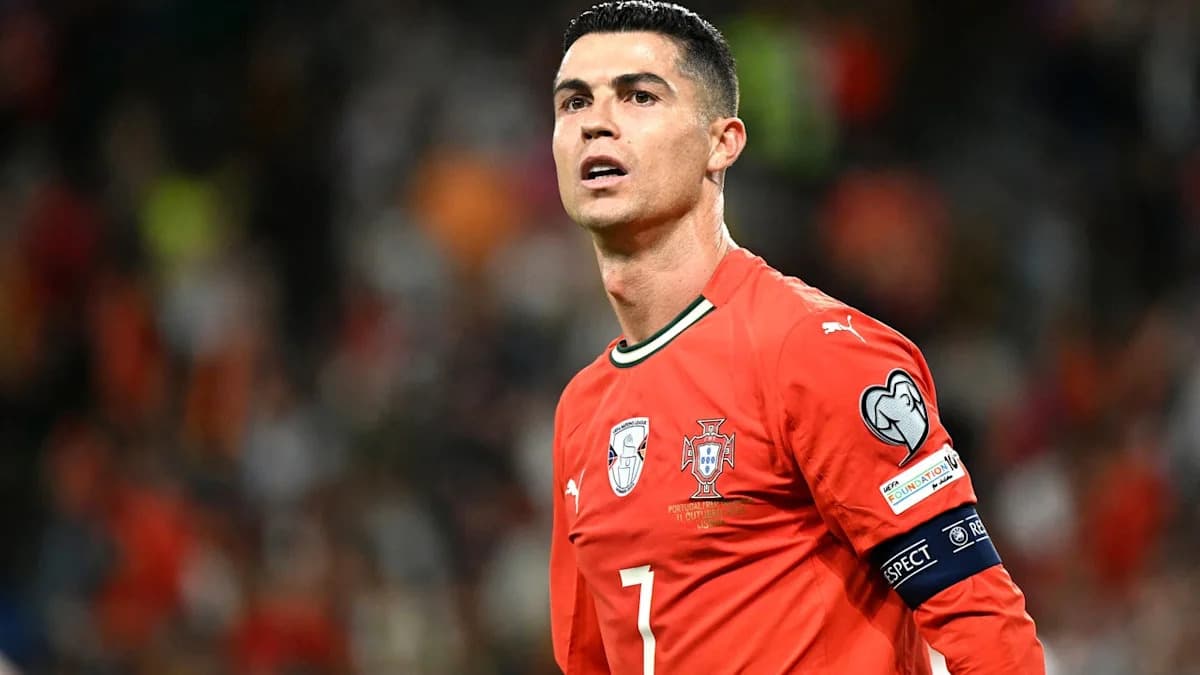
Cristiano Ronaldo arrived in 2009 as the most expensive footballer in history. In his first two seasons, Madrid won only a Copa del Rey. The Champions League drought dragged on. The relationship between player and club had its awkward moments.
In September 2012, after scoring twice against Granada, Ronaldo refused to celebrate and later said: “I’m sad and the people at the club know it.” The comment triggered days of speculation and criticism. The mood around him was far from universally adoring.
It took five years for Ronaldo to lift his first Champions League with Madrid, in Lisbon in 2014 against Atletico. By the time he left in 2018, he had four European Cups in white and the status of all-time top scorer.
The lesson is obvious. With forwards of that level, the wait can be worth it. The turbulence, the ego, the tactical compromises — all of it becomes a footnote if the trophies follow.
Somewhere between Di Stefano’s quote in the tunnel and the whistles on the terraces lies the reality of Mbappe’s time at Madrid so far: a superstar delivering goals, straining the system, and forcing the club to decide what kind of team it wants to be.
Do they bend everything around him, as they once did for Ronaldo? Or do they ask the player who has always been the protagonist to change for the collective?
The next move will define not just Mbappe’s legacy in Madrid, but the direction of the club’s next era.