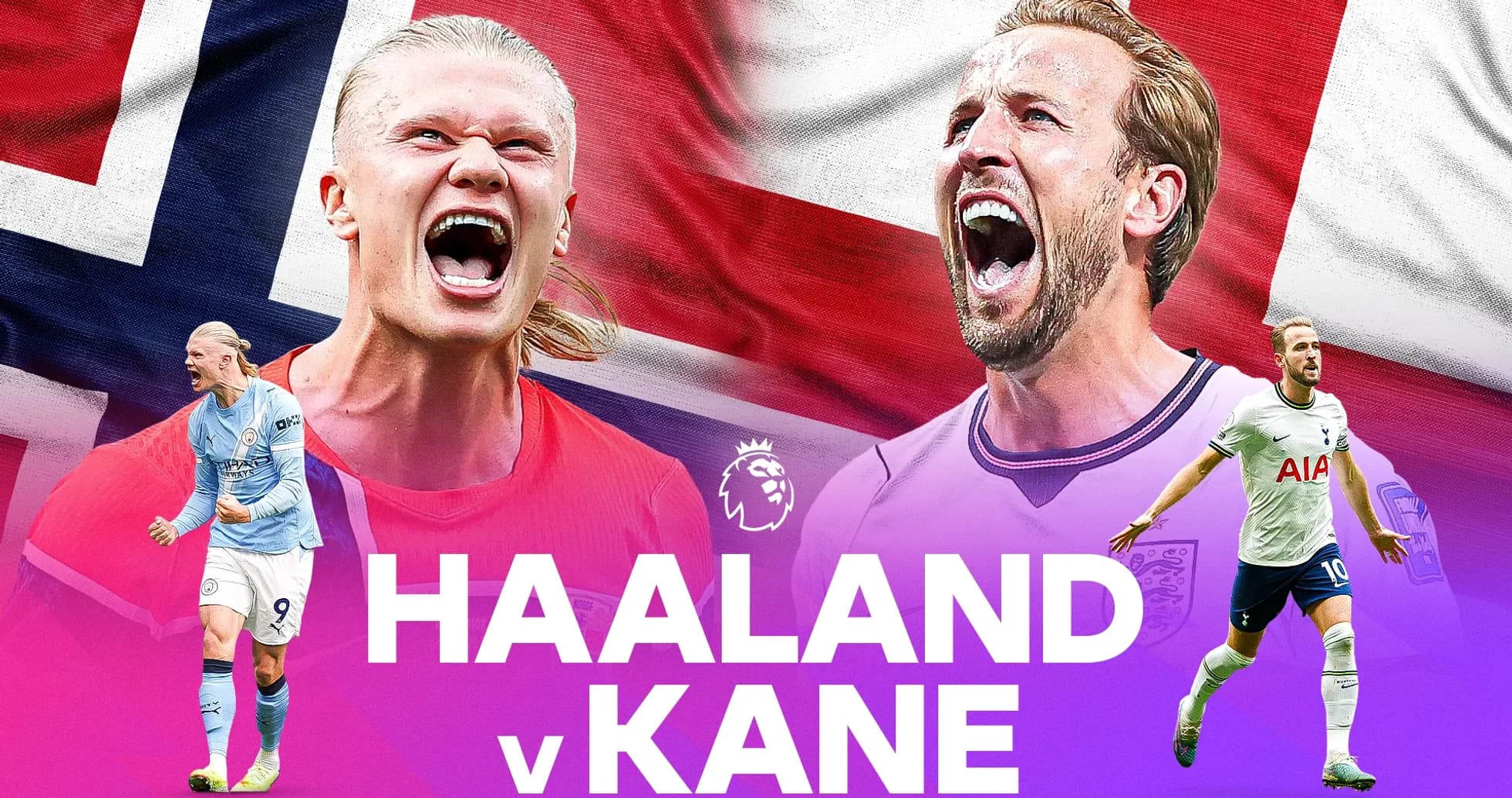
Harry Kane vs Erling Haaland: A Striker Showdown
Harry Kane and Erling Haaland are cut from the same cloth and yet nothing alike.
Two of the greatest strikers the Premier League has ever seen, both defined by goals, both the centre of gravity for club and country. But as No 9s, they live at opposite ends of the spectrum.
Haaland is the executioner. A ruthless, almost mechanical finisher, obsessed with numbers and silverware. He lurks on the shoulder, then explodes. Cold. Efficient. Brutal in the penalty area.
Kane is the conductor. Creator and finisher rolled into one. He wore the No 10 shirt at Tottenham Hotspur for a reason: he sees the whole pitch, not just the goalframe. He drops deep, threads passes, dictates tempo – and still scores in every conceivable way.
Their rivalry in England has mostly been parallel rather than direct. They shared just one Premier League season, 2022/23, before Kane left for Bayern Munich. Yet the argument over who is better has never really cooled. It flares again on Saturday, when Kane’s England face Haaland’s Norway in the 2026 FIFA World Cup quarter-final.
Before they meet in the desert, the numbers tell their own story.
Haaland’s insane rate, Kane’s towering total
Strip it back to the Premier League stats and both sit in rarefied air.
Haaland has 112 Premier League goals, already 25th on the all-time list. His goals-per-90 figure, 0.91, is the best the league has ever seen.
Kane, though, stands on a different peak: 213 Premier League goals, second only to Alan Shearer’s 260. His rate of 0.71 goals per 90 puts him fourth in history.
Kane is just 47 shy of Shearer. At his old Spurs rhythm of around 25 league goals a season, he would have needed roughly a season and a half more in England to stand alone at the top. He has almost double Haaland’s Premier League goals.
But he’s had the time. Nine seasons as a first-team regular at Spurs. Haaland has only four Premier League campaigns behind him.
Project Haaland’s current rate forward and the picture shifts. At 0.91 per 90, he needs 113 more league games – about four seasons at his usual 33 matches a year – to score the 102 goals required to pass Kane and move into second all-time.
He has eight years left on his current deal. He needs only half of that to overhaul Kane. After that, another 52 matches, at the same strike rate, would likely be enough to hunt down Shearer’s 47-goal lead.
Give it time and the Norwegian is on course to become the most prolific scorer the Premier League has ever seen. But that is tomorrow’s story. Right now, Kane’s body of work still casts the longer shadow.
Different paths, similar heights
Their journeys into English football could hardly have been more different.
Kane’s rise at Spurs was a slow ignition. He was 21 when he finally detonated under Mauricio Pochettino in 2014/15, after years of loans and doubt. Once he caught fire, he never really cooled.
Haaland arrived like a meteor. In his debut Premier League season, 2022/23, he smashed the single-season record with 36 goals. Nobody had seen anything like it.
That same year was Kane’s farewell to Spurs. He scored 30 league goals in a side that often looked broken. It was the second time he had hit 30 in a Premier League campaign.
Look at their best seasons and Kane’s consistency shows through. Haaland’s top-flight peak is that 36-goal avalanche in 22/23. Kane’s best years? Thirty goals in 22/23. Thirty in 17/18. Twenty-nine in 16/17. Between them, they fill the upper reaches of the scoring charts, but Kane appears more often in the single-season top five.
Haaland holds the eye-catching records: fastest to 100 Premier League goals, most goals in a single season, the best per-90 strike rate the league has ever seen.
Kane counters with longevity and loyalty: the most goals for a single Premier League club (213 for Spurs) and the most goals in London derbies (51). He has been the heartbeat of one club and one city in a way Haaland, the serial collector of titles, has not needed to be.
On individual awards, they are almost level, which only strengthens the Norwegian’s case given the age gap. Haaland, seven years younger, already owns five Golden Boots across the Premier League and Champions League, plus three Player of the Year awards (Premier League, Bundesliga, UEFA) and a European Golden Shoe.
Kane’s trophy cabinet is even more crowded with personal honours: nine Golden Boots (three in the Premier League, three in the Bundesliga, one in the Champions League, one at a World Cup, one at a Euros) and a Bundesliga Player of the Year, along with two European Golden Shoes. He has been the defining finisher of his generation across multiple competitions.
Team trophies? That’s where Haaland surges ahead.
He has three league titles – two Premier Leagues and one Austrian Bundesliga – and a Champions League crown. Add to that five domestic cups: two FA Cups, one EFL Cup, one DFB-Pokal and one Austrian Cup.
Kane’s club honours are slimmer by comparison: two Bundesliga titles and a single DFB-Pokal. His years at Spurs, spent outside the title-winning elite, add weight to his goal tallies but leave the medal count light.
Some will argue that makes his numbers even more extraordinary. Others will simply point to the trophy cabinet and shrug. Both views have merit.
Kane’s Bayern storm, Haaland’s Norway avalanche
If you want to know what Kane might have done in a title-winning machine, look at his Bundesliga record.
Ninety-eight goals in 94 league matches for Bayern Munich. Those are Messi and Ronaldo numbers, the kind of absurd output that makes you wonder how many he would have scored had he spent his prime in a Pep Guardiola side.
Haaland, though, has his own trump card away from club football: his international record.
For Norway, a team that rarely sits at the top table, he has 62 goals in 54 caps. He scores at 1.26 goals per 90 minutes for his country and has found the net in each of his last 14 internationals. In a non-elite national side, that is astonishing.
Kane’s England record is superb in its own right: 85 goals in 119 caps, at 0.83 per 90. He is England’s all-time leading scorer and the focal point of a side that routinely goes deep into tournaments. But Haaland’s ratio is on another plane.
So where does that leave the argument?
Balanced on a knife edge. Kane leads many metrics because he has simply played more football at the top level. Haaland leads in strike rates and trophies because he has spent his formative years in super-teams designed to win everything.
As of July 2026, though, one detail tilts the scales.
In 2025/26, Kane scored more goals in all competitions for his club than anyone else in Europe. Sixty-one in total. Kylian Mbappe finished with 42. Haaland with 38.
At 32, Kane is not winding down. He is setting the pace.
Right now, on form and on output, he is the best striker in the world.
On Saturday, under World Cup lights, Haaland gets his chance to argue back – not with words or numbers, but with the only currency that really matters to either of them: goals.