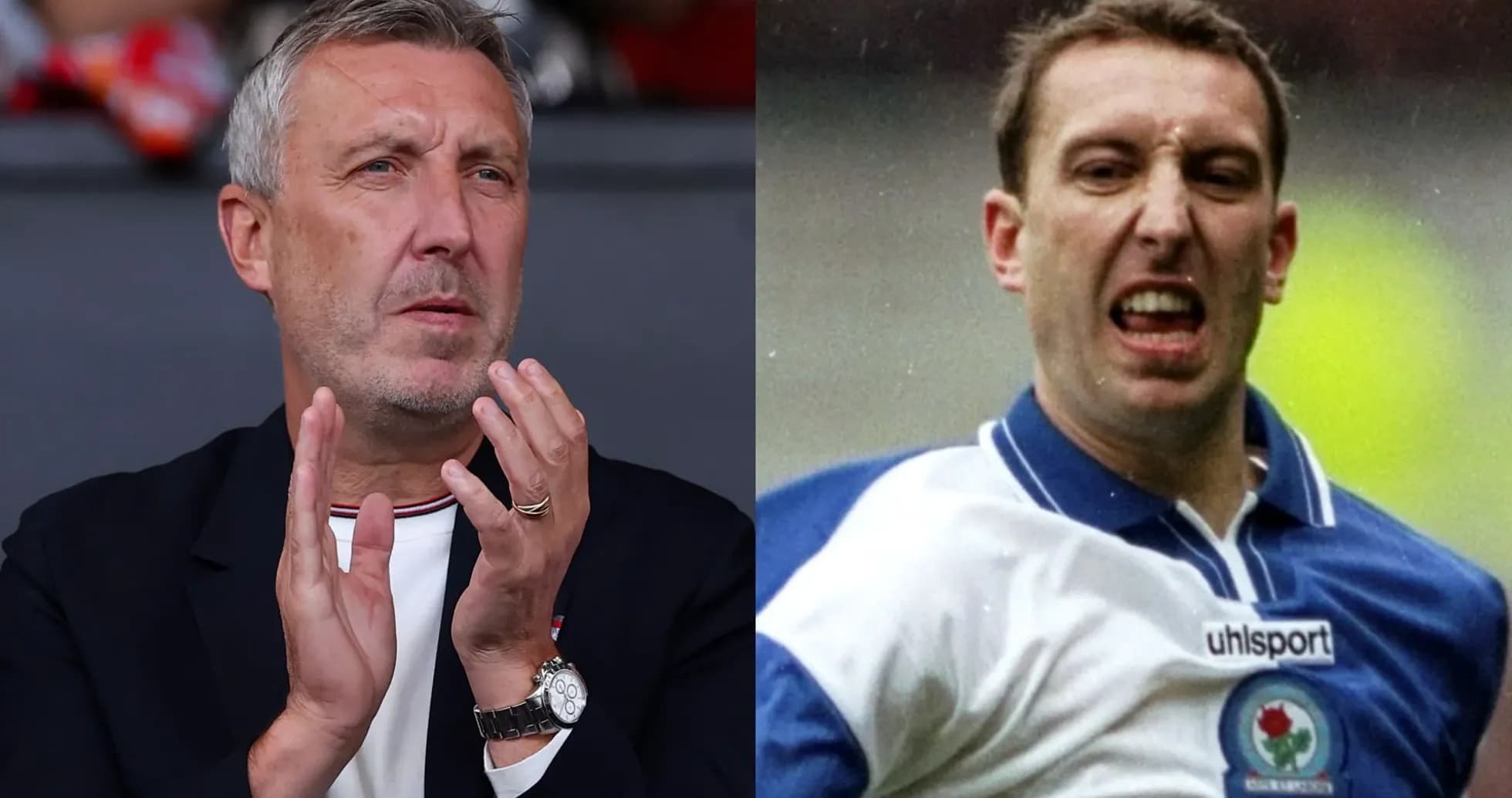
Jason Wilcox: From Blackburn Star to Manchester United Director
Jason Wilcox spent a decade hugging the touchline at Blackburn, supplying bullets for one of English football’s most ruthless strike partnerships. Now, at 55, he’s in a very different role – pulling strings behind the scenes at Manchester United, where every decision is dissected and replayed like a dubious offside.
From winger to power-broker. It’s been quite a journey.
From title winner to boardroom influence
Bolton-born Wilcox came through Blackburn’s youth ranks and grew into a mainstay of the Rovers side that stunned the Premier League in 1994-95. More than 270 senior appearances, a league title, and three England caps tell one story. Colin Hendry fills in the rest.
“Jason was good. Jason was very effective as a winger,” the former Blackburn defender told GOAL, speaking in association with IvyBet. With Wilcox on the left, Stuart Ripley on the right and Alan Shearer and Chris Sutton devouring chances in the middle, Blackburn’s attacking pattern was brutally simple and almost impossible to stop.
“That’s why these lads more or less won Blackburn the Premiership,” Hendry said. “But it was supply as well.” Wilcox wasn’t the headline act, but he was part of the machinery that made Kenny Dalglish’s side champions.
After that peak came a more nomadic spell. Wilcox moved on to Leeds, Leicester and Blackpool before calling time on his playing career in 2006. He stepped away from football altogether, built a private business and, for a while, drifted out of the game’s daily grind.
Then he came back. And he came back with purpose.
Building a new career at City and beyond
In 2012, Wilcox returned to the sport at Manchester City’s academy, a familiar environment for a former wide man who had always seen the game a step ahead. He climbed quickly, eventually becoming a director at the club and helping to shape one of the most productive youth systems in Europe.
Hendry admits he never imagined that path for his old team-mate.
“Jason's position, I would have never thought, to be fair, that may have happened,” he said. “But then he did do well after his career. He did a business and then he was at Man City academy, grew at the Man City Academy to the head of the Academy, got headhunted off to Southampton and from Southampton all the way along, he's been doing really well.”
Southampton came calling in January 2023, luring Wilcox to St Mary’s as his reputation as a director of football grew. His work on the south coast only enhanced that standing.
By April 2024, Manchester United moved to bring him in as technical director. Now he has stepped into the full director of football role at Old Trafford, right in the centre of the storm, with a major say in recruitment on the pitch and in the dugout. The appointment of Michael Carrick to replace Ruben Amorim as manager is one such call that lands firmly on his desk.
It is a job that demands conviction. And a thick skin.
A sharp football brain – and a sharper tongue
Hendry is adamant that Wilcox has the intelligence and personality to survive the glare.
“He's obviously a very clever character. He was a clever footballer,” he said. That football brain, Hendry believes, has translated into Wilcox’s off-field success, even if he has taken a different route from many ex-pros.
“Sometimes good, great footballers don't make great coaches and great managers. But then Jason's gone down a different path,” Hendry explained. Coaching at youth level, then climbing into leadership roles, has suited Wilcox’s skill set.
He is not just a strategist, though. In the Blackburn dressing room, he was also the resident comic.
“He's a funny guy though. Jason was very sharp, very quick witted,” Hendry recalled. Wilcox used to mimic Ray Harford and Kenny Dalglish, with Hendry remembering “a couple of good takes on the Gaffer and Ray, God rest his soul. And even Tony Parkes as well, God rest his soul. Jason was a comedian, if I'm being honest.”
The humour and the edge that once lit up a dressing room now sit inside a boardroom where the margins are just as fine, but the stakes are different.
The modern power game: recruitment and control
At United, Wilcox’s remit is clear: help dictate transfer business and shape the squad. It is the kind of role that has drawn criticism for years, especially when managers feel squeezed by decisions made above their heads.
Hendry recognises how much the landscape has changed.
“The game's moved on. So the recruitment, that's a job in itself,” he said. Clubs now pore over data, personality profiles and background checks long before a player signs. Nothing is left to chance.
“To a layman, you're thinking of all these different things, criteria that players have got, and they go into everything these days at the top level,” Hendry continued. “They go into everything - they go on about their social aspects, their upbringing, they go so far back into things. And I do understand, but I don't know how much of that really affects that individual as a footballer.”
For all the science and structure, Hendry still believes one principle should never be lost.
“I do think that the manager, the coach, the man, the guy that's picking the team on the Saturday to play that game should have an input into who they have in the squad,” he said. Reality, of course, is more complicated. Budgets, wage structures and long-term planning all feed into every deal.
“And what I mean by funding is what the budget is they've got to spend, the wages, and everything else, all that's going to be taken into consideration because the club's got to be run properly,” Hendry added. “I understand that as well as, but I do think the main man should have a bit of an influence as to what he's looking to bring into his squad.”
That balance – between the director of football’s long-term vision and the manager’s immediate needs – will define Wilcox’s time at Old Trafford. He once supplied crosses for Shearer and Sutton; now he supplies players and managers for one of the world’s most scrutinised clubs.
If he gets it right, Manchester United’s next great side might owe as much to the quiet work of a former winger as to the stars on the pitch.