Inter Miami's Messi Era: A One-Man Show with No Successor
On nights like this, the illusion falls away.
Inter Miami had the ball in Nashville. They passed it, recycled it, stroked it around. And lost 4-1.
They were ripped apart in transition, their midfield carved open like it wasn’t there. Hany Mukhtar, one of MLS’ most ruthless playmakers, treated them as target practice. He scored twice, gliding into spaces that should never have been available at this level. Sam Surridge added another. Andy Najar, a right back in name only on this evidence, stormed forward to join the fun and finished as Miami’s defensive shape disintegrated.
In the middle, Eddi Tagseth and Matthew Corcoran didn’t just win the battle. They ran Miami into the ground. It was embarrassing. It was also familiar.
Because there is a simple, brutal formula to exposing this team: mute Lionel Messi as much as you can, and everything else collapses.
A fragile core behind the superstar
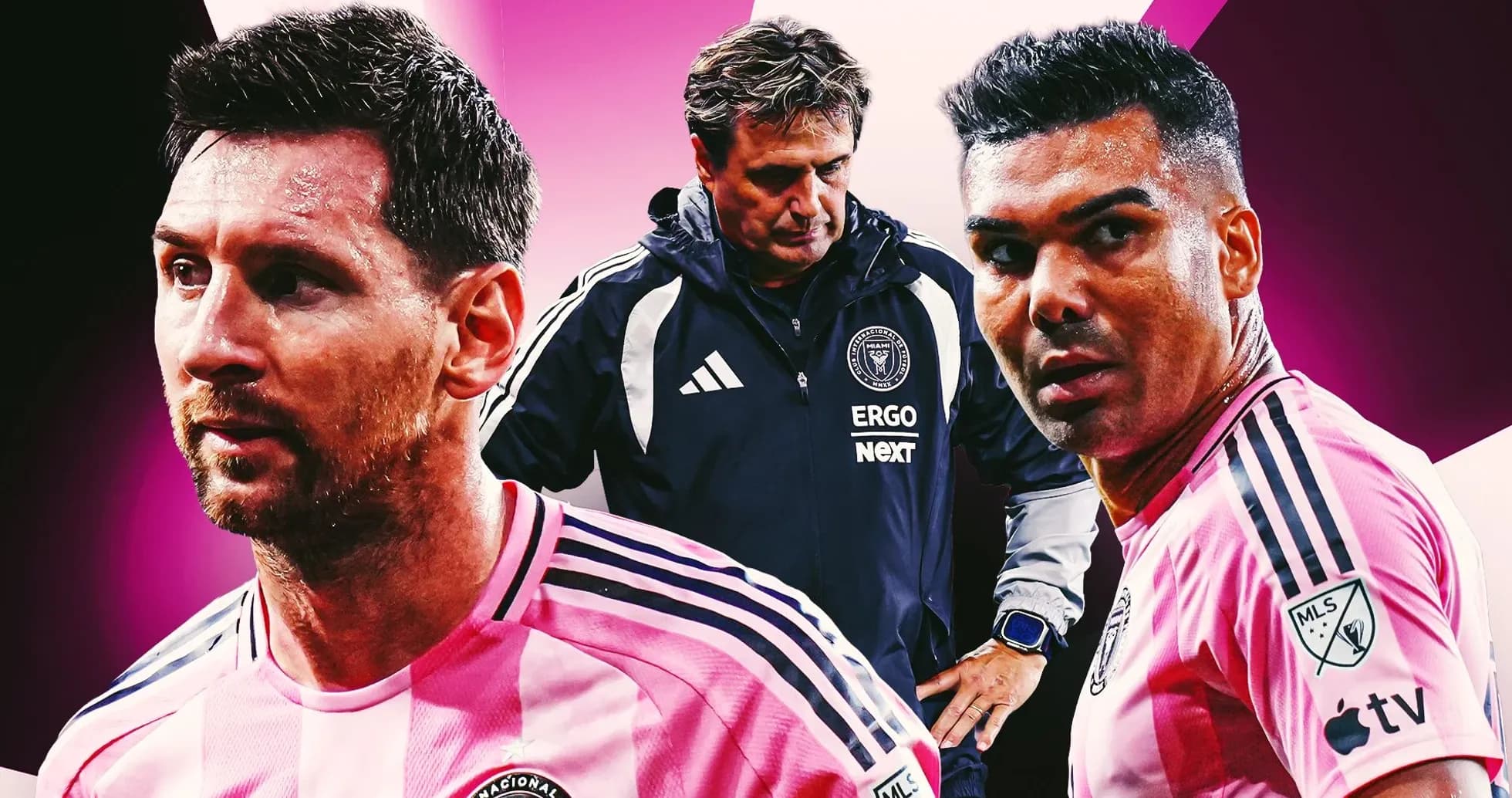
Messi doesn’t defend. At 39, Luis Suárez can’t really press, no matter how much he wants to. Rodrigo De Paul covers every blade of grass on the right, but Casemiro, the marquee post-World Cup signing, looks like he’s wading through mud in central areas. The drop from Jordi Alba to Sergio Reguilón, who hasn’t played regular soccer since 2022, is exactly as jarring as it sounds.
There is no clever tactical tweak that fixes all of that. No magic shape that turns slow legs into quick ones or tightens gaps that are physically impossible to close. Strip away Messi and this is, at best, an average playoff team with obvious structural flaws.
That should be solvable. On paper, anyway.
Even under MLS’ restrictive salary rules, Miami have shown a willingness to stretch, bend and contort the cap in ways that infuriate rival fanbases. They have pulled off big-name signings when logic suggested they shouldn’t be able to. Creativity off the field hasn’t been the problem.
Squad-building missteps
This roster screams for energy up front and dynamism in central midfield. Those players are hard to find. Elite No.8s don’t just drop into MLS, and they rarely arrive in their prime.
But it’s not hard to imagine a world where N’Golo Kanté is in this team instead of Casemiro. Or a world where the club didn’t drop around $15 million on Germán Berterame, a forward who doesn’t dominate in any one area.
Benjamin Cremaschi is another sliding-door moment. The homegrown midfielder openly admitted in an interview that he felt misused under Javier Mascherano. A different pathway, more care, and Miami might have had exactly what they now lack: a young, energetic central midfielder to build around.
Those are front-office decisions. Yet they all orbit the same gravitational force.
A club built to please one man
Messi is not just the star. He is the project.
This has been true from the start. In 2023, Sergio Busquets and Jordi Alba arrived in large part to help lure Messi to South Florida. De Paul has openly said that the chance to play alongside Messi and stay sharp for the World Cup, with the pair reportedly putting in extra training sessions together before the tournament, drove his exit from Atlético Madrid.
Even Casemiro, a long-time rival from the Real Madrid–Barcelona wars, framed his move in Messi-centric terms.
“For me, without a doubt, I am coming only to play with the best player of all time,” he told reporters at his unveiling. “I want to enjoy, I want to help him to keep winning because he is a winner. Another player is joining who wants to win, who wants to compete.”
Whether Messi is personally making the calls or simply blessing them is almost beside the point. The roster is clearly built to keep him happy. Not to outlast him.
And that is where Miami’s real problem lies.
A league about to change, a club that might not
MLS is on the verge of a structural shift. From the 2027-28 season, the league will move to a fall-spring calendar, aligning more closely with Europe and opening a different kind of transfer window. Owners have already heard proposals about loosening salary rules and allowing greater spending.
This is the moment ambitious clubs can step up, act like serious operators, and build squads that can compete beyond the novelty factor.
Miami should be at the front of that line. Messi’s contract runs through the end of the 2028 season. He is tied to next year’s “sprint season” and the first full fall-spring campaign. On paper, they have time: an abbreviated season, one full year, and what’s left of this one with the greatest player of all time.
But the contract is one thing. Reality is another. If Messi walks at the end of this year, the picture turns bleak very quickly.
They would be left with expensive Designated Players on big money, locked in for the long haul, and not obviously suited to carrying a post-Messi team. De Paul is under contract as a DP through 2029. So is Berterame. Casemiro does not occupy a DP slot at the moment, but Miami have already shown with De Paul that they can start a player on smaller money and then bump him into DP territory later.
That scenario — aging, high-earning stars without the central figure that justified their presence — is the nightmare.
The dream successor who may never come
What Miami need next isn’t just another star. They need a face of the franchise. A player who can anchor the sporting project and the commercial machine.
Julián Álvarez is the fantasy that keeps coming up. He’s young enough. Good enough. Marketable enough. His work rate fits the league, his Argentine roots keep the emotional connection alive. He’s the one name that actually looks like a succession plan rather than a stopgap.
But that plan runs straight into hard numbers.
Atlético Madrid paid an initial €75 million, with another €20m in potential add-ons, to sign him from Manchester City in 2024. This summer, they reportedly turned down a €150m offer from Real Madrid. For Miami to get him, they would need to put together a transfer package that obliterates normal MLS spending patterns — and that’s before even talking about his salary.
So the one player who makes real sense as Messi’s heir is also the least realistic.
If Álvarez is out of reach, the next logical path is obvious: go American.
The U.S. options — and their limits
Christian Pulisic and Weston McKennie are the only American stars who truly fit the bill. Pulisic is the most recognizable active U.S. player on the planet. McKennie brings quality, charisma and a personality that would land well in the American market.
Both could help define the next version of Inter Miami. Neither could replace what Messi is.
They don’t bring the same global box-office draw. They don’t command the same gravitational pull with sponsors, tourists, broadcasters. They would be important pieces, but not the pillar around which you build a global brand.
And that’s the crux of it: Miami aren’t just tied to Messi as a footballer. They are tied to him as a business model.
Messi as the business plan
Messi’s presence drives everything. Sponsorship deals. Ticket prices. The international buzz that turned a once-ordinary MLS club into a global talking point.
A stand at Nu Stadium carries his name. His compensation reportedly includes ownership shares. This is not a standard DP arrangement. It is a partnership, and it underpins the entire project.
Miami have yet to show what the club looks like when that partnership ends.
The warning from the past
The history is not flattering.
Before Messi arrived, Miami were one of the league’s worst teams. They had already tried the star route with Blaise Matuidi and Gonzalo Higuaín. Neither moved the needle in the way Messi has, on or off the pitch. The club sat in the bottom third of MLS in attendance.
By July 2023, when Messi finally walked through the door, Miami were effectively out of the playoff race. They had never lifted a trophy. Phil Neville had been sacked. The roster was riddled with holes. The project looked aimless.
Messi changed all of that in an instant. But the danger is obvious: when he goes, they could slip straight back into that same pattern — only this time with more money tied up and fewer escape routes.
The transition is coming. Whether Miami like it or not.
The looming question
Right now, the club’s sporting and commercial identity is welded to one man, who ultimately decides when his time in South Florida ends. That leaves Miami with very little control over the timeline and even less clarity over what follows.
Could Messi summon one last Herculean run and drag this flawed team to another trophy? Of course. He has done it before, almost by force of will. But nights like the Nashville defeat, with Miami outplayed and outworked, suggest that asking him to cover all these cracks again is a monumental demand.
So the image lingers: Messi walking down the tunnel after another frustrating result, the crowd still buzzing just because he was there.
The real question for Inter Miami isn’t how many more times he’ll make that walk.
It’s what, and who, will be left when he makes it for the last time.