Ibrahim Mbaye: Youngest African Scorer at FIFA World Cup
There is a version of 16 June 2026 that disappears into the dustbin of World Cup history.
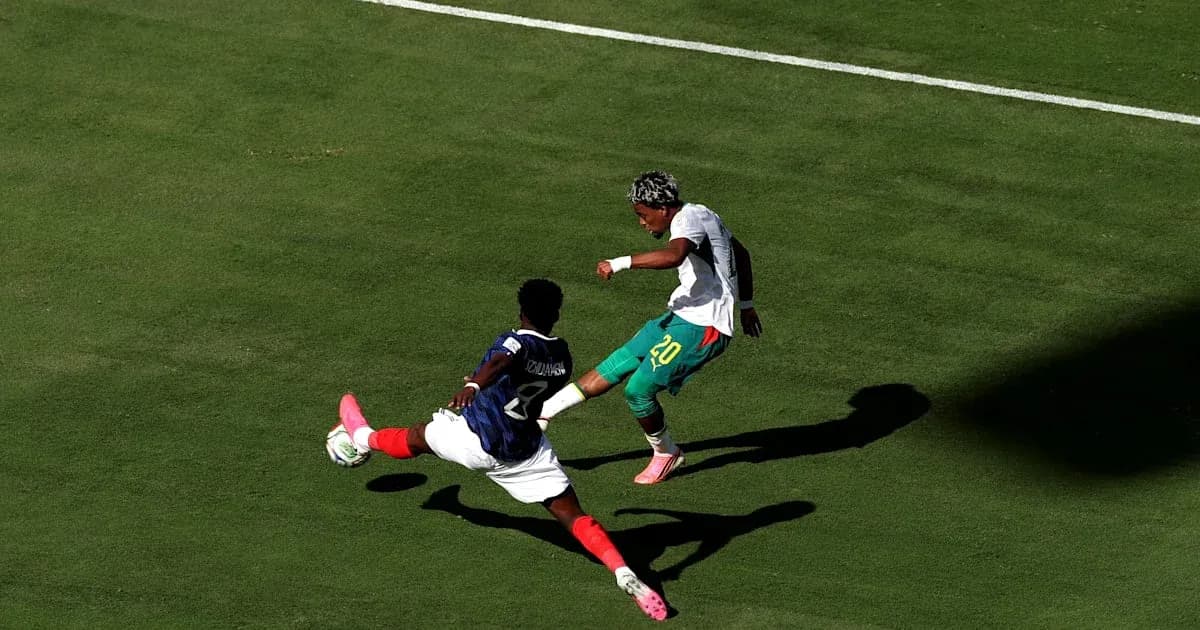
France 3, Senegal 0, MetLife Stadium drifting towards full-time, the stands thinning as neutrals head for the exits. On comes a teenager, a footnote in a game that looks done. Ibrahim Mbaye is supposed to make up the numbers.
He refuses.
Wide on the right, he takes the ball, squares up Théo Hernandez, sells him with a feint and a roll, then lashes a shot past Mike Maignan. Ninety-fifth minute. France 3, Senegal 1. The contest is over, but the moment is not. The scoreboard says consolation; the record books call it something else entirely.
At 18 years and 143 days, Mbaye becomes the youngest African ever to score at a FIFA World Cup, nudging aside Moussa Wagué’s mark from 2018. Pull the camera back and the list of younger scorers is tiny and terrifying: Pelé, Manuel Rosas, Gavi, Lamine Yamal. That’s the company he’s keeping now.
C’est du sérieux. And for Mbaye, serious business started long before MetLife learned his name.
Books, then Ballon d’Or
Rewind ten months. Paris Saint-Germain are heading to Marseille for a Ligue 1 game. The squad boards the plane. One of their brightest prospects is missing.
Mbaye is not injured. He is not dropped. He is sitting his baccalauréat, the exam that decides whether France considers you properly educated. While his team-mates settle into hotel rooms and pre-match routines, he is solving equations.
PSG arrange a separate trip. He finishes the exam, travels down, and joins the squad in time for an 8pm kick-off. No fuss, no drama. Just a teenager juggling calculus and the cauldron of the Vélodrome on the same day.
For most players, that story would define a career. For Mbaye, it barely registers. It was just Tuesday.
At PSG’s academy, this is not treated as a charming quirk. It is policy. The same production line that has delivered Warren Zaïre-Emery and Senny Mayulu to the first team drills its youngsters in classrooms as hard as on the training pitch. Academy director Yohan Cabaye cites a 95 per cent baccalauréat pass rate among their players and insists the habits of the desk and the habits of the ball are inseparable.
In Mbaye, that philosophy has its poster boy. The nutmeg on Hernandez and the finish past Maignan are not a flash of street football improvisation. They are a problem solved in real time, a calculation executed at full speed. He treats an exam hall and a 95th-minute World Cup chance with the same, unnerving calm.
The boy from Trappes who turned his back on Les Bleus
Mbaye’s story begins in Trappes, a Paris suburb that knows how to produce footballers. Nicolas Anelka came from here. So did a generation of talent that fed French youth teams. Mbaye’s father is Senegalese, his mother Moroccan, and his entire football education ran through France’s age groups.
He was good enough that France barely contemplated losing him.
Then, in November 2025, he chose Senegal.
There was no tug-of-war, no public row, no ultimatum. The decision was his, and he owned it. After lifting the Africa Cup of Nations trophy in January, he told Senegalese broadcaster RTS: “I will never regret choosing to play for Senegal because it was a decision from the heart.” Months later, asked again, he doubled down: “If only you knew… it’s the best decision I’ve ever made in my life. The Senegalese have such huge hearts; it’s incredible.”
That is why the goal against France carried a weight beyond the scoreline. A boy raised in the Paris suburbs, sculpted in France’s most prestigious academy, scoring his first World Cup goal against the country that shaped him — while wearing the green of Senegal.
Quelle histoire. If you pitched it to a film producer, they might tell you to tone it down.
A career on fast-forward
Strip away the romance and Mbaye’s rise is ruthless in its efficiency.
He makes his Ligue 1 debut at 16 years, 6 months and 23 days, becoming PSG’s youngest-ever league starter, taking a record off Zaïre-Emery. He signs his first professional contract in February 2025, scores his first senior goal within weeks, and by August is the youngest Frenchman to appear in a UEFA Super Cup, overtaking a mark Ryan Giggs set back in 1987.
In May 2026, he steps up again: stoppage time away at Lens, the title race still alive, and he delivers the goal that seals PSG’s 14th Ligue 1 crown. No time, no space, no margin for error. He finds a way.
For Senegal, the timeline is just as compressed. Senior debut against Brazil in November 2025. A goal three days later in only his second cap. Then the Africa Cup of Nations: the youngest player ever to feature at the tournament in December, and by January, the youngest AFCON goalscorer in Senegal’s history, as the team celebrates lifting the trophy before CAF’s later ruling to award the victory to Morocco. The medal’s story became complicated; his emergence did not.
Four goals in twelve caps before his nineteenth birthday. The comparisons with Kylian Mbappé do not feel lazy. They feel inevitable.
Coaches talk first about his brain. His decision-making. When to carry, when to release, when to slow a move down and when to rip through it. He does not hog the ball to make a point. He does not need twenty touches to leave a mark.
He often needs one.
“Mbaye is world class, and he is ours, he did not choose France – he chose Gaindeyi,” Senegalese journalist Wahany Johnson Sambou told Olympics.com in January, invoking the Wolof name for the national team. “He’ll do great things, just watch.”
Dakar, then LA: the Olympic path
Senegal’s Olympic football story is still in its opening chapters. One appearance in the men’s tournament, at London 2012, was enough to launch Sadio Mané, Idrissa Gueye and Cheikhou Kouyaté towards the European spotlight. They have not been back since.
That could be about to change.
This October, Dakar hosts the Youth Olympic Games. The eyes of the sporting world will land on Senegalese soil, on its stadiums, its academies, its next wave. There is a feeling, faint but growing, that this is the moment Senegal steps fully into the Olympic football conversation.
Mbaye sits right at the heart of that possibility. Born in January 2008, he will be 20 when the men’s Under-23 tournament kicks off at LA 2028, an age that has previously belonged to Lionel Messi, Neymar and Mohamed Salah on this stage. Olympics.com has already highlighted him as one of Africa’s brightest prospects for those Games. The tag fits.
What makes the idea of Mbaye in LA so compelling is not the medals he has already stacked up or the records he has already stolen. It is the temperament behind them. The same cool that got him through a baccalauréat exam on a matchday afternoon. The same clarity that allowed him to walk into a World Cup opener, down 3-0 to the reigning world champions, and still find the angle, the nutmeg, the finish.
For now, he keeps moving the way he always has: quietly, calmly, a step ahead of the schedule everyone else drew up for him.
The world can either catch up, or watch him disappear into the distance.