Gianni Infantino Faces Legal Threats Over World Cup Deal
“Tell Mike it was just business. I always liked him.”
In The Godfather, that line lands like a hammer because it strips away the last illusion: no one is untouchable. This week, for the first time, that same chill has settled over Gianni Infantino.
The Fifa president has been under siege for almost six weeks, accused of driving a covert plan to flog football’s greatest shared asset – the World Cup – at a price Uefa calls criminally low, with the added sting that he stood to collect a vast personal salary from the deal. The story has been told and retold: the man hired to guard the game instead hawking it around the corridors of political power.
For a while, it felt like noise. Angry columns. Furious fans. The odd rebuke from former players – right down to Mikaël Silvestre, once a reliable utility man at Manchester United, now issuing solemn denunciations. Irritating, yes. Fatal, no. Power this entrenched tends not to fall to gnats around the ankles.
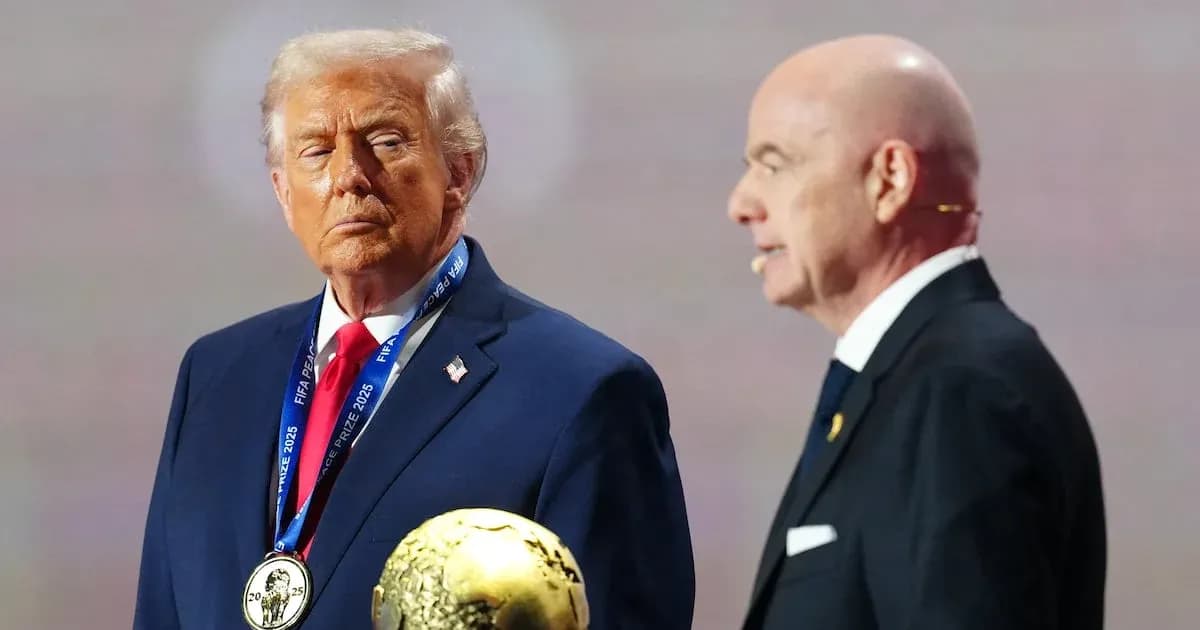
Infantino has already sold the world once. Twice, if you count the spectacle of him sidling up to Donald Trump, trading access and prestige for a peace prize, a trinket, and a seat at the kids’ table of global politics. And yet, you could always imagine the reset: the staged performance at a lectern, the Football Jesus routine. Arms windmilling, voice soft, words thick with talk of solidarity, equality, growth, opportunity. The painted-on eyes staring out from behind the papier-mache mask of authority. You don’t buy me out. I buy you out.
This week, something different crept in. Something harder.
The lawsuit that really bites
The shift comes from a place Infantino cannot charm, lecture or outspin: discovery.
Uefa’s lawsuit in the US – one that may not even be designed to win in the conventional sense – has forced open a door that Fifa and its allies desperately want to keep shut. The case centres on an alleged undervaluation of World Cup rights, and on Uefa’s charge of “criminal mismanagement” against Fifa and its president. But the real weapon is procedural: the right to see the paperwork.
Discovery means documents. Internal memos. Contracts. Texts fired off from a golf cart after lunch. Emails between Fifa, Thrive Capital and Trump ally Greg Maffei, who advised on the deal. All of it dragged into the light.
Nobody in Infantino’s orbit wants that.
You can see the panic in the responses. Fifa’s counterfiling dismisses the whole affair as a “smear campaign” – then promptly underlines its fear of discovery, spelling out its urgent intention to resist that very process. The quiet part, said out loud.
And then there is Josh Kushner.
Kushner steps back, and lawyering up begins
Kushner, the venture capitalist whose firm Thrive Capital was the money engine behind the Fifa Forward plan, has now been named in discovery in Florida. His involvement always reeked of proximity and convenience: the man you approach for finance and favours just happens to be the brother of Jared Kushner, the president’s son-in-law. What a coincidence.
This week, Kushner put distance between himself and the project. He said he “would not have gotten involved” had he known the full picture, and described the situation as regrettable. On the surface, it sounds mild, even polite. Underneath, it reads like a man stepping carefully away from the blast zone.
He has also hired Alex Spiro, a lawyer whose client list includes Elon Musk – in the “pedo guy” defamation case – and Alec Baldwin, after the fatal shooting on a film set. This is not a dab of legal lip balm. This is the nuclear option.
When people around you start lawyering up at that level, they are not expecting a minor skirmish. They are preparing for a war in which emails, WhatsApp chats and scribbled notes on hotel stationery may suddenly become central exhibits.
And this is where Infantino’s fortress begins to look less like a palace and more like an exposed compound.
Trump’s embrace – and the inevitable shrug
Trump’s early support for Infantino was never quite the ironclad embrace some painted it to be. On Truth Social in early August, the former president warned that removing Infantino would be “really bad” – but hedged it with a telling clause: “If for any reason” Fifa got rid of him. Since then: silence.
The optics of their partnership once looked almost comic-book. Infantino, the gleaming bald impresario of global football; Trump, lumbering alongside him like a walking, talking slab of American fast food, honey-glazed and trundling through conference halls in a baggy suit, calling him “a very tall, very handsome man”.
It always felt brittle. Trump’s politics recognises only winners and losers, nothing in between. He will usher you in, boom your name down a marble staircase, slap your back in front of the cameras. But once you drift into the loser column – or even into the maybe-loser column – the warmth evaporates.
The roll call of discarded loyalists is long. Michael Cohen, once the man who would “take a bullet” for Trump, ended up imprisoned, disbarred and politically exiled. Jeff Sessions, the former US attorney general who hailed Trumpism as “a movement”, now sits on the outside, derided by his old patron as weak, confused, dumb, “a disgrace” and worse.
There is a pattern. If you orbit too close to that sun and your trajectory dips, the fall is swift and cold. Infantino, for all the smiles and handshakes, is just another name on a list if the cost of protecting him climbs too high.
Right now, as discovery looms, that cost is rising.
No safe rooms left
The danger for Infantino is not the public outrage or the angry editorials. Those he can ride out. The danger is the slow, legal grind of a case that keeps asking questions and refuses to go away.
Uefa’s aim is simple: open the box. See what’s inside. If the court allows discovery, Fifa, Thrive Capital and Maffei will all have to reveal what they knew, when they knew it, and how the numbers were crunched when the World Cup was effectively put on the block. Uefa does not have to topple the entire edifice in court. It just has to keep the coals hot and the process alive.
Behind the scenes, Infantino is working the old levers. He is touring Fifa’s outer provinces, shaking hands, collecting endorsements. Saudi Arabia has offered backing “at this time” – a phrase that does its own quiet work. A Fifa congress looms in November, where votes will be counted and loyalties tested.
Yet history in football politics is unforgiving. Sepp Blatter and Michel Platini did not fall because of years of muttered discontent. They were undone by a single illegal payment allegation that seemed to come from nowhere, then refused to leave.
That is the true menace of discovery. You do not know which drawer will be opened, or which seemingly minor email will suddenly glow under the courtroom lights. You do not know whose name will be on the line above yours, or which ally will decide that self-preservation matters more than solidarity.
Infantino’s camp can shout “smear campaign” as loudly as it likes. The real question is simpler, and it no longer belongs to him: will the court let the world look inside the box?
“Today I settle all the family business,” Michael Corleone says, before the door closes.
For Infantino, the door is still open. The family, though, is starting to look elsewhere.