Ghana's Iron Curtain Holds as England Struggles in Stalemate
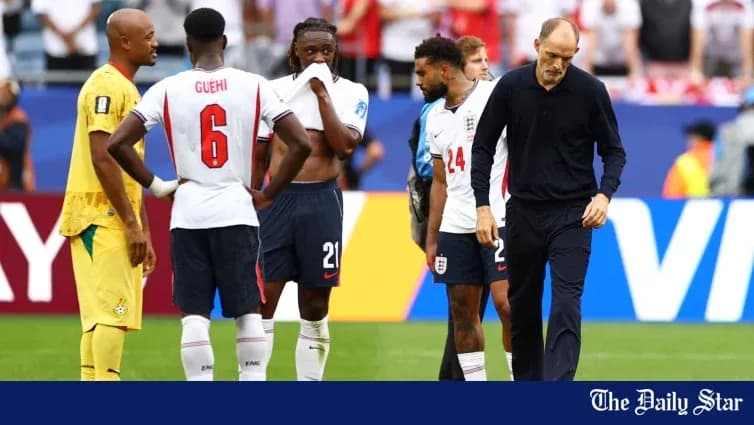
Thomas Tuchel walked off with a point, a clean sheet, and a statistic that will haunt England far more than the scoreline.
Seventy-eight point eight percent possession. The highest ever recorded by any side at a World Cup, going back to 1966, without finding the net. An entire match spent camped in Ghana’s half, and nothing to show for it but frustration and a few gasps of disbelief.
This was not the free-flowing reprise of the 4-2 win over Croatia. This was a grind.
Ghana Dig In, England Run Into a Wall
From the first whistle, the pattern was set. England on the ball, Ghana in their shape. White shirts shuttling it side to side, red shirts refusing to move.
Tuchel called it “one of the most physical performances” he has seen from a defending team, and it showed. Ghana didn’t just sit deep; they snapped into every duel, crashed into every second ball, and treated every cross as a personal challenge.
England, for all their control, never quite found the angles. The ball went wide, the ball came back. Another recycle, another attempt to drag Ghana out of their block. They barely budged.
Set-pieces became England’s lifeline. They had enough of them, as Tuchel admitted, “to decide the match,” but the delivery and the finishing never quite aligned. Corners were cleared, free kicks flicked on but not finished. Half-chances, not hammer blows.
The pressure built. The goal never came.
Possession Without Punch
England’s dominance of the ball looked impressive on the stats sheet, less so on the scoreboard. Ghana accepted long spells without a touch, trusting their discipline and their bodies to hold the line.
Every time England tried to speed things up, Ghana’s back line and midfield snapped into position. Passing lanes closed. Shots were blocked. Crosses met a forehead in red.
Tuchel knew what the fans had come to see after the Croatia win: tempo, combinations, goals. Instead, they got a tactical stalemate and a lesson in how hard it is to break a deep block when the final pass and finish are just off.
“If one team tries to play and run against this deep block and you don’t find the spaces and it’s difficult for you to create chances it can be difficult to watch,” he admitted. Difficult to watch, and even harder to win.
Kane’s Moment Goes Begging
And yet, for all the toil, the game still offered England one golden chance to steal it.
Eighty-sixth minute. Substitute Nico O’Reilly rose to meet a cross and crashed his header against the bar. The rebound dropped perfectly, almost invitingly, for Harry Kane. The captain, in the position he lives for, with the goal gaping.
He lashed it over.
Tuchel did not disguise the shock at that miss. “Ninety-nine out of 100 he will convert this chance,” he said, and nobody in the stadium would argue. It was the sort of opportunity Kane usually buries with ruthless inevitability. On this night, the ball flew into the stands and with it went England’s last, best chance.
The moment summed up the evening: effort, pressure, territory, but no finish.
Tuchel Stays Upbeat as England Edge Closer
Tuchel, though, refused to sink into gloom. He insisted there were “more positives than negatives” in the performance, pointing again to Ghana’s ferocity and England’s control of the game, even if it lacked incision.
He also understood the mood outside the dressing room. Supporters who had been treated to a four-goal show in the opener saw a very different side of tournament football here: the kind where patience replaces swagger and one mistake can define the night.
“We always try to entertain our fans. It was difficult today,” he said. “I hope they don’t lose belief. There’s a long way to go.”
The table backs him up. Four points from the first two games leaves England on the brink of the knockout rounds, all but assured of a place in the last 16. The margin for error remains, the path forward still open.
Next comes Panama on Saturday, a chance to restore the attacking rhythm and turn sterile dominance back into goals. The question now is simple: was this just one of those nights, or an early warning that against organised, physical opposition, England’s slick passing can still be made to look blunt?