FIFA COO Kevin Lamour Departs Amid Infantino Controversy
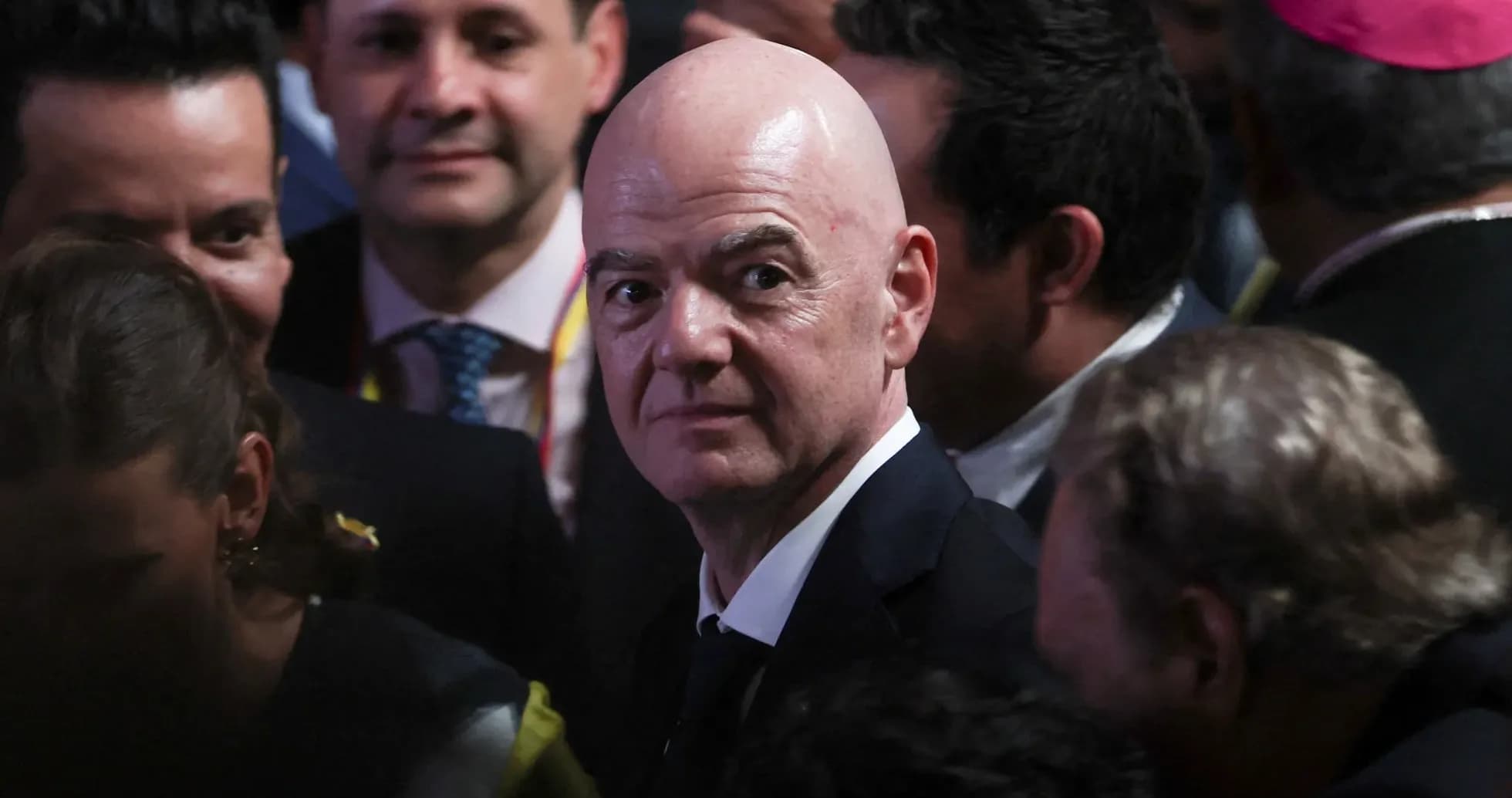
FIFA’s chief operating officer Kevin Lamour has left the organisation, deepening the storm swirling around president Gianni Infantino and his controversial commercial plans.
The departure was confirmed late on Monday in a brief statement that raised more questions than it answered.
“FIFA can confirm that the working relationship between FIFA and Kevin Lamour as FIFA’s Chief Operating Officer has ended on 17 August 2026,” a spokesperson said. “FIFA thanks Kevin for his two years of service and wishes him the best of luck for the future. No further comment will be made on the matter.”
No explanation. No detail. Just an exit – weeks after Lamour publicly attacked Infantino’s flagship proposal to sell a stake in FIFA’s commercial arm.
A close ally turned critic
Lamour was no outsider. The Frenchman joined FIFA’s senior leadership in November 2024 but had been around Infantino’s camp far longer, part of the inner circle that helped drive the Swiss-Italian lawyer’s successful presidential bid in 2016.
That made his recent intervention all the more explosive.
Last month, Lamour accused FIFA staff of having been “deceived” over Infantino’s plan to spin off a new $20bn subsidiary and sell up to 20 percent of it to private equity investors in order to raise $4.2bn. He branded the scheme “the project of one person”.
“Our mission … is to serve football, not to serve the personal interests of a person who, unfortunately, believes he embodies FIFA when he is supposed to be at its service,” Lamour said.
The words cut straight to the heart of the current battle over power, money and control in Zurich.
His broadside landed just after Carlos Cordeiro, a senior adviser to Infantino and former U.S. Soccer president, resigned in protest against the same proposal, calling it “a bad deal for football”. By the end of that day, Infantino had withdrawn the plan.
The retreat did not end the backlash. It simply moved it onto a different front.
Infantino’s fourth-term push under siege
Infantino’s attempt to secure a fourth term as FIFA president in March next year was once treated as a formality. That assumption has evaporated.
Three of world football’s most influential blocs – UEFA, the Asian Football Confederation (AFC) and CONCACAF – are now openly ranged against the 56-year-old. He still commands strong backing from the African and South American confederations, but the old aura of inevitability has gone.
Last week, UEFA, the AFC and CONCACAF jointly called for an independent review of Infantino’s conduct. Sources familiar with the manoeuvring say the letter is seen inside those confederations as a potential exit ramp: a way for Infantino to walk away with some dignity if the pressure becomes intolerable.
At the same time, human rights in sport organisation FairSquare has moved to attack the foundation of his re-election bid.
On Monday, FairSquare confirmed it had written to FIFA’s Governance, Audit and Compliance Committee (GACC), urging that Infantino be ruled ineligible to stand again.
“The complaint we have filed provides clear evidence that this is a clear breach of the rules and one that sets a very dangerous precedent,” FairSquare director Nicholas McGeehan told Reuters.
“The rules state clearly that three presidential terms is the maximum allowed. FIFA can’t simply circumvent this rule – which serves as a check on presidential power – by saying that his first term doesn’t count.”
FIFA did not immediately respond to a request for comment.
The battle over term limits
At the core of the legal and political fight is a simple question: how many terms is too many?
FIFA’s statutes limit presidents to three terms. Infantino, though, successfully argued in 2022 that his first spell in charge, from 2016 to 2019, should not count. He said it merely completed an interrupted mandate after Sepp Blatter’s resignation amid a corruption scandal.
Infantino was elected at an Extraordinary Congress in 2016, then re-elected unopposed in 2019 and again in 2023. The current push would give him another four years on top of that.
FairSquare’s letter to the GACC was drafted with the help of Miguel Maduro, the former head of FIFA’s independent Governance and Review Committee. Maduro warned that ignoring the term-limit rule would shred what remained of FIFA’s reform credentials.
“The principle of term limits was a fundamental aspect of the 2016 reform aimed at limiting power and the rule introduced is clear: no FIFA President can serve more than three terms of office,” he said in a statement.
“Trying to carve out an exception to such a rule for Mr Infantino reveals both a resistance to the principle of term limits and how some at FIFA conceive of rules not as rules but as obstacles to be circumvented.”
The language mirrors the criticism already levelled at Infantino over his commercial ambitions: that structures, checks and balances are there to be bent, not obeyed.
Mounting scrutiny beyond Zurich
Infantino’s conduct has not only drawn scrutiny inside football.
FairSquare previously lodged a complaint with the International Olympic Committee, accusing him of breaching the IOC’s rules on political neutrality by supporting United States President Donald Trump. That complaint was rejected last month. Infantino has been an IOC member since 2020.
Even so, the pattern is clear: a president constantly pushing at the edges of the rules, and a growing coalition determined to push back.
Now, with Lamour gone, another prominent internal critic has left the stage. One of the architects of Infantino’s rise has walked away after denouncing what he saw as the personalisation of FIFA’s power and resources.
The question is no longer whether there is a crisis around Infantino’s leadership. It is whether he can still survive it long enough to ask world football for one more mandate.