Fenerbahçe Dominates Sturm Graz in Champions League Qualifier
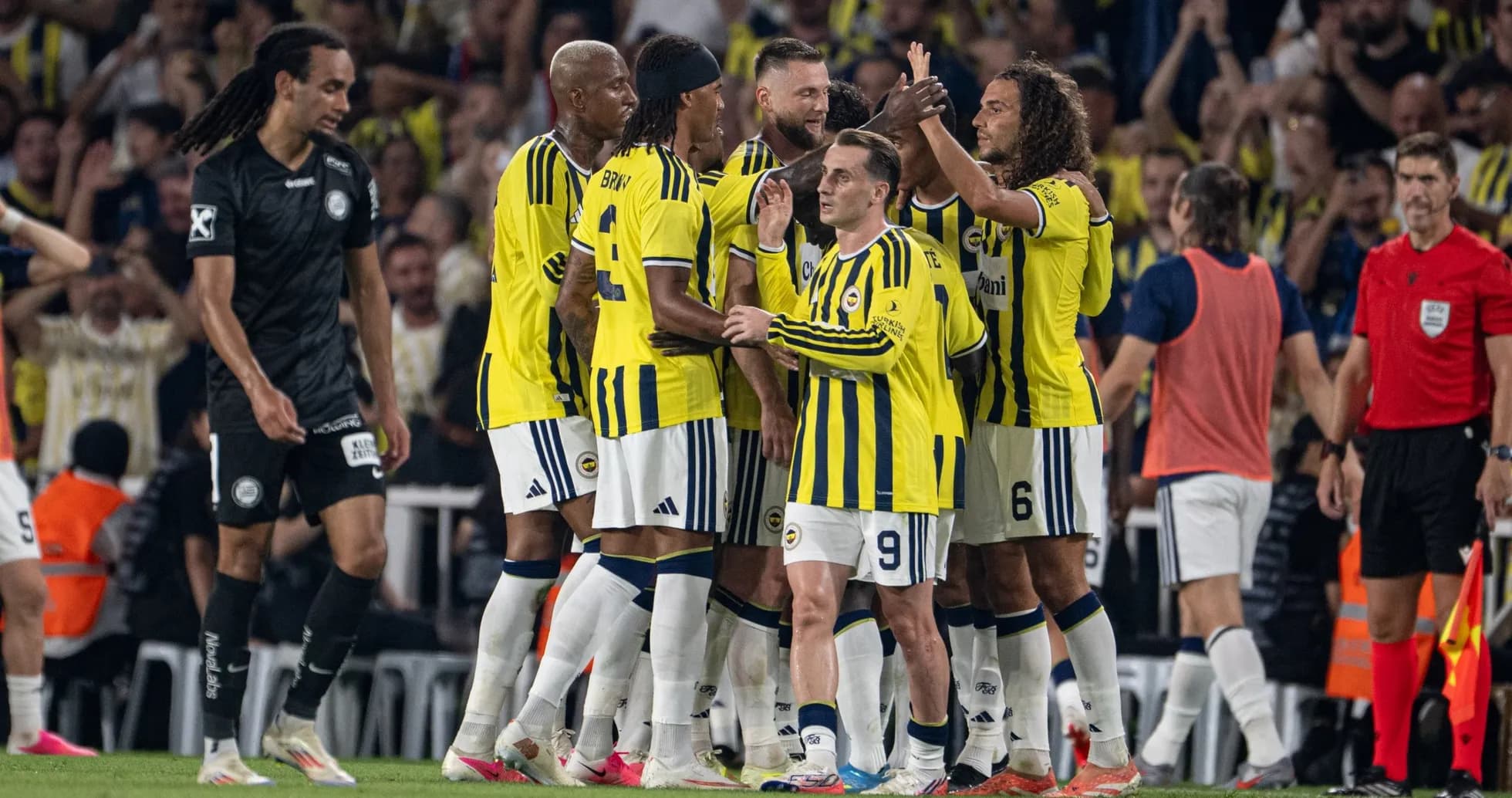
Fenerbahçe’s 2-0 win over Sturm Graz at Chobani Stadium was a controlled, almost textbook example of how to use structure, pressing traps and technical superiority to dominate a Champions League 3rd Qualifying Round tie. The Turkish side imposed their 4-2-3-1 from the opening whistle, turning 72% possession and a 17–5 shot advantage into a comfortable two-goal cushion by half-time, then managing the rhythm maturely after the break. Sturm Graz’s 4-4-2, designed to be compact and direct, was pinned so deep that it rarely transitioned into genuine counter-attacking threat.
Ismail Kartal’s 4-2-3-1 was built on a secure base and a double pivot that controlled both tempo and rest defence. With M. Gunok in goal, the back four of N. Semedo, M. Skriniar, N. Ake and J. Oosterwolde held an aggressive line, compressing the field into Sturm’s half. The key, though, was the Kante–Guendouzi axis. N. Kante sat slightly deeper as the primary screener, constantly occupying the central lane behind Talisca and the three attacking midfielders. His positioning allowed Fenerbahçe to commit numbers forward without losing control of second balls; Sturm’s front two of S. Wlodarczyk and S. Jatta were often isolated, forced to chase lateral passes rather than attack space.
Ahead of them, M. Guendouzi operated as the tempo-setter, linking the first and second lines and frequently stepping into the right half-space to overload alongside M. Asensio and N. Semedo. This created a 3v2 against Sturm’s left side, pulling E. Soglo and S. Seidl narrow and opening corridors for switches to the opposite flank, where K. Akturkoglu and J. Oosterwolde could receive in space. The first goal on 9 minutes, finished by Talisca from an assist by K. Akturkoglu, encapsulated this structure: circulation through midfield, half-space occupation, then a sharp vertical action into the box.
The attacking trio behind Talisca was configured to constantly stress Sturm’s defensive line. M. Greenwood on one side and M. Asensio centrally drifted between lines, while K. Akturkoglu stretched the pitch horizontally. Talisca did not simply pin the centre-backs; he dropped into pockets, drawing one of A. Vallci or J. Mitchell out, which opened channels for third-man runs. Fenerbahçe’s 12 shots inside the box underline how often they managed to play into advanced central zones rather than settle for speculative efforts from range.
Sturm Graz, in their 4-4-2 under Fabio Ingolitsch, set up with two narrow banks of four, aiming to deny central progression and spring forward through quick vertical passes into Wlodarczyk and Jatta. In practice, they were pushed so deep that their first line of pressure often began around their own box. With only 28% possession and 222 total passes (164 accurate, 74%), Sturm’s midfield four of J. Hodl, L. Weinhandl, Jon Gorenc Stankovic and S. Seidl spent long stretches shuttling laterally rather than engaging high. The foul count – 19 to Fenerbahçe’s 10 – reflects a reactive, last-ditch defensive performance, frequently breaking up combinations rather than dictating where the game was played.
The second goal, scored by M. Greenwood at 45' from an M. Asensio assist, effectively killed the contest as a tactical battle. It came at the end of a half in which Fenerbahçe had already produced 10 shots on goal in total and forced Sturm’s back line into constant emergency defending. The timing meant Fenerbahçe could adjust after the interval from aggressive probing to controlled risk management.
Out of possession, Fenerbahçe’s pressing was measured rather than reckless. The first line, with Talisca screening passes into Jon Gorenc Stankovic, forced Sturm wide. From there, the trigger was often a backward or square pass towards the full-backs, where the near-side winger jumped and the full-back stepped high behind him. This structure allowed Fenerbahçe to keep Sturm to just 1 shot on goal and 5 total shots, while M. Gunok (Fenerbahçe) was called into action only once, making 1 save. The rest defence, anchored by Skriniar and Ake with Kante just in front, consistently swept up any attempted direct balls into the channels.
Sturm’s best defensive performer was arguably their goalkeeper. D. Khudyakov (Sturm Graz) made 8 saves, a figure that underlines both Fenerbahçe’s attacking volume and the degree to which the Austrian side relied on their last line. The 5 blocked shots by Fenerbahçe further emphasize how often they were able to shoot from dangerous positions, forcing desperate interventions.
The substitution patterns reinforced the tactical story. At 30', A. Brown (IN) came on for J. Oosterwolde (OUT), a like-for-like change that maintained the aggressive full-back profile on the left. After the break, Sturm attempted to inject energy and verticality with a triple change on 64' – G. Mamageishvili (IN) for S. Seidl (OUT), R. Fosso (IN) for L. Weinhandl (OUT), and N. Weiper (IN) for S. Jatta (OUT) – shifting towards fresher legs in midfield and attack. However, with Fenerbahçe already in game-management mode, these changes produced more running than genuine structural change.
On 69', Kartal refreshed his attacking line with Fred (IN) for M. Greenwood (OUT) and I. Kahveci (IN) for M. Asensio (OUT), adding control and work rate in the central band to close any remaining transition windows. Later, M. Muldur (IN) for N. Semedo (OUT) and O. Aydin (IN) for K. Akturkoglu (OUT) at 85' further solidified the flanks, ensuring Sturm could not exploit tired legs in wide areas. Sturm’s final change, B. Beganovic (IN) for J. Hodl (OUT) on 87', came too late to alter the pattern.
Statistically, the match paints a clear picture of territorial and technical dominance. Fenerbahçe’s 578 total passes with 520 accurate (90%) reflect a side comfortable circulating under minimal pressure, using the ball as a defensive tool once the 2-0 lead was established. Sturm’s 222 passes and lower completion rate highlight how rarely they could string together possession phases long enough to move their block upfield.
With 4 corner kicks to Sturm’s 2 and a 4–0 edge in offsides, Fenerbahçe consistently played on the front foot and on the edge of Sturm’s line, accepting occasional offside calls as the cost of aggressive depth. The disciplinary numbers – 3 yellow cards for Sturm Graz and none for Fenerbahçe – align with a game in which the visitors were stretched and often late into duels, while the hosts controlled both space and tempo.
Overall, this was a tactically mature performance from Fenerbahçe: a clear structural plan, high technical execution, and intelligent in-game management once the two-goal advantage was secured. Sturm Graz’s 4-4-2 never found a stable pressing height or a reliable outlet, leaving them defending deep for most of the 90 minutes and relying heavily on D. Khudyakov to keep the scoreline respectable.