Enzo Fernández and the Symbolism of Topo Gigio in Football
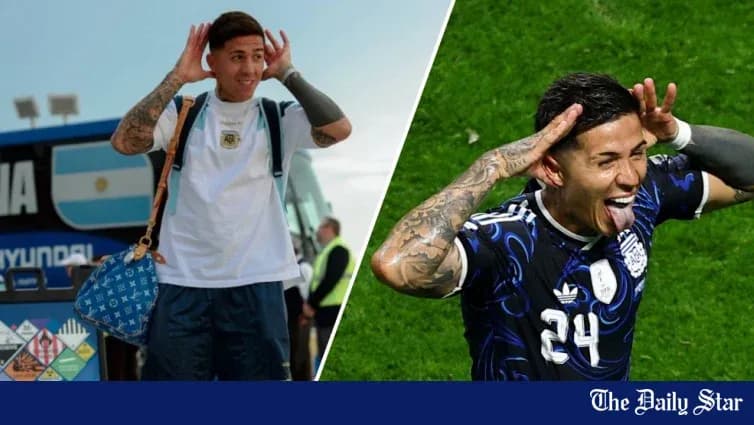
Enzo Fernández stepped onto the tarmac in Kansas City with the same swagger he had shown in the World Cup semifinal. No goal this time, no roaring crowd, just a team flight to catch. Yet the gesture was there again: hands cupped behind his ears, the now-familiar “Topo Gigio” celebration aimed at the cameras before Argentina flew out to New York.
The message travelled faster than the plane.
By the time Lionel Scaloni’s squad finally landed—thunderstorms pushing their arrival at New York’s airports back to around midnight—the image was already ricocheting around social media. Fernández wasn’t just packing his boots for Monday’s FIFA World Cup 2026 final against Spain at MetLife Stadium. He was carrying a symbol.
A mouse, a legend, and a gesture of defiance
To the uninitiated, it might look like a simple taunt. To Argentina, it’s loaded.
“Topo Gigio” began life far from the pitch. Created in 1958 by Italian artist Maria Perego, the puppet mouse became a soft-spoken television star, a children’s favourite across Latin America in the 1980s and 1990s. Its trademark pose—hands cupped behind the ears—was playful, almost innocent.
Football turned it into something else.
On April 8, 2001, Boca Juniors icon Juan Román Riquelme scored against River Plate in a Superclásico charged with tension on and off the field. He walked towards the directors’ box, stopped in front of then-club president Mauricio Macri’s seat, and raised his hands behind his ears. In that moment, the cute TV mouse became a symbol of rebellion.
Riquelme was in the middle of a contract dispute. The celebration was immediately read as a pointed message to the board, even though he would later say it was for his daughter. The nuance didn’t matter. The image stuck. The gesture entered Argentine football mythology.
From there, “Topo Gigio” moved from generation to generation. It resurfaced on the biggest stage in Qatar in 2022, when Lionel Messi used it after Argentina’s stormy World Cup quarter-final win over the Netherlands. In a night thick with needle and words exchanged off the pitch, Messi’s celebration was widely seen as a direct response to Dutch coach Louis van Gaal. Another layer added. Another chapter written.
Fernández writes his own chapter
Enzo Fernández grew up in that football culture, where celebrations are never just about joy. They are about context, memory, and message.
So when he scored against England in the World Cup 2026 semifinal, he didn’t sprint to the corner flag in a blur of emotion. He chose his moment. Amid the noise and hostility of one of international football’s fiercest rivalries, he stopped, turned, and raised his hands behind his ears.
The “Topo Gigio” was back, this time in the boots of a Chelsea midfielder carrying the weight of Argentina’s new generation. It fit the occasion perfectly. A semifinal against England, a global audience, a young star stepping into the spotlight and dipping into a celebration that belongs to the country’s football soul.
That gesture, repeated again before boarding the flight in Kansas City, no longer feels like a simple homage. It has become part of Fernández’s own identity on this World Cup stage. A signal of defiance, of confidence, of a player unafraid of the noise around him.
Calm before the final storm
On the field, Argentina kept things light before leaving the Midwest. Scaloni oversaw a gentle training session in Kansas City, a final tune-up before shifting camp to the East Coast. No heavy drills, no risks. Just enough to keep the legs sharp and the minds clear ahead of Spain.
The real intensity will come under the lights at MetLife Stadium, where the World Cup trophy will be on the line in the early hours of Monday [1am, Bangladesh Time]. By then, the storms will have cleared, the travel will be forgotten, and only the football will matter.
But when Enzo Fernández next cups his hands behind his ears, on the biggest stage of all, will it be remembered as the celebration that crowned a world champion—or the gesture that left Argentina wondering what might have been?