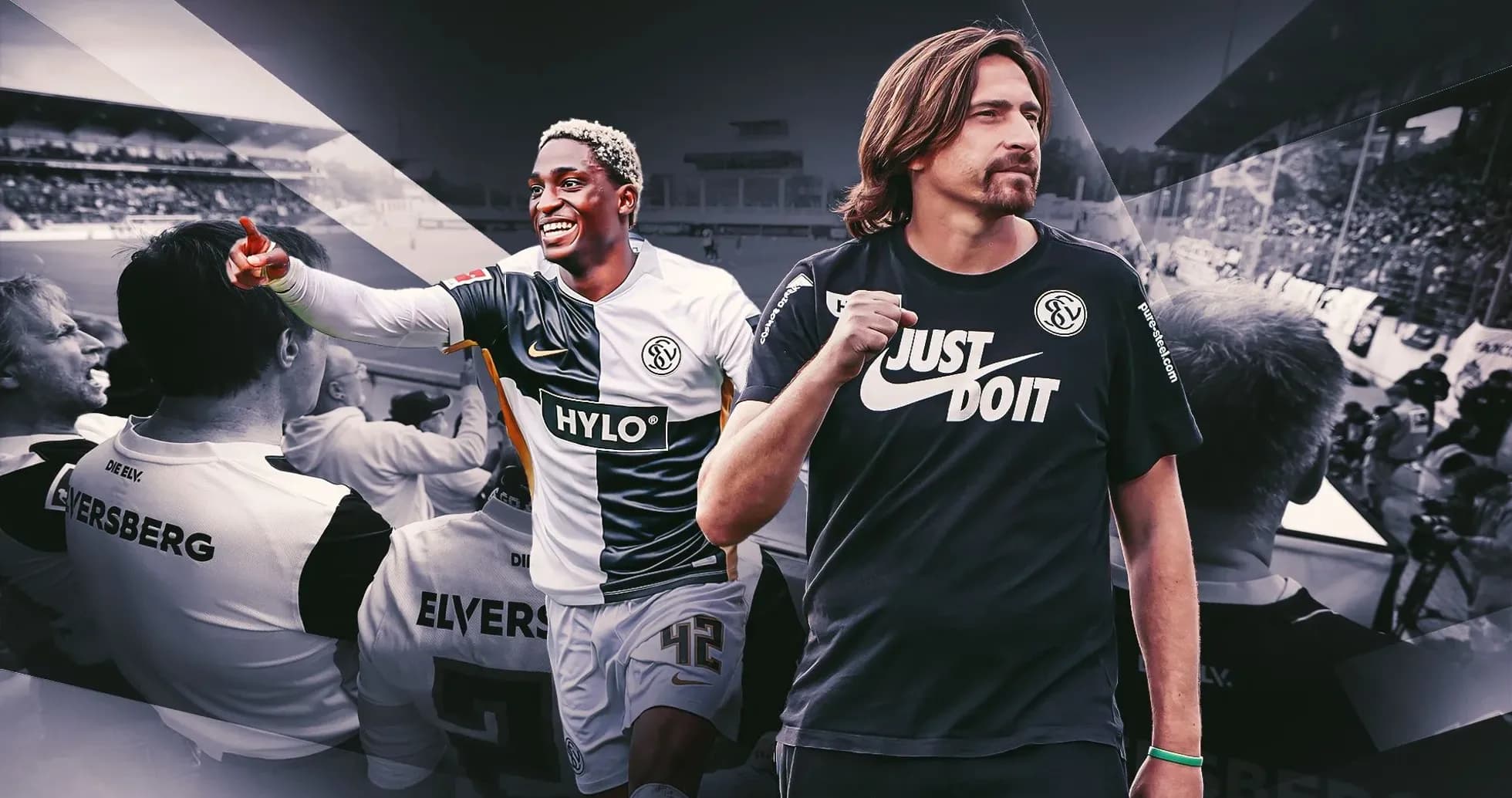
Elversberg: The Village Club's Journey to Bundesliga Glory
In Elversberg, the road to the Bundesliga quite literally runs out.
There is no train station. No grand town hall. Just 13,000 people in a small Saarland municipality that ranks only 30th in its own state. Yet this place, once known only to locals and commuters, now hosts a Bundesliga club. The Dorfverein – the “village club” – has crashed football’s most exclusive party.
From village pitch to professional dream
The story starts in 1907, pauses for a world war, and then drifts through decades of amateur football. For the best part of a century, Elversberg were a footnote, not a headline.
The shift came with a local pharmaceutical company. Ursapharm, under club president Frank Holzer and later his son Dominik, became the driving force and main sponsor. The company’s backing nudged Elversberg into the professional era.
Promotion to the 3. Liga arrived in 2013. So did immediate relegation. Still, the foundations were being laid. Ursapharm bought the naming rights to the ground, turning it into the Ursapharm-Arena an der Kaiserlinde – a nod to a century-old lime tree that once stood proudly beside the pitch before it fell in 2015. The stadium slowly grew to a 10,000 capacity.
What Elversberg lacked was not money, but a footballing idea.
Steffen’s revolution
That arrived in 2018 with Horst Steffen. He did not tiptoe in. He ripped up the script.
Steffen installed a front-foot, attacking style that made Elversberg must-watch football. Goals, risk, chaos. He once admitted he preferred a spectacular win to a “measly 1-0”. His team played like they believed him.
The payoff came in 2021-22 with the Regionalliga Südwest title and a return to the 3. Liga. This time, they were ready.
The warning shot to the rest of Germany came in August 2022: a 4-3 DFB-Pokal shock against Leverkusen, the biggest upset in the club’s history. Bochum ended that cup run in the next round, but Elversberg were relentless in the league. They edged Freiburg to the 3. Liga title after a breathless promotion race in which the top five sides were separated by only five points.
They didn’t just win. They entertained. Elversberg scored 80 goals in 38 games – the best attack in the division – with Stuttgart loanee Nick Woltemade chipping in 10. Steffen’s philosophy had taken root.
The first season in the 2. Bundesliga brought bumps and bruises, but also stability: 11th place and survival. Then came 2024-25 – and a shot at the promised land.
Agony at the door of the Bundesliga
Elversberg finished third behind Köln and Hamburg, earning a promotion/relegation play-off against Heidenheim. Ninety minutes from history, they ran into heartbreak.
The first leg ended 2-2. The second was locked at 1-1 deep into stoppage time. Then, in the fifth added minute, Leo Scienza struck for Heidenheim. One kick, one goal, one dream shattered.
The blow doubled a few weeks later. Steffen, the architect of Elversberg’s rise, left for Werder Bremen. The club banked €300,000 in compensation, but no amount could replace the coach who had dragged them to heights nobody had imagined.
Sporting director Nils-Ole Book now faced the most important decision in the club’s history. He wanted a modern tactician, someone who would keep the high-intensity, attacking DNA while promoting youth. The search was long, the criteria demanding.
They landed on Vincent Wagner, the coach who had just guided Hoffenheim’s reserves to promotion to the 3. Liga in 2024-25.
“With everything he brings to the table, he fits in very well with us,” Book said at Wagner’s unveiling. “Vincent will not only continue our current path, but also enrich and develop it with new energy.”
It sounded ambitious. It also sounded risky.
Doubts, departures – and a new rise
The doubts were understandable. Wagner had no top-level track record. Key attacking loanees Fisnik Asllani and Muhammed Damar returned to their parent clubs. Defensive leader Robin Fellhauer left for Augsburg. Pundits lined up to predict a step backwards, a mid-table fade.
Book refused to let the project stall. With limited resources, he rebuilt on the fly.
Lukasz Poreba, Bambase Conté and Jarzinho Malanga arrived on loan from Bundesliga clubs. Lasse Günther and Jan Gyamerah came in permanently to shore up the back line. The pieces looked modest on paper.
On the pitch, they clicked fast.
Elversberg stormed out of the blocks in 2025-26, winning seven of their first nine league games. They wobbled at times, but never fell out of the promotion race. Schalke eventually pulled away to win the title, leaving a scrap for the second automatic spot that went down to the final day.
Elversberg held second, ahead of Paderborn on goal difference, and faced rock-bottom Preußen Münster at home. It looked favourable, but also dangerous. One bad day, one nervous performance, and the dream was gone.
Wagner’s side didn’t blink. They blew Münster away 3-0. When the final whistle went, Elversberg were a Bundesliga club for the first time in their 119-year existence.
“Of course, this is something special,” Wagner said afterwards. “A friend of mine said this week, ‘If Elv can get promoted, it’s like flying to the moon.’ And we managed to make the moon landing today.”
The moon landing came despite losing the league’s top scorer, Younes Ebnoutalib, to Eintracht Frankfurt in January, and seeing Book depart for Borussia Dortmund two months later. The spine of the project was being sold off in real time, yet the results did not collapse.
Lukas Petkov stepped up, scoring six times in the second half of the campaign and finishing with 11 assists across the season. Tom Zimmerschied proved the ideal foil, adding nine goal contributions of his own. Elversberg ended with a league-high 64 goals scored and only 39 conceded – the second-best defensive record behind Schalke.
The village club were no longer just a curiosity. They were a machine.
Building for the big time
Promotion triggered sweeping change. The Ursapharm-Arena needed upgrading to meet Bundesliga standards. Construction began, with capacity set to rise to 15,000 by next spring. For now, one side of the ground looks like a building site, a temporary steel gantry erected so journalists can actually see the action.
Off the pitch, there was another key appointment. Christian Weber arrived from Fortuna Düsseldorf after 16 years as scout and sporting director. Filling Book’s shoes was a daunting task; his reputation for unearthing under-the-radar talent had become part of Elversberg’s identity.
Weber responded with a transfer window that matched the club’s daring.
He prised 21-year-old attacking midfielder Maurice Krattenmacher from Bayern for just €2m. He leaned again on the loan market, bringing in Francis Onyeka from Bayer Leverkusen, Noah Darvich from Stuttgart and Noel Futkeu from Eintracht. Then came the headline deal: breaking the club transfer record to sign Cole Campbell from Dortmund for €6m.
Campbell, one of the United States’ brightest prospects, instantly became the face of the new Elversberg. Technical director Josef Welzmüller did not hide his excitement.
“He’s a fantastic player. He’s very fast and strong with the ball and in one-on-one situations,” Welzmüller told Bulinews in August. “We are very, very sure that he will have a breakout season.”
The temptation for a club of Elversberg’s size, stepping into the Bundesliga, would be to rip up the playbook and go defensive. Not here.
Welzmüller made it clear: there would be no retreat, no low block as a default survival plan. Wagner, fond of his space analogies, likened staying true to their style in the top flight to a “mission to Mars”.
“We won’t do anything different,” Welzmüller told BBC Sport. “The identity stays the same and it is built on three core pillars. The first is to be brave, the second is to be intense and the third is to be clever.”
Those pillars were put to the test immediately.
Leverkusen stunned, Gladbach shell-shocked
On the opening weekend, Elversberg faced Carles Martínez’s Leverkusen. Established power against promoted upstarts. It took 10 minutes for the script to tear.
Petkov struck first, his effort taking a deflection and wrong-footing Mark Flekken. Moments later, Campbell announced himself with a ferocious drive that the Leverkusen goalkeeper could not hold. Two goals inside 10 minutes. The finish was ruthless, the run even more impressive – Campbell pounced on a loose pass, surged towards the box and lashed home with the conviction of a veteran, not a 20-year-old still feeling his way into a new club.
Any thought of a second-half response was smothered almost instantly. Twenty-five seconds after the restart, David Mokwa arrived to turn in a low Petkov cross from close range. 3-0, and Ursapharm-Arena was in uproar.
Leverkusen rallied through Patrick Schick and Christian Kofane, but the damage was done. Elversberg, with seven Bundesliga debutants in the starting XI and Campbell – with just 10 previous top-flight appearances – somehow the most experienced player in the matchday squad, had overpowered one of the league’s heavyweights.
“We fortunately did this with our fans behind us, we’re small but mighty,” Wagner said afterwards. “We’ll have to continue to play courageous football as it’s the only way we’re going to have a chance in this league.”
Matchday two offered a very different challenge: a trip to ista-Borussia-Park and a meeting with Gladbach. This time, the fairytale threatened to unravel.
Elversberg trailed 3-1 before the hour. Wagner was sent off for protesting Gladbach’s second goal, furious after the referee awarded a throw-in to the hosts instead of Elversberg in the build-up. The touchline general was gone, the noise of the crowd rising.
From the stands, he still found a way to influence the game.
Krattenmacher came on and changed the mood in an instant. Within a minute of his introduction, he headed against the crossbar, then reacted quickest to slide the rebound into the net. Belief flickered back to life.
Felix Heidel then stepped up on 80 minutes and bent a free-kick beautifully into the corner to make it 3-3. Suddenly, Gladbach were clinging on.
Deep into stoppage time, the comeback turned into a statement. Futkeu, another substitute, drove at the defence and squared for Krattenmacher, who swept in his second and Elversberg’s fourth. From 1-3 down to 4-3 up, away from home, as a newly-promoted side.
“I enjoyed the way we played football – simply a sensational team performance from everyone,” Wagner told reporters. Club captain Lukas Pinckert summed up the mood: “We were 1-3 down in front of this crowd and turned the game around as a newly-promoted team – that’s remarkable. We’re simply a unit, we never give up.”
The message to the rest of the league could not have been clearer.
Bayern on the horizon – and no fear
Now comes the ultimate test. Bayern on Sunday. Harry Kane, Michael Olise, the full weight of German football’s superpower rolling into a village with no train station and a half-built stand.
If results elsewhere fall kindly, Elversberg could even end the weekend at the top of the Bundesliga. The idea sounds absurd, almost cartoonish. Inside the club, it sounds like an opportunity.
They watched Schalke hold Bayern to a 0-0 draw last time out. They saw the blueprint for stubborn resistance. They will not copy it.
There will be no bus to park, no abandonment of principle. Elversberg will go at Bayern the same way they went at Leverkusen, the same way they refused to bow in Mönchengladbach – with bravery, intensity, and a refusal to be cowed by reputation.
For Welzmüller, a Munich native who grew up supporting Bayern, the occasion carries a personal charge.
“It will be insane. [But] we don’t fear anybody,” he has said of the fixture.
That, more than the moon landings and Mars missions, more than the transfer coups and tactical revolutions, is what defines Elversberg.
They are the village club that refuses to act like one.