Elversberg's Historic Promotion to Bundesliga
Elversberg have smashed through German football’s glass ceiling. A side from a town smaller than many Bundesliga attendances will line up among the country’s giants next season, after a 3-0 win over already-relegated Preussen Munster sealed promotion and a place in history.
On Sunday at the compact Waldstadion an der Kaiserlinde, it took just a quarter of an hour for the story to take shape. Bambase Conte struck first, David Mokwa quickly added a second, and the noise from the 10,000-capacity ground began to feel far too big for its modest frame. When Mokwa grabbed his second midway through the second half, the outcome was beyond doubt. So was Elversberg’s rise: second place secured, the Bundesliga guaranteed.
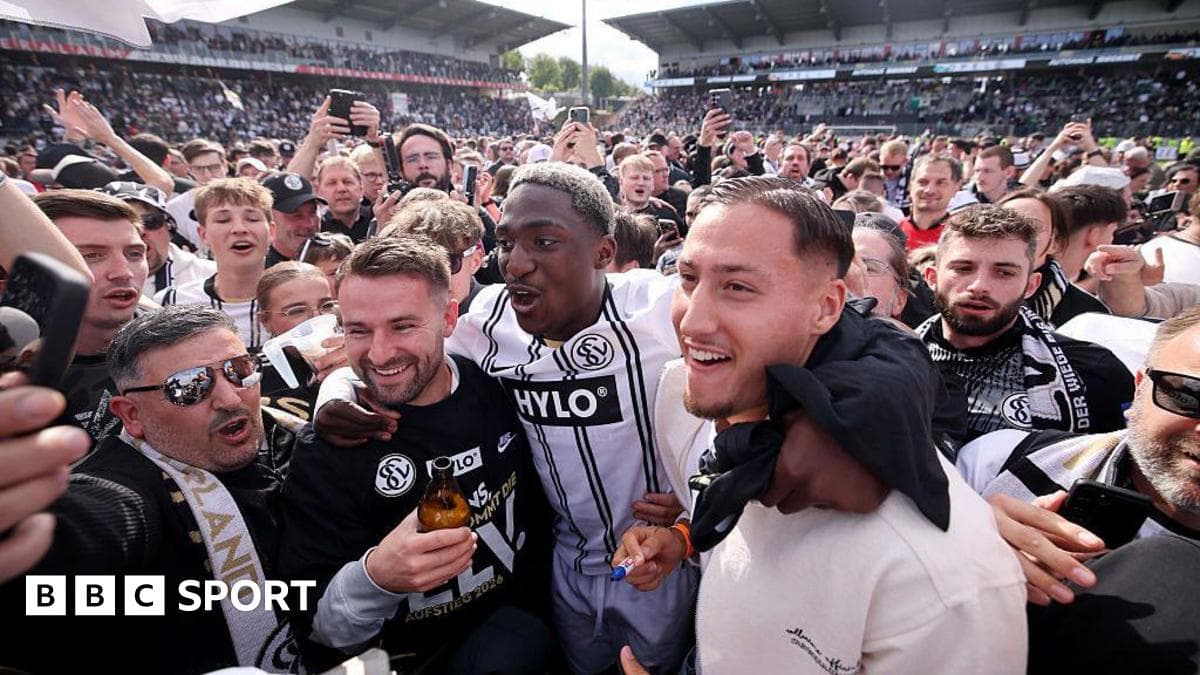
The final whistle turned the afternoon into a landmark. Supporters surged from the stands and spilled onto the pitch, folding players and staff into a single, jubilant mass. This was not just promotion. It was the culmination of a stunning climb: three promotions in five years, from the regionalised fourth tier to the summit of the German game.
Only a year ago, the dream had been delayed in the cruellest fashion. Elversberg had pushed all the way to the Bundesliga promotion-relegation play-off, only to fall 4-3 on aggregate to Heidenheim. The gap between fairytale and frustration felt agonisingly small.
The wider football world had its fun at their expense back then. Rail operator Deutsche Bahn posted an image of a train with a single carriage, a pointed joke that Elversberg would hardly need anything larger to carry their support to the play-off. The punchline has not aged well. The same fanbase has now filled a stadium to bursting and will soon be travelling to some of the grandest arenas in Europe.
For Spiesen-Elversberg, in the small south-western state of Saarland, this is uncharted territory. Founded in 1907, the club had never even reached the 2. Bundesliga until the 2023-24 season. As recently as 2021-22, they were still battling in the regionalised fourth tier. The jump from that level to facing Bayern Munich, Borussia Dortmund and the rest in such a short span borders on the improbable.
The infrastructure is racing to keep up with the football. The Waldstadion an der Kaiserlinde is already under renovation to meet Bundesliga standards, with capacity scheduled to rise to 15,000 by spring 2027. For now, it remains a tight, intimate venue, the kind where visiting heavyweights will find little glamour and plenty of noise.
Elversberg will not be alone in stepping up. Schalke, a club whose name and history dwarf almost everyone else in the division, have claimed the 2. Bundesliga title and return to the top flight after three years away. Their re-emergence restores one of German football’s great fixtures lists, but it is Elversberg’s presence that truly twists the narrative.
At the other end of the ladder, the season still has a sting. Wolfsburg, 16th in the Bundesliga, must fight to preserve their status in a promotion-relegation play-off against Paderborn, who finished third in the second tier. One of them will stand between Elversberg and a slightly less daunting debut campaign.
Yet the night belongs to the smallest town ever to send a club into the Bundesliga. From a one-carriage joke to a first-class ticket to the top table, Elversberg have turned a punchline into a statement. Now the question moves from “how did they get here?” to something far more intriguing: how long can they stay?