Denver Summit W Dominates Houston Dash W in 4-1 Victory
Houston Dash W’s 1-4 home defeat to Denver Summit W at Shell Energy Stadium was defined by Denver’s vertical efficiency and control of key spaces rather than sheer volume of possession. In an NWSL Women group-stage match where Denver held 53% of the ball and doubled Houston’s shots on goal (7 to 3), the visitors repeatedly exploited Dash structural weaknesses in transition and wide defending. Houston’s 4-4-2, set up by Fabrice Gautrat, never quite solved Denver’s 4-2-3-1 rotations between the lines, and the game tilted decisively once Denver’s third goal arrived early in the second half.
Scoring Pattern
The scoring pattern tells a clear tactical story. Denver struck first on 15' when J. Sonis, operating from the left-back slot but given license to advance, finished after a combination with Y. Ryan. The assist from Ryan underlined Denver’s intent to overload the left half-space, dragging Houston’s right side narrow and exposing the channel outside Avery Patterson. On 34', N. Flint made it 0-2 with a “Normal Goal”, capitalizing on Denver’s ability to sustain pressure: with 8 corners to Houston’s 3 and 9 shots inside the box, Denver repeatedly pinned the Dash deep and attacked second balls.
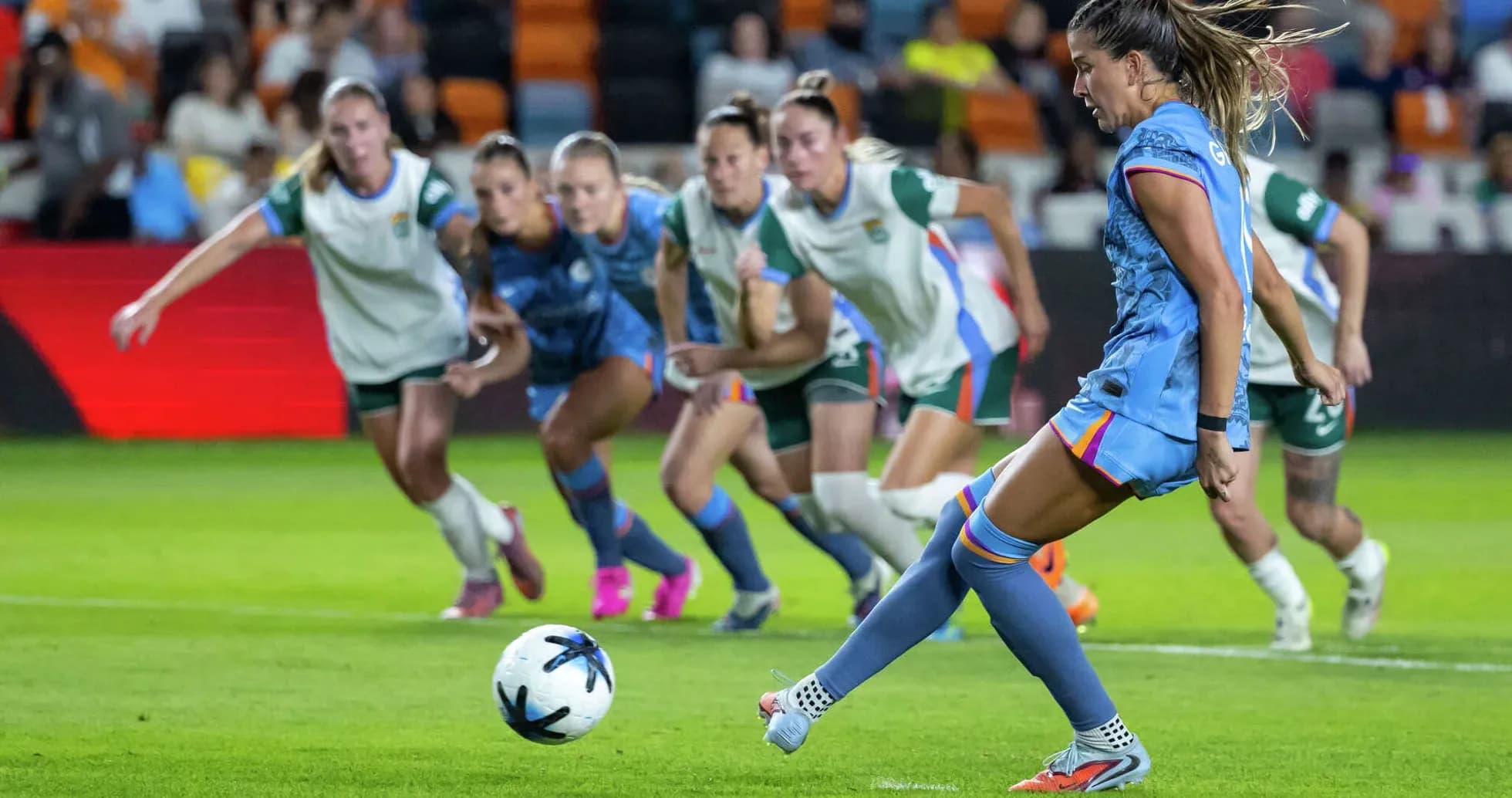
Houston’s lifeline came at 45', when midfielder Maggie Graham converted a penalty to cut the deficit to 1-2 at halftime. That moment briefly validated Houston’s plan to get both strikers, Kate Faasse and Clarissa Larisey, running in behind and forcing Denver’s back four into recovery tackles.
Second Half
However, Denver reasserted control almost immediately after the interval. On 49', Delanie Sheehan, one of the double pivot, stepped into advanced territory and finished a move created by right-back Ayo Oke’s forward thrust and delivery. That goal, assisted by A. Oke, was emblematic: Denver’s full-backs pushed high with confidence, trusting the central pairing and back line to manage Houston’s two forwards.
The only disciplinary events came for the hosts, and both were directly tied to defensive stress:
- 51' Danielle Colaprico (Houston Dash W) — Foul
- 74' Linda Ullmark (Houston Dash W) — Foul
Denver finished with 0 cards; Houston with 2, both for “Foul”. There were no VAR incidents and no dismissals, so the game’s edge came from tactical superiority rather than chaotic discipline.
Substitution Patterns
Substitution patterns reinforced the underlying tactical battle. At 46', immediately after the break, Mary Hardin (IN) came on for Clarissa Larisey (OUT), a move that shifted Houston’s 4-4-2 towards a more conservative back line and reduced their vertical threat. Denver responded on 59' by introducing Yuna McCormack (IN) for Ayo Oke (OUT), freshening the right side after Oke’s high-intensity first hour, including the assist on Sheehan’s goal.
On 60', Carson Pickett (IN) replaced Natalie Means (OUT), giving Denver a more experienced presence on the left and further stabilizing their build-up. Houston tried to regain midfield control on 62' as Sarah Puntigam (IN) replaced Danielle Colaprico (OUT), but by then Denver’s structure was firmly established.
Denver’s fourth goal, on 72', again came from J. Sonis, once more assisted by Y. Ryan. This repeat combination underlined Denver’s clear pattern: Ryan, as the central attacking midfielder, drifted into the left channel to link with Sonis, creating overloads against Houston’s right side. With 14 total shots and 9 inside the box, Denver’s wide-to-central connections were relentless.
Houston’s late changes—Lisa Boattin (IN) for Leah Klenke (OUT) and Emina Ekic (IN) for Linda Ullmark (OUT) both on 78', followed by Messiah Bright (IN) for Kate Faasse (OUT) on 84'—were attempts to add attacking quality on the flanks and up front. But by that stage, Denver had dropped into a compact 4-4-1-1 out of possession, protecting central zones and forcing Houston into lower-value efforts: only 3 shots on goal from 7 total attempts, and just 3 from inside the box.
Denver’s final substitution at 90', Emma Regan (IN) for N. Flint (OUT), was a classic game-management move, adding fresh legs in midfield to see out a 1-4 advantage.
Structural Perspective
From a structural perspective, Houston’s 4-4-2 hinged on Jane Campbell’s distribution and the full-backs’ ability to progress play. With 382 total passes and 295 accurate (77%), the Dash were tidy enough but lacked penetration. Their 7 offsides suggest a deliberate attempt to stretch Denver’s back line, yet the timing and support runs were inconsistent. Wide midfielders Katherine Ann Rader and Linda Ullmark were often pinned back by Denver’s full-backs and wingers, leaving the two central midfielders, Colaprico and Graham, outnumbered against Denver’s double pivot plus Ryan.
Denver, with 424 passes and 349 accurate (82%), used their slight possession edge more aggressively. The 4-2-3-1 allowed Sheehan and Devin Lynch to control tempo while Ryan floated between lines. The back four—Ayo Oke, Eva Gaetino, Kaleigh Kurtz, and Janine Sonis—held a relatively high line, supported by Abby Smith’s willingness to sweep, compressing the pitch and making it harder for Houston to link midfield to attack.
Goalkeeper Usage
Goalkeeper usage was revealing. Both keepers recorded 2 saves, but the context differed: Campbell faced 7 shots on target, conceding 4, as Denver consistently created high-quality looks inside the box. Abby Smith, behind a well-protected back line, dealt with only 3 shots on goal, most from less threatening positions.
Statistical Overview
Statistically, Denver’s superiority in “Shots on Goal” (7-3), “Total Shots” (14-7), and “Shots inside box” (9-3) aligned with the scoreline. Their 11 fouls to Houston’s 5 reflected a willingness to disrupt transitions higher up the pitch, while avoiding bookings. Houston’s two yellow cards, both for “Foul”, came as last-resort interventions once Denver had already broken lines.
In overall form terms, Denver Summit W showed a cohesive, proactive model: full-backs high, a fluid No. 10 in Y. Ryan, and a forward line that attacked the half-spaces ruthlessly. Houston Dash W, by contrast, revealed a defensive index vulnerability on their right flank and in transition coverage, issues that will need addressing if their 4-4-2 is to withstand similarly dynamic 4-2-3-1 systems later in the group stage.