Declan Rice's Tactical Shift: Arsenal's Dilemma Ahead of Title Run-In
Mikel Arteta has spent most of this season picking between good options. Now, with the finish line in sight, he is down to awkward compromises.
Ben White’s knee injury in Sunday’s win over West Ham United has ripped a hole in Arsenal’s defensive structure at precisely the wrong time. Jurrien Timber has already been out since mid-March. One more pillar gone, one more problem to solve.
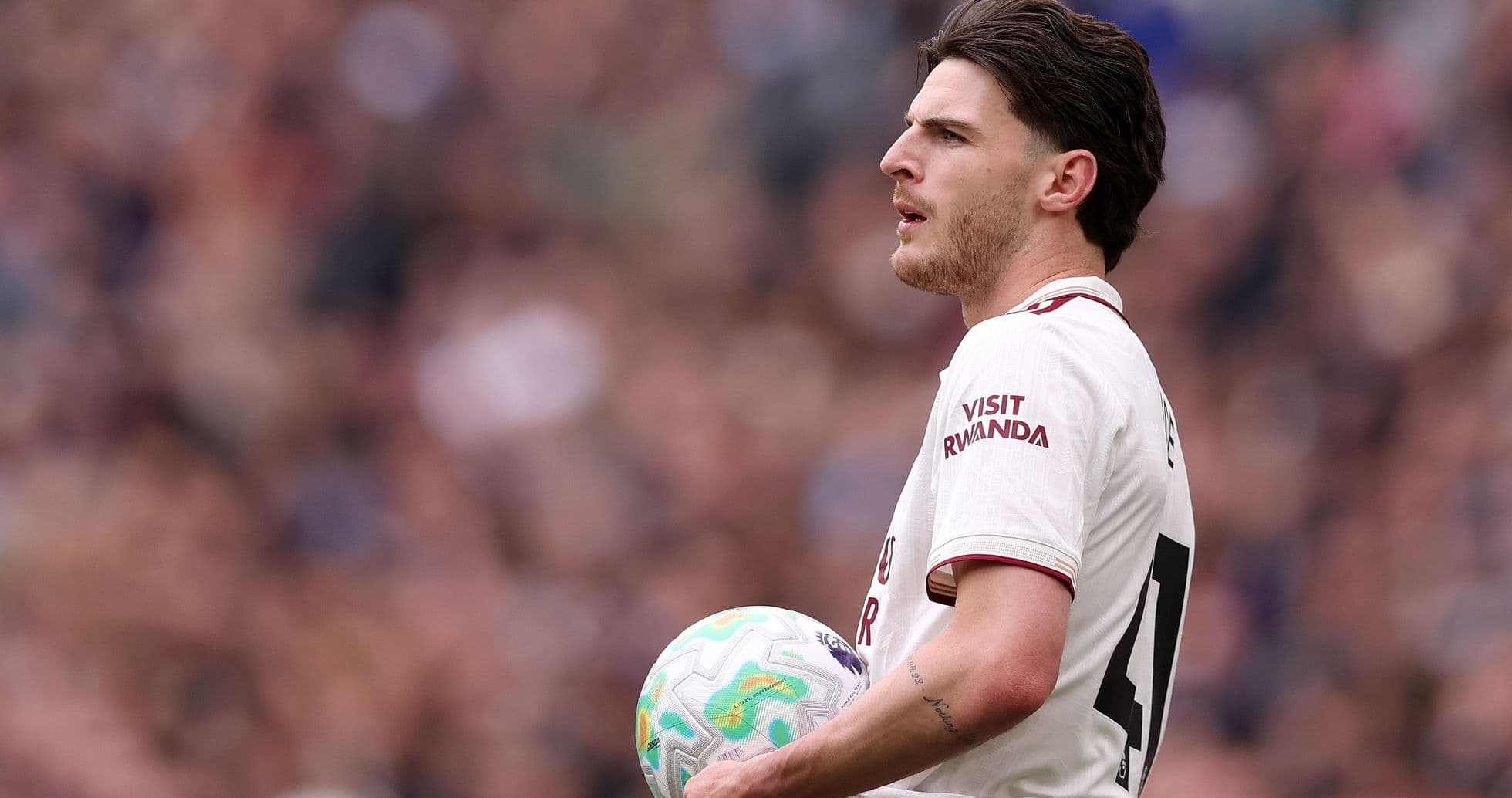
Arteta’s answer at the London Stadium was bold. He dragged Declan Rice out of the role that has defined Arsenal’s season and pushed him to the right flank to steady the back line. For a while, their £100m midfield engine became a makeshift full-back, before Cristhian Mosquera eventually took over.
It was more than a quick tactical patch. It was a glimpse of what the run-in might look like.
Rice has been the heartbeat of this title charge, the constant presence in front of the defence, dictating tempo and driving Arsenal forward. Five goals and 11 assists in 53 appearances tell part of the story; the authority with which he has patrolled midfield tells the rest. Yet now, with bodies running out, his versatility is being dragged into the spotlight.
The debate has already started.
On The Good, The Bad and The Football podcast, Paul Scholes and Nicky Butt went straight back to the 1990s for a comparison. Butt recalled how Roy Keane once spent most of a season at right-back to plug a gap at Manchester United. It was not his natural home, but it worked because of who he was.
“Roy Keane played right-back for two-thirds of a season,” Butt said, underlining just how long a top midfielder can be sacrificed for the greater good.
Scholes picked up the thread. “He played there loads because United had Bryan Robson and Paul Ince. Roy played there loads and was brilliant. Declan Rice looks like he would suit playing at right-back to me. He can play there. He’s not a big creator anyway.”
It is a pointed observation. Rice’s value does not lie in threading eye-of-the-needle passes in the final third; it lies in control, aggression, recovery runs, and the ability to shut down danger before it blooms. Those traits translate well to a modern full-back role, especially in a side that dominates the ball.
The question is whether Arsenal can afford to lose him from the middle when the stakes are this high.
Arsenal sit top of the Premier League with 79 points from 36 matches, five points clear of Manchester City. The table flatters them only slightly; City still have a game in hand and the experience of hunting down leaders in May. Any slip from Arsenal now feels fatal. Every selection call is a risk-reward equation.
Arteta’s next decision comes quickly. Burnley visit the Emirates on Monday. It is a game Arsenal are expected to control, but expectation has crushed better teams in title races. Does the manager trust Mosquera from the start, keeping Rice where he has been so influential? Or does he double down on the West Ham experiment and lock Rice into the back four, betting that his presence there will prevent the kind of chaos that can derail a season in a single half?
The calendar offers no breathing space. After Burnley, Arsenal finish their Premier League campaign away at Crystal Palace, a fixture that has tripped them up before. Then comes Budapest and Paris Saint-Germain in the Champions League final on May 30, the club’s biggest European night in a generation.
White’s injury has not just shuffled a back line. It has forced Arteta to weigh two versions of his team: one with Rice as the axis in midfield, another with Rice as the emergency right-back, echoing the Keane role Scholes and Butt remember so well.
Titles are often decided by moments, but they are also shaped by choices like this. Where does Declan Rice do the most damage for Arsenal now – in the heart of the pitch, or guarding a vulnerable flank when the season’s biggest prizes are on the line?