Declan Rice's Boot Transition: From adidas to Nike and Beyond
At London Colney, the first clue wasn’t a headline or a leaked document. It was a pair of boots.
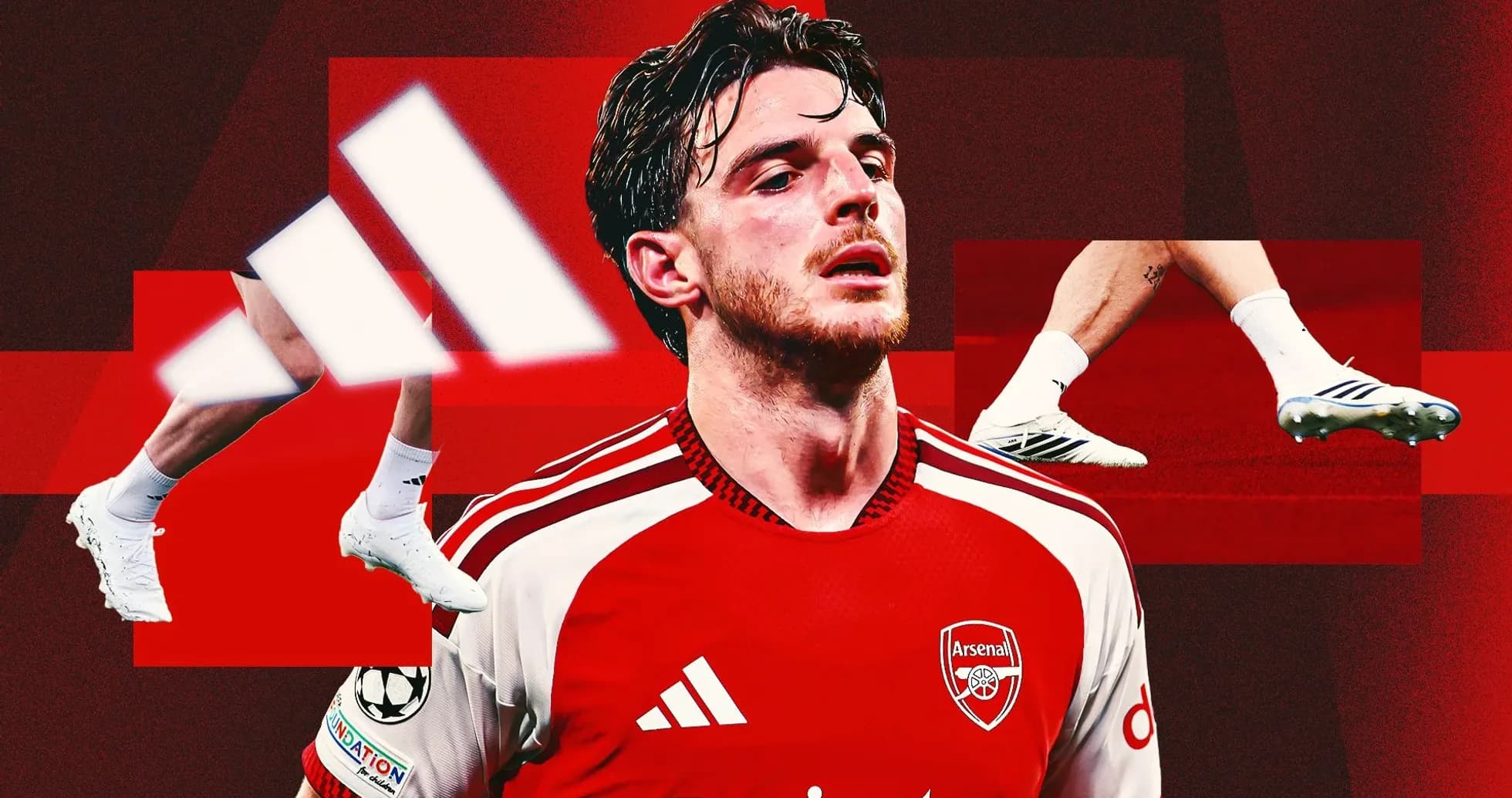
In late August, Declan Rice stepped out for Arsenal training not in his familiar adidas COPA Pures, but in gleaming white, red and gold Nike Tiempo Maestris. For boot-spotters, that’s not a fashion choice. It’s a flare in the sky.
After seven years with adidas, Rice suddenly looked like a man shopping around.
From Three Stripes to Swoosh… and Beyond
The sight of Rice in Nikes instantly set the industry talking. A switch from adidas to Nike would mark a return rather than a debut. The 27-year-old began his professional journey as a Nike athlete, wearing Tiempos throughout his rise at West Ham before signing with adidas in 2019.
The Tiempo line is familiar territory for him – Nike’s answer to the heritage COPA, built for players who value comfort and control. On paper, it’s a seamless alternative.
But this isn’t a straight two-horse race.
Rice hasn’t just flirted with the Swoosh and gone back. After that first training session in Tiempos, he briefly reverted to his COPAs, then turned up earlier in September in a completely unbranded whiteout pair at London Colney. In matches, he’s still in adidas – almost certainly down to existing contractual obligations – but the training ground tells a different story.
That unmarked pair didn’t stay a mystery for long. Specialists quickly identified the shape as Under Armour’s new Magneto 6, a far more left-field option than Nike’s flagship models and a clear sign Rice is casting the net wide before signing his next lucrative deal.
Whiteouts and blackouts rarely happen by accident. They usually signal that a contract is running down or that a parting of ways has already been agreed. Rice’s recent rotation feels like a classic case of a top player weighing up his next move before what looks increasingly like a break from adidas.
The adidas Question
What’s driving the change? That part remains unclear.
After seven years with the German giant, Rice might simply want something new on his feet and his balance sheet. But the timing and the pattern suggest more than boredom with a boot silo.
Rice has been one of the faces of adidas’ more understated COPA range and has featured in various campaigns over the years. Yet it’s hard to place him alongside the brand’s true poster boys. On the men’s side, that spotlight currently falls on Lionel Messi, Lamine Yamal and Jude Bellingham.
The hierarchy has been obvious. A recent example stung: adidas’ slick, five-minute World Cup short film, “Backyard Legends”, rolled out Hollywood star Timothee Chalamet and the Three Stripes’ main trio, alongside Ousmane Dembele, Pedri, Raphinha and Florian Wirtz. Rice was nowhere to be seen.
The same story played out before Euro 2024, when Bellingham fronted the pre-tournament push. Rice, England regular and Premier League powerhouse, again stood on the outside of the marquee moments.
Domestically, he’s known as a big character with a warm, engaging personality. On the pitch, he’s one of the best midfielders in the world. Globally, though, his profile hasn’t quite exploded to match that status. A new boot partner, with a different vision of his marketability, might feel like the catalyst he needs.
From a purely commercial standpoint, the logic is obvious. At adidas, he’s part of a packed roster. At Nike or Under Armour, he would instantly become one of the standout names. That kind of elevation – more attention, more campaigns, more storytelling built around him – could easily sway the decision.
There’s also another angle: this might not be Rice walking away from adidas, but adidas stepping back from Rice. Brands routinely reassess their portfolios, and if they feel they’re not getting enough commercial return, they can choose not to extend. Players are usually informed in the final year of their deal, and funding and promotional backing often tail off once that call is made.
Rice’s recent absence from adidas’ big set-piece campaigns fits that pattern neatly.
A Changing Boot Landscape
This isn’t happening in a vacuum. The boot market has been reshaped in the years since Covid-19.
Nike, for instance, cut ties with several elite players as part of a strategy to focus on its biggest commercial weapons: Cristiano Ronaldo, Kylian Mbappe, Marcus Rashford and a select few others. The message across the industry has been clear – if you’re not central to the brand story, you’re expendable.
At the same time, top players have become more demanding. Sources told The Athletic that some elite footballers actively look elsewhere because they “require more attention and promotion than they have sometimes received from the largest brands”. For a player of Rice’s standing, that sentiment would resonate if he feels overlooked by the Three Stripes.
Money sits right at the heart of it. At the top end, boot deals can be worth 10-15% of a player’s club salary. If another brand offers stronger terms, plus a bigger role in their narrative, heads will turn. They always do.
There’s also a broader trend: autonomy. Control. Players want more say over how they look and how they’re sold to the world.
Vinicius Junior famously blacked out his Nike boots in 2022, a pointed response to what he felt were unsatisfactory new terms after his contract expired. He wanted a partner “willing to invest in his brand through campaigns and activation worldwide”. Nike eventually paid up and kept him, but not before the message was delivered in the most visible way possible.
Now Mbappe, the heir to Ronaldo as Nike Football’s modern face, is being linked with a sensational break from the Swoosh after two decades. The reported suitor? An “unknown” disruptor – widely rumoured to be Swiss running specialists ON – where he would have a stake in the company, influence product strategy and the freedom to co-design his own signature line.
That’s the new frontier: not just endorsement, but ownership and authorship.
On a slightly smaller scale, second-tier brands are aggressively building star rosters. PUMA, Under Armour, New Balance and Mizuno have all pulled big names away from Nike and adidas. Neymar, Kai Havertz, Bukayo Saka, Eberechi Eze and Ibrahima Konate have all made that jump in recent years, trading mega-brand status for more central billing and very healthy contracts.
Others have gone even further. Bayern Munich and France star Michael Olise famously doesn’t have a boot deal at all. Former Arsenal defender Hector Bellerin once simply bought his boots online. For some, independence is the ultimate statement.
What Happens Next?
For all the noise, an adidas renewal for Rice cannot be dismissed.
We’ve seen this movie before. Players test alternatives, black out their boots, send subtle – and not-so-subtle – messages, then circle back to their original supplier on improved terms. Erling Haaland did it. Vinicius Jr did it. Both used uncertainty as leverage before signing new deals.
Rice’s current boot carousel feels like the same game of high-stakes brinkmanship. Nike’s Tiempos, Under Armour’s Magneto 6, unbranded whiteouts, the contractual adidas in matches – each step is a data point for him and a nudge for the brands watching.
He’s not just changing boots. He’s testing his value.
Right now, the only certainty is that something is shifting. A midfielder who has quietly become one of the most influential players in Europe is finally forcing the conversation about how he’s marketed off the pitch.
The next contract he signs won’t just decide what’s on his feet. It will tell us exactly how the football world – and the brands that shape it – really see Declan Rice.