Cristiano Ronaldo's Journey: From Manchester Battles to World Cup Dreams at 44
Cristiano Ronaldo has spent two decades redefining what a football career can look like. Manchester United knew they were buying raw electricity when they plucked him from Sporting in 2003. Nobody knew they were signing a phenomenon who would bend the sport’s record books to his will.
Now 41, wearing the yellow of Al-Nassr in the Saudi Pro League, he is still collecting titles. Another domestic crown sits alongside those from United, Real Madrid and Juventus. The numbers keep climbing, the milestones keep falling. The chase for 1,000 competitive goals is real. So are the five Ballons d’Or and the stack of Champions League trophies that have framed his era.
And he is not done yet. Ronaldo is preparing to captain Portugal at the 2026 World Cup. The story, somehow, keeps stretching.
“He was crying, but he would wake up”
To understand how, you go back to Manchester. Back to the training pitches where a skinny teenager from Madeira met the unforgiving edge of elite English football.
Eric Djemba-Djemba was there. The former United midfielder watched those first battles unfold and, speaking to GOAL courtesy of Betinia NJ, painted a vivid picture of a talent forged under fire.
“I'm so happy for him because he wants to be there, he always wants to be first, he always wants to be there winning the game, winning the training,” Djemba-Djemba said.
Training at Carrington was no sanctuary. It was a test. Every day.
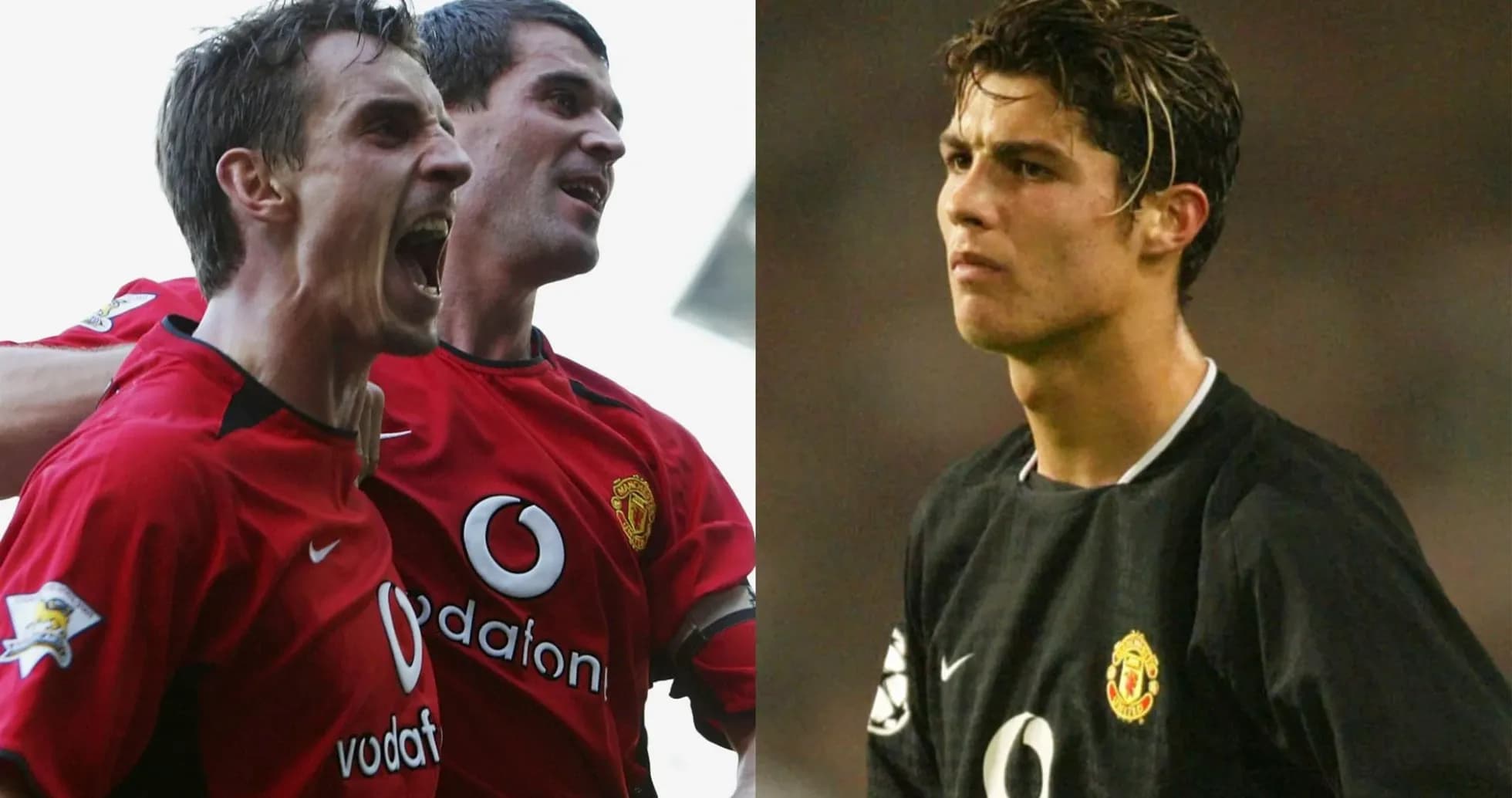
“I remember the training, people they can tackle him every time - Gary Neville, Roy Keane, they were tackling him, but he was there, he was crying, but he would wake up, continue running, and I'm happy for him, he deserved it.”
Those are not the images that usually accompany talk of one of the game’s great “mentality monsters”: a teenager in tears, repeatedly chopped down by senior pros. But that is where the legend took shape. Hit, get up, go again. Ronaldo built a career on that loop.
The “robot” who refuses to slow down
Four World Cups later, he is still out in front, still redefining longevity. Djemba-Djemba looks at his former team-mate and sees a machine with no obvious off switch.
“I think he can go to 44, 45, Cristiano can do that, he has energy to do that,” he said. “He's amazing. I don't know how he does it, but he's a robot, he's amazing! I think Cristiano can go until 44, but he cannot do until 44, 45, with the national team and his team. But Cristiano can go to 44, easily.”
That is the tension now. Club and country. League and World Cup. The body might allow him to keep playing into his mid-40s, but can he carry both loads? Even Djemba-Djemba, who backs him to stretch the limits, draws a line between the relentless rhythm of club football and the emotional, physical strain of international duty.
Yet when the conversation turns to the World Cup, certainty fades. Because this is Ronaldo. The normal rules rarely apply.
A World Cup in Portugal – and one last act?
By 2030, FIFA’s showpiece will be shared by Portugal, Spain and Morocco. A World Cup on home soil, in the country that raised him and then built statues in his honour. Ronaldo would be 45.
On paper, it sounds fanciful. On the pitch, he has spent a career turning that sort of talk into a challenge.
Djemba-Djemba will not rule it out.
While he accepts the difficulty of juggling domestic and international demands deep into his 40s, he can still see the image clearly: Ronaldo, back home, one final tournament, a farewell on the biggest stage of all.
“I think if Cristiano goes to 44, and in four years the World Cup is in Portugal, if Cristiano is still playing, I think it will be a good last competition for him to finish his career in Portugal with the World Cup,” he said.
And if he is still lacing up his boots, Djemba-Djemba is in no doubt how the country would react.
“I'm sure in Portugal they will say yes for the manager to bring him to be there in the squad. I would do that for him, bring him in the squad, to say to him thank you for everything he did for his country.”
It is a powerful idea: the teenager who once cried on a Manchester training pitch, hacked down by senior pros, walking out at a World Cup in Portugal at 44 or 45, carrying a nation’s gratitude on his shoulders one last time.
Impossible? That word has never sat comfortably next to Cristiano Ronaldo’s name.