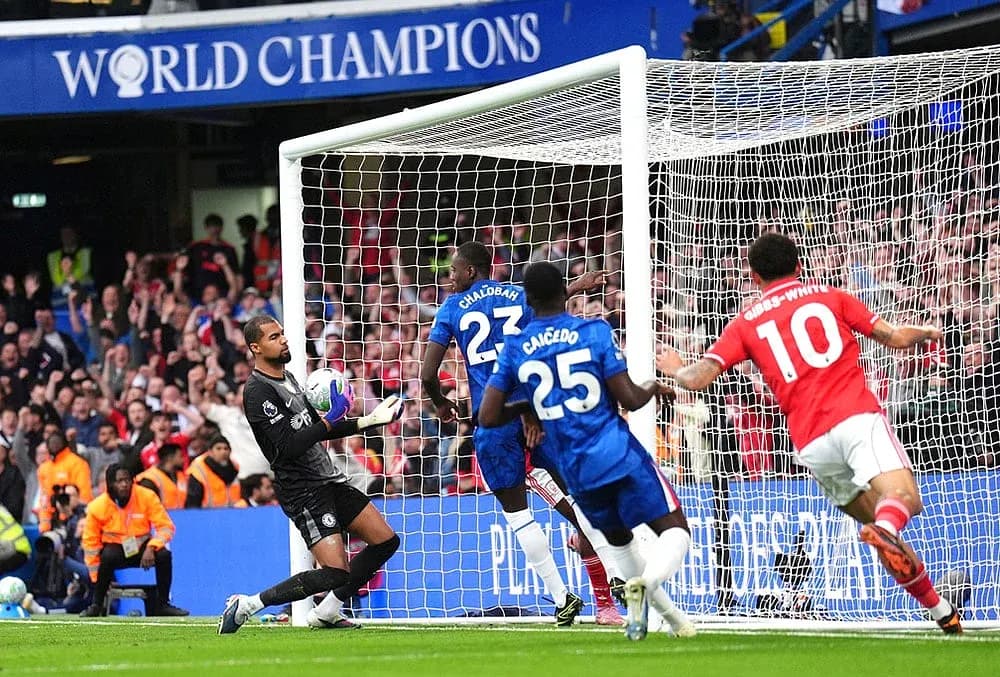
Chelsea's Season Takes a Dark Turn After Defeat to Nottingham Forest
Stamford Bridge had the feel of a crossroads fixture, and following this result the story of Chelsea’s season took a darker turn while Nottingham Forest’s survival arc gathered real momentum. In a Premier League campaign where the numbers have often flattered to deceive, this 3-1 away win crystallised the underlying trends of both sides.
Chelsea came into Round 35 in 9th place with 48 points, their overall goal difference a fragile +6 built on 54 goals scored and 48 conceded. The season’s statistical DNA already hinted at imbalance: at home they had scored 24 and conceded 24 in 18 matches, averaging 1.3 goals for and 1.3 against. Forest arrived 16th on 42 points, their overall goal difference -2 (44 scored, 46 conceded) but with a quietly impressive away profile: on their travels they had scored 26 and conceded 25 in 18 matches, averaging 1.4 goals for and 1.4 against. That symmetry away from home foreshadowed the cold efficiency they would show in west London.
Calum McFarlane’s Chelsea kept faith with the 4-2-3-1 that has underpinned their season, a shape they have used in 30 league matches. Robert Sánchez started in goal behind a back four of Malo Gusto, Trevoh Chalobah, Tosin Adarabioyo and Marc Cucurella. In front of them, Romeo Lavia and Moisés Caicedo formed a double pivot, with Cole Palmer, Enzo Fernández and academy product Josh Derry supporting Joao Pedro as the lone forward.
Across the technical area, Vitor Pereira opted for something more direct: a 4-4-2 that departed from Forest’s usual 4-2-3-1 template (used 29 times this season). Matz Sels anchored a back line of Z. Abbott, Cunha, Morato and Luca Netz. The midfield four of Dilane Bakwa, Ryan Yates, Nicolás Domínguez and James McAtee was built to run, press and break, while Igor Jesus partnered Taiwo Awoniyi up front.
The absentees framed the tactical voids on both sides. Chelsea’s list was long: M. Mudryk suspended, A. Garnacho and Pedro Neto inactive, J. Gittens and an unnamed hamstring victim missing through muscle issues. The upshot was a shortage of natural wide threats and senior rotation options in the attacking band, forcing Derry into a high-responsibility role and placing an even heavier creative burden on Palmer and Enzo.
Forest’s injury sheet was arguably more structural. O. Aina, W. Boly, John Victor, Murillo, D. Ndoye, I. Sangaré and N. Savona were all unavailable, along with C. Hudson-Odoi. That stripped Pereira of two centre-backs (Boly, Murillo), a starting full-back (Aina), a key ball-winner (Sangaré) and his most natural wide outlet in Hudson-Odoi. The response was to compress the team’s risk profile: a compact 4-4-2, conservative full-backs, and a heavy emphasis on vertical transitions.
Discipline has been a defining theme of Chelsea’s season, and it hung over this match. Across the campaign, their yellow cards peak late: 22.35% between 76-90 minutes, with another 20.00% between 61-75. Their red-card distribution is spread alarmingly evenly, with a noticeable spike of 28.57% in the 61-75 band. Caicedo personifies that edge: 10 yellows and 1 red in 30 appearances, plus 46 fouls committed. Cucurella and Chalobah also arrive with a red card apiece. Forest, by contrast, tend to lose their composure just before and just after half-time, with 23.21% of their yellows in each of the 46-60 and 61-75 ranges, and their solitary red of the season coming in the 31-45 window. Yet at Stamford Bridge, it was Chelsea’s structural indiscipline rather than a single flashpoint that proved costly: chasing a 0-2 half-time deficit, they were forced into riskier pressing and wider distances between lines, exactly the scenario their card profile warns against.
The “Hunter vs Shield” duel was defined by Joao Pedro on one side and Forest’s away defensive record on the other. Pedro entered the game as one of the league’s elite forwards: 15 goals and 5 assists in 33 appearances, with 48 shots (28 on target) and 29 key passes. He is not just Chelsea’s finisher but also their conduit, reflected in 656 passes at 76% accuracy and 67 dribble attempts. Up against a Forest side conceding 1.4 goals away on average, the expectation was that he would find chances.
Yet Forest’s “shield” was collective. Morato and Cunha formed a physically dominant axis, while the double screen of Yates and Domínguez cut off the inside channels that Pedro and Palmer thrive on. Forest’s broader defensive profile helped them here: they have kept 5 clean sheets away and, even when conceding, rarely collapse, with their heaviest away defeat only 3-0. At Stamford Bridge, even when Chelsea did pull one back after the break, Forest’s structure never truly disintegrated.
In the “Engine Room” duel, Caicedo’s duel with Forest’s midfield was the match’s hidden narrative. Caicedo’s season numbers are those of a high-end enforcer-playmaker hybrid: 1,877 passes at 92% accuracy, 83 tackles, 56 interceptions and 14 successful blocks. He is the metronome and the fire blanket. But without a fully fit and rhythmically sharp Lavia beside him and with Enzo pushed higher, Chelsea’s rest defence was repeatedly exposed to Forest’s two-striker transitions. Yates and Domínguez, supported by McAtee’s drifting between the lines, dragged Caicedo into wider zones, opening central lanes for Awoniyi and Igor Jesus to attack.
On the flip side, Forest’s own creative fulcrum, M. Gibbs-White, started on the bench but loomed over the narrative as their season’s chief chance-maker: 13 goals, 4 assists, 46 key passes and 52 dribble attempts. His presence among the substitutes gave Pereira a late-game control lever if required, but Forest’s early 2-0 lead made his introduction more about game management than rescue work.
From a statistical prognosis standpoint, the result aligns more with Forest’s trajectory than Chelsea’s. Heading into this game, Chelsea’s overall scoring average of 1.5 goals per match was offset by 1.4 conceded; they had kept only 9 clean sheets and failed to score 7 times. Forest mirrored them with 1.3 goals scored and 1.3 conceded overall, 9 clean sheets and 14 blanks, but crucially they were trending upwards with a form line of WWWDW. Chelsea, by contrast, were in freefall with LLLLL.
A 3-1 away win at Stamford Bridge is an outlier in scoreline but not in underlying direction. Forest’s compact 4-4-2, ruthless first-half finishing and controlled aggression dovetailed with Chelsea’s late-card tendencies, shaky home record (6 wins, 5 draws, 7 losses) and overreliance on Joao Pedro’s individual brilliance. Following this result, the numbers tell a simple story: Forest’s survival is being built on clear tactical identities away from home, while Chelsea’s season is being defined by structural imbalance, disciplinary risk and a growing disconnect between their talent and their table position.