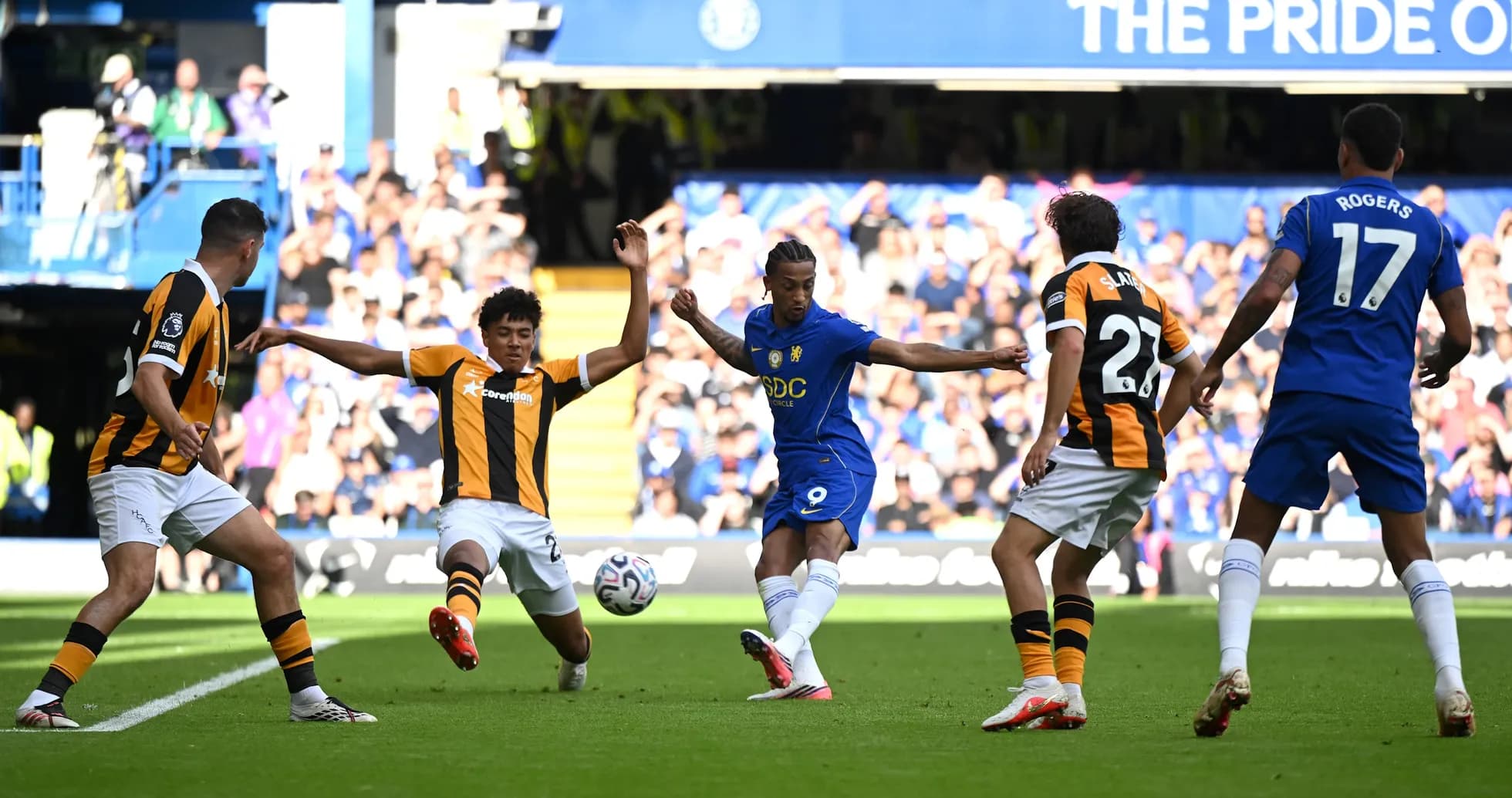
Chelsea and Hull City Battle to 2-2 Draw: Tactical Insights
Stamford Bridge closed its afternoon under a grey London sky with the sense of a story half-finished. Chelsea and Hull City shared a 2-2 draw, but beneath the scoreline lay two very different tactical identities colliding in Round 4 of the Premier League season.
I. The Big Picture – Two projects, one stalemate
Following this result, Chelsea sit 5th with 7 points, their overall goal difference at +1 after scoring 10 and conceding 9 across 4 matches. At home they remain unbeaten: 1 win, 1 draw, 6 goals for and 5 against at Stamford Bridge. This is a side whose seasonal DNA is clear already – high-output, high-risk football. They average 3.0 goals for at home but also 2.5 conceded, with no clean sheets in any venue and not a single game where they have failed to score.
Hull City leave London still unbeaten and perhaps feeling they let something slip. They remain 3rd on 8 points, with an overall goal difference of +3 from 5 scored and only 2 conceded. On their travels they have been impressively efficient: 1 win, 1 draw, 3 goals for and just 2 against, part of a broader defensive record that includes 3 clean sheets overall. If Chelsea’s season is a wild open book, Hull’s is a carefully curated file: controlled, compact, rarely chaotic.
The 2-2 at half-time – Chelsea 1-2 down – and the full-time parity captured the broader narrative: an expansive, attacking Chelsea trying to punch through a disciplined Hull 5-4-1, with the visitors threatening to steal the points through structure and set resilience.
II. Tactical Voids – Who was missing, and what that meant
Chelsea came into this fixture without a spine of experience and ball-winning. M. Caicedo’s injury stripped Xabi Alonso of his most natural defensive midfielder, while J. Henderson’s wrist injury removed a vocal organiser and tempo-setter. E. Emegha and M. Palestra were also absent, trimming attacking rotation and wide options from the bench.
Their absence pushed responsibility onto R. Lavia as the single true holding presence, flanked by hybrid profiles like R. James and M. Gusto stepping into midfield lines. It made Chelsea more fluid, but also more vulnerable in defensive transitions – a pattern consistent with their season-long record of 9 goals conceded overall and 0 clean sheets.
Hull City had their own absentees, but of a different flavour. I. Ansah (back injury), J. Butland (arm injury), D. Gyabi and C. Hughes (both groin), E. Matazo (knee) and H. Morita (calf) left the visitors light in rotation, especially in central zones. Yet the starting structure remained intact, allowing S. Jakirović to lean on continuity: the same 5-4-1 that has been used in all 4 league matches.
Disciplinary trends also framed the contest. Heading into this game, Chelsea’s yellow cards were spread, but with a notable 33.33% spike in the opening 15 minutes and 22.22% between 76-90 minutes – a profile of a team that starts and finishes with aggression. Hull’s cautions peaked between 46-60 minutes at 30.77%, suggesting a side that tightens the screws early in second halves. In a match that swung in phases, those rhythms of risk were always likely to shape when tackles flew and tempers rose.
III. Key Matchups – Hunter vs Shield, and the engine room
The most compelling duel on paper and on grass was the “Hunter vs Shield”: Chelsea’s attacking trident against Hull’s low block.
João Pedro arrived as one of the league’s headline forwards. With 3 goals and 3 assists in 4 appearances, he has been both finisher and creator, taking 8 shots (4 on target) and winning 34 of 61 duels. Stationed as the lone striker in a 4-2-3-1, he was the reference point for everything Chelsea did vertically. Behind him, M. Rogers and C. Palmer brought different kinds of threat: Rogers with 3 goals, 1 assist and 12 dribbles attempted; Palmer with 2 goals, 2 assists, 12 shots and 9 key passes, the chief conductor between the lines.
They were up against a Hull side whose season has been built on defensive clarity. Overall, Hull have conceded just 2 goals, with an average of 0.5 against per match and 3 clean sheets. On their travels, they allow only 1.0 goal per game. The back five of L. Coyle, S. Ajayi, J. Egan, N. Mendy and R. Giles formed a compact shell in front of K. Tzolakis, narrowing the central channels where João Pedro and Palmer like to combine.
The true two-way pivot of the contest, though, was M. Belloumi. Officially a midfielder in Hull’s 5-4-1, he has been their creative and defensive heartbeat: 2 goals, 1 assist, 8 shots, plus 10 tackles, 3 successful blocks and 9 interceptions in just 315 minutes. Belloumi’s capacity to spring counters and then drop in alongside M. Crooks and R. Slater gave Hull a platform to break Chelsea’s rhythm.
On the other side, Chelsea’s “engine room” lacked Caicedo but leaned on the versatility of J. Hato. The 19-year-old, listed among the league’s leading assist providers with 2, has contributed 7 tackles, 2 blocks and 2 interceptions, embodying Alonso’s desire for defenders who can both break and build play. Flanked by L. Colwill and W. Fofana, Hato’s positioning was crucial in containing O. McBurnie, Hull’s physical focal point who has 6 shots, 3 on target, 2 yellow cards and a relentless 74 duels contested.
McBurnie’s duel with Chelsea’s centre-backs was as much about territory as goals. His ability to win 36 of those 74 duels and draw 9 fouls allowed Hull to climb the pitch, especially when under sustained pressure. With Crooks – another card-prone enforcer with 2 yellows in just 159 minutes – stepping into challenges, Hull’s midfield tried to disrupt Palmer’s and Rogers’ timing between the lines.
IV. Statistical Prognosis – Chaos vs control
Following this result, the underlying trajectories remain intact. Chelsea’s attack is elite in volume: 10 goals overall, with an average of 2.5 per match, and 2.0 on their travels. Yet their defensive record – 9 conceded overall, 2.3 per match – keeps them on a knife-edge. They have not missed a penalty this season, but they have not taken one either; their margins are carved almost entirely in open play.
Hull City, by contrast, are the embodiment of control. They score modestly – 1.3 goals per match overall, 1.5 on their travels – but they defend with remarkable discipline, conceding 0.0 at home and 1.0 away. Their unbeaten run, with 2 wins and 2 draws, is built on structure rather than volume.
In xG terms – if we translate the season’s patterns into probabilities – Chelsea’s games feel like 3- or 4-goal affairs waiting to happen, while Hull’s tend to be decided on finer margins. The 2-2 draw at Stamford Bridge, with Chelsea’s attacking wave meeting Hull’s organised resistance, fits both narratives perfectly.
Following this result, the prognosis is clear: Chelsea will continue to live on the edge, needing their front four of João Pedro, Rogers, Palmer and the advancing full-backs to outscore their own instability. Hull will keep climbing if their defensive platform holds and Belloumi continues to bridge defence and attack. On this evidence, both projects are on course – one chasing control through chaos, the other chasing points through order.