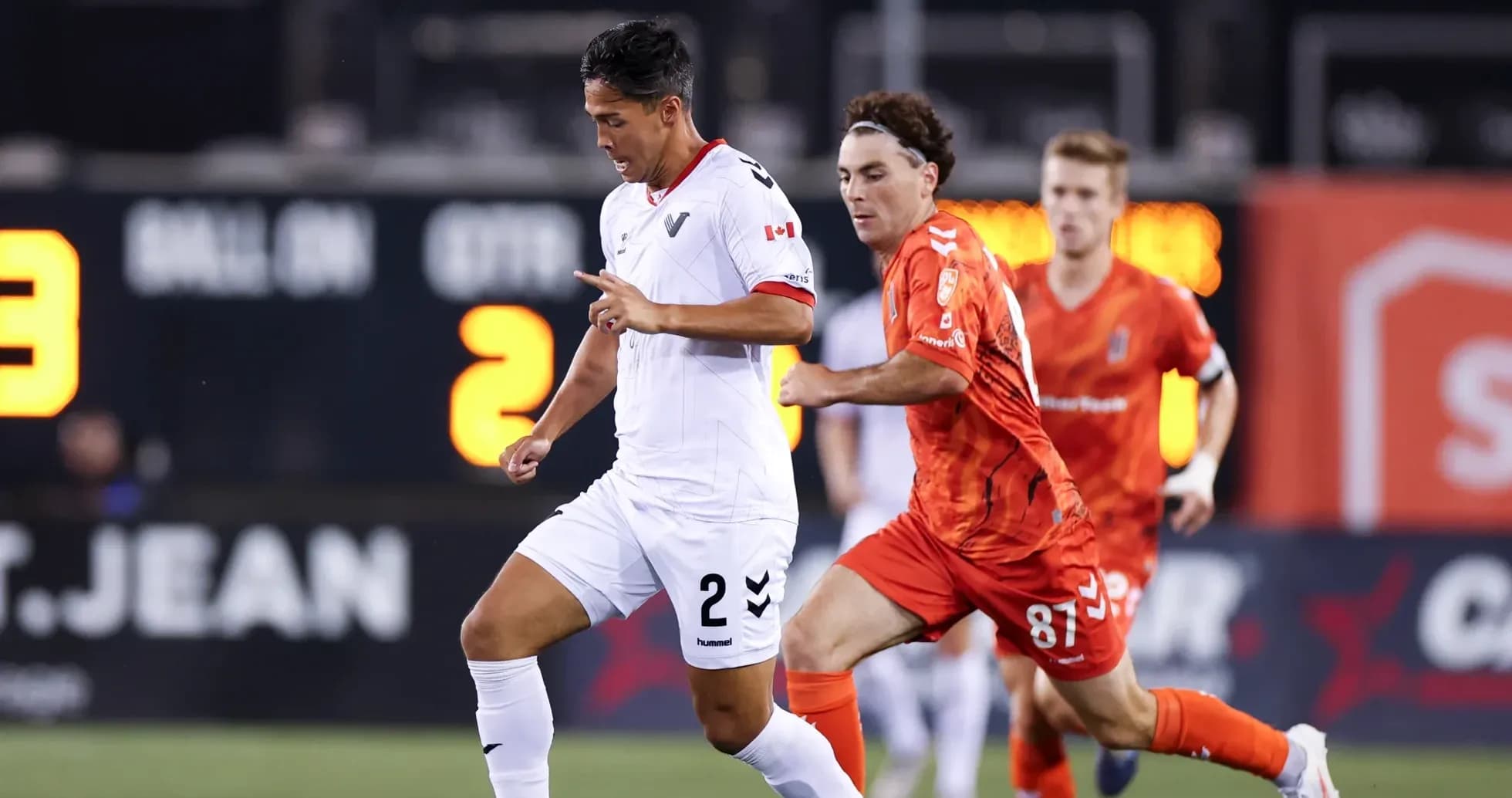
Cavalry FC Dominates Supra du Quebec 6–0 in Canadian Premier League Showdown
The lights at ATCO Field had barely cooled when the numbers began to tell the story. In the chill of a Foothills County night, Cavalry FC did more than beat Supra du Quebec; they underlined the gulf between a side cruising at the top of the Canadian Premier League and one still learning what it takes to live there. A 6–0 full-time score, after a 2–0 half-time lead, was not a freak result but the logical extension of two very different seasonal identities colliding.
Cavalry arrived as league leaders, first in the table with 53 points from 23 matches, and a goal difference of 35 built on 48 goals scored and only 13 conceded overall. At home they had been ruthless all campaign: 12 matches, 9 wins, 3 draws, 0 defeats, 30 goals for and 7 against. Supra, by contrast, came in as sixth with 25 points from 23 games, their overall goal difference of -13 a product of 31 goals scored and 44 conceded. On their travels they had been lively but fragile: 12 away fixtures, 4 wins, 2 draws, 6 defeats, 20 goals for and 27 against.
The formations on the night reflected those trajectories. Cavalry lined up in a 4-4-2, a slight departure from their more frequent 4-2-3-1 but perfectly suited to turning territorial dominance into penalty-box pressure. N. Ingham in goal had a back four of B. Kamdem, A. Didic, D. Klomp and A. Pearlman in front of him, a line that has been the backbone of a defence conceding only 0.6 goals per match overall and just 0.6 at home. Ahead of them, a midfield of G. Ntignee, E. Kobza, N. Myroniuk and N. Edwards supported a front two of A. Musse and Robert Owen Antoniuk.
Supra du Quebec’s 4-3-3, meanwhile, was more idealistic than pragmatic. With J. Milli in goal and a back four of C. Auguste, M. Chretien, Z. Brault-Guillard and D. Abzi, they leaned on volume passers and progressive full-backs who have often been asked to do too much. In midfield, A. Sissoko, Alessandro Biello and S. Rea formed a technically sound trio, while a front line of L. Kwemi, I. Conde and N. Santos carried the attacking threat that has delivered 1.7 goals per away game but at the cost of structural stability.
This was a match where absences were not the story; both coaches had access to their core personalities. Instead, the disciplinary histories of these squads hung over the contest like an unspoken risk. Cavalry, who spread their yellow cards fairly evenly but show a noticeable spike between 46-60 minutes at 23.53%, play with a controlled aggression that rarely spills into chaos. Their red cards this season have been rare, and crucially they have not missed from the penalty spot, converting all 4 attempts overall.
Supra, by contrast, live closer to the edge. Their yellow card curve rises steeply late on, with 21.67% of bookings arriving between 76-90 minutes, a period often coinciding with fatigue and chasing games. More telling is their red card profile: although not shown minute by minute here for individuals, the team has seen dismissals in the final quarter of matches, underlining how emotional and stretched they become when behind. Players like D. Abzi and M. Chretien, both prominent in the yellow and red card charts, illustrate that their back line’s aggression is as much a liability as an asset.
Within that context, the “Hunter vs Shield” battle was always going to be decisive. Supra’s main hunter, L. Kwemi, came into the fixture with 7 goals in 21 appearances, a forward who thrives on space and quick transitions. Alongside him, I. Conde added 3 goals and 1 assist in 15 appearances, a secondary threat with decent dribbling and penalty-winning ability. But they were running into one of the most complete defensive shields in the league: the Cavalry centre-back pairing of D. Klomp and A. Didic.
Klomp is not just a stopper; with 4 goals and 1 assist this season, he is a set-piece weapon. He has blocked 7 shots and won 52 of 92 duels, marrying aerial dominance with composure on the ball. Didic complements him with 2 goals and 3 assists, 6 blocked shots, and 13 interceptions, turning defence into a launchpad. Together with full-backs Kamdem and Pearlman—who has 2 assists and has won 65 of 104 duels—they created a line that not only shut down Kwemi and Conde but also stepped into midfield to suffocate Supra’s transitions.
The “Engine Room” confrontation was equally decisive. For Cavalry, E. Kobza and N. Edwards brought steel and verticality. Kobza, with 2 assists, 18 tackles and 10 interceptions this season, is the archetypal screening midfielder, happy to absorb pressure and foul when necessary—his 25 fouls committed and 7 yellow cards underline his role as enforcer. Edwards, with 3 goals and 8 key passes, adds a late-running threat that complicates marking schemes.
Supra’s counter-engine of Biello, S. Rea and Sissoko is technically refined. Biello’s 91% passing accuracy and 24 interceptions speak to his reading of the game, while Rea’s 3 assists and 40 key passes make him one of the league’s more creative midfielders. Sissoko, with 21 tackles and 11 interceptions, offers bite. But against Cavalry’s compact 4-4-2 block, their passing lanes were repeatedly compressed, forcing them wide where Cavalry’s full-backs and wide midfielders could double up.
Statistically, the outcome felt pre-written. Heading into this game, Cavalry’s home attack averaged 2.5 goals per match, while Supra’s away defence conceded 2.3. The intersection of those curves points exactly where the final score landed: a high-scoring home side exploiting a porous travelling back line. Conversely, Supra’s away attack, at 1.7 goals per match, met a Cavalry home defence conceding only 0.6, a mismatch that explained how easily the leaders managed a clean sheet.
From a tactical prognosis standpoint, this was the league’s most balanced unit imposing its will. Cavalry’s clean-sheet count—10 overall, split evenly between home and away—reflects a structure that holds even when the scoreline balloons. Their ability to marry that defensive platform with relentless attacking volume, especially at home, makes them overwhelming favourites in fixtures like this.
For Supra du Quebec, the story is more complicated. Their attacking pieces are individually good enough to trouble most sides, but the structural risk baked into their 4-3-3, combined with late-game disciplinary volatility, leaves them exposed against top-tier opposition. Until they can reconcile their desire to play with their need to protect a defence conceding 1.9 goals per match overall, nights like this in Foothills County will remain painfully familiar.