Brighton Dominates Wolves with 3–0 Victory at Amex Stadium
Brighton’s 3–0 home win over Wolves at the Amex Stadium was a controlled, possession-heavy dismantling that was effectively decided inside the opening five minutes. In this Premier League Round 36 fixture, Fabian Hurzeler’s side combined structured build-up with ruthless early execution, then managed the game through their passing and pressing. Wolves, under Rob Edwards, never established a stable attacking platform, limited to five shots and 28% of the ball, with their only clear threat arriving sporadically in transition. By full time, the 3–0 scoreline accurately reflected Brighton’s territorial dominance and superior organisation in every phase.
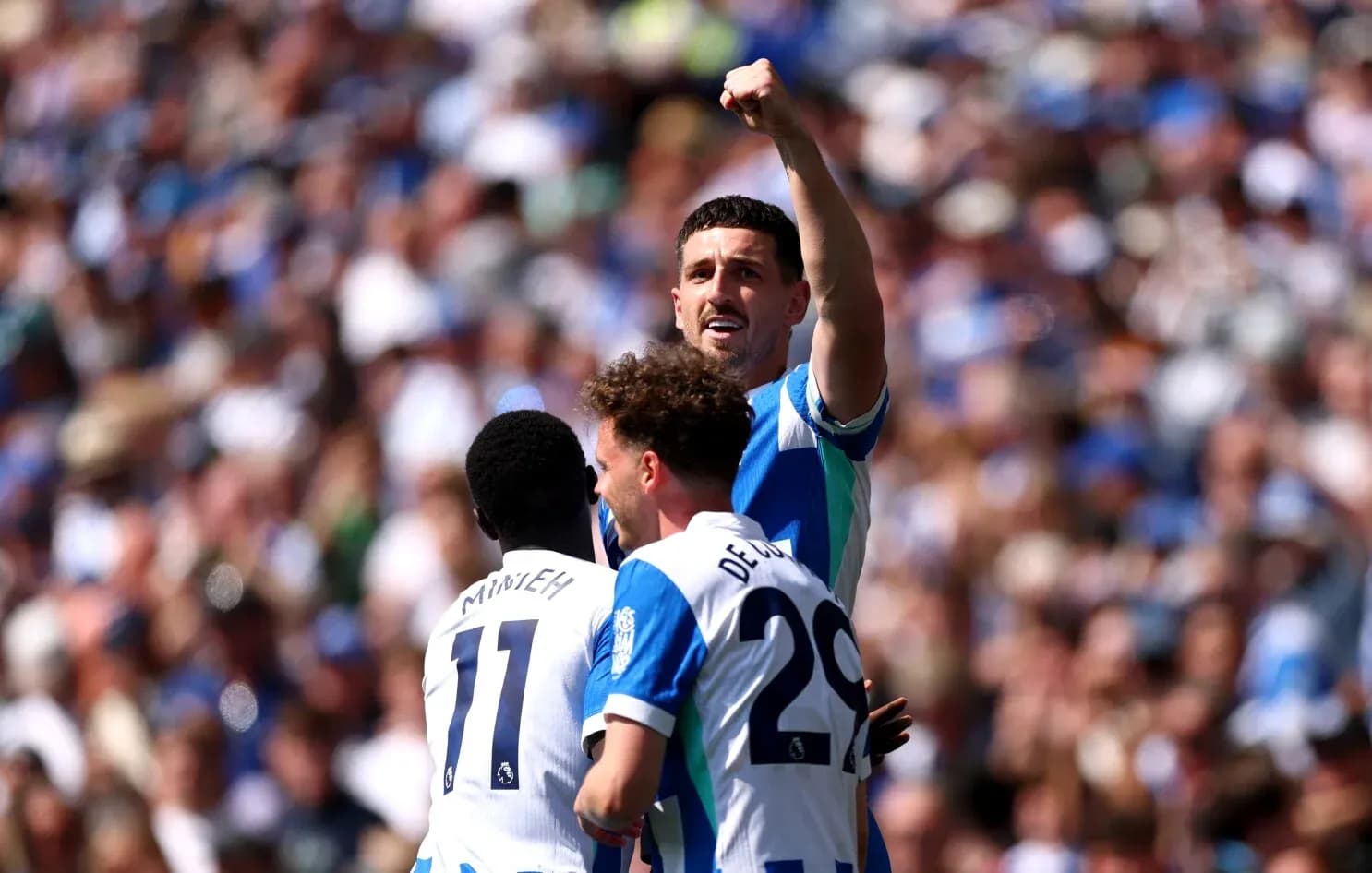
The scoring opened almost immediately. At 1', Jack Hinshelwood arrived from midfield to finish a move down Brighton’s left, assisted by Maxim De Cuyper. The Belgian was again decisive at 5', delivering for Lewis Dunk to make it 2–0, giving Brighton a two-goal cushion long before Wolves could settle into any structure. The only first-half card came at 24': Kaoru Mitoma (Brighton) — Foul.
Second Half Adjustments
With Brighton 2–0 up at the interval, Wolves made an adjustment at 46', as David Møller Wolfe (IN) came on for Hugo Bueno (OUT), a clear attempt to stabilise their left flank. At 49', Hwang Hee-chan (Wolves) — Foul, signalling Wolves’ growing desperation to disrupt Brighton’s rhythm. Hurzeler’s first change came at 58', Joël Veltman (IN) for Kaoru Mitoma (OUT), shifting Brighton towards a more conservative, defensively secure right side.
Wolves then doubled down on changes at 67', with Rodrigo Gomes (IN) for Pedro Lima (OUT) and Jean-Ricner Bellegarde (IN) for Mateus Mané (OUT), chasing more vertical thrust. The aggression brought another booking at 68': André (Wolves) — Foul. Brighton responded at 76' with a midfield refresh and a new focal point up front: Yasin Ayari (IN) for Carlos Baleba (OUT) and Georginio Rutter (IN) for Danny Welbeck (OUT), adding fresh energy between the lines and in pressing.
The final blow came at 86', when Yankuba Minteh struck Brighton’s third, a late goal that underlined their control rather than changing the game’s direction. Hurzeler then managed minutes and tempo at 88', with Charalampos Kostoulas (IN) for Jack Hinshelwood (OUT) and Solly March (IN) for Maxim De Cuyper (OUT). Wolves’ last roll of the dice arrived at 89', Angel Gomes (IN) for Hwang Hee-chan (OUT) and Tolu Arokodare (IN) for João Gomes (OUT), but the structure of the match was already fixed.
Card totals were: Brighton: 1, Wolves: 2, Total: 3.
Tactical Analysis
Tactically, Brighton’s dominance was built on their possession structure and full-back usage. With no formation explicitly listed, the personnel suggests a back four of Ferdi Kadıoğlu, Jan Paul van Hecke, Lewis Dunk, and Maxim De Cuyper, with Carlos Baleba and Pascal Groß forming the central platform. De Cuyper’s advanced positioning on the left was pivotal: he produced two assists inside five minutes, repeatedly overloading Wolves’ right and combining with Mitoma and Hinshelwood. Those early patterns forced Wolves’ block deep and narrow, opening central lanes for Groß and Hinshelwood to receive facing goal.
In possession, Brighton’s 72% share of the ball (578 total passes, 498 accurate at 86%) reflects a controlled, patient approach. Dunk and van Hecke recycled under minimal pressure, while Baleba acted as the primary outlet to break the first Wolves line. Groß’s positioning between Wolves’ midfield and defensive lines enabled Brighton to convert sterile possession into territory, constantly offering a forward passing option. The high volume of shots inside the box (10 of 14 total) shows how consistently Brighton progressed into dangerous central zones rather than relying on low-quality long-range efforts.
Out of possession, Brighton were compact and proactive. They committed only 9 fouls and received a single yellow, a sign of control rather than last-ditch defending. Their press, led by Welbeck and supported by Minteh and Mitoma, forced Wolves to play long from Daniel Bentley, breaking up any attempt at structured build-up. The fact Wolves managed just 5 total shots, with only 1 on target, underlines how rarely they could sustain attacks in Brighton’s half.
Individually, Bart Verbruggen’s role was more about concentration and distribution than shot-stopping; he made 1 save, with Wolves generating 0.49 xG. Brighton’s defensive line, anchored by Dunk, largely prevented high-quality chances before they reached the box. On the other side, Bentley was far busier, making 3 saves against a Brighton attack that produced 1.62 xG. Both goalkeepers are credited with 0.25 goals prevented, indicating that while neither was under siege, the finishing and defensive structures were broadly in line with the underlying chance quality.
The substitutions reinforced the tactical narrative rather than changing it. Veltman’s introduction for Mitoma nudged Brighton into a more balanced, slightly more conservative shape once the game state was secure at 2–0. Ayari and Rutter added legs and pressing intensity just as Wolves were tiring, which helped sustain Brighton’s territorial control and contributed to the late third goal. Wolves’ changes, in contrast, were reactive and search-based: fresh full-backs and forwards were introduced, but with only 225 passes (154 accurate, 68% completion) and just 1 corner, they never built the platform needed to exploit those attacking profiles.
Statistical Summary
Statistically, the verdict is clear. Brighton’s 3–0 win aligns closely with the underlying numbers: a 1.62–0.49 xG edge, 14–5 in total shots, and 6–1 in shots on target. Their passing accuracy of 86% versus Wolves’ 68% encapsulates the technical and structural gap on the day. The foul count (9 for Brighton, 11 for Wolves) and the card split (1 and 2) further illustrate how Wolves were chasing the game, often arriving late to duels as Brighton circulated possession. With both keepers posting identical goals-prevented figures but facing vastly different volumes and qualities of attack, the decisive factor was Brighton’s ability to convert early pressure into goals and then manage the match through superior structure and ball control.