Bournemouth vs Liverpool: A Tactical Analysis of the Premier League Clash
The Vitality Stadium felt tight and tense as Bournemouth and Liverpool walked out for a fifth-round Premier League meeting that laid bare the different realities of their seasons. For Bournemouth, 17th with 3 points and still without a win after 5 matches, this was about survival and self-belief. For Liverpool, 6th with 9 points and unbeaten, it was about control, patience and the quiet authority of a side that expects to be in the conversation come May. A 1–0 away win to Liverpool in regular time crystallised those trajectories.
I. The Big Picture – Two 4-2-3-1s, two very different identities
Both managers mirrored each other structurally in a 4-2-3-1, but the personnel and the season’s patterns told a different story.
Bournemouth’s season so far has been defined by fragility at both ends. Overall, they had scored 6 and conceded 8 in 5 matches, giving them a goal difference of -2. At home, they had 3 goals for and 4 against; on their travels, another 3 scored and 4 conceded. The averages underline the tightrope: at home they averaged 1.0 goal for and 1.3 against, away 1.5 for and 2.0 against, for an overall 1.2 scored and 1.6 conceded per match. There is enough attacking output to believe in, but not enough control to turn draws into wins.
Liverpool arrived with a more balanced profile. In total this campaign, they had 7 goals for and 4 against (goal difference +3), with a subtle split between Anfield and the road. At home they had scored 2 and conceded 2, averaging 1.0 for and 1.0 against; on their travels they had 5 scored and only 2 conceded, with away averages of 1.7 for and 0.7 against. Unbeaten in 5, with 2 wins and 3 draws, they had already banked 3 clean sheets overall, 2 of them away.
The formations on the day reflected these arcs. For Bournemouth, Đ. Petrović behind a back four of A. Smith, J. Hill, António Silva and A. Truffert set a clear defensive platform. In front, T. Adams and A. Scott formed the double pivot, with Rayan, R. Christie and M. Tavernier supporting lone forward Evanilson. It was a structure designed to compress space and then spring through Tavernier’s direct running and Evanilson’s link play.
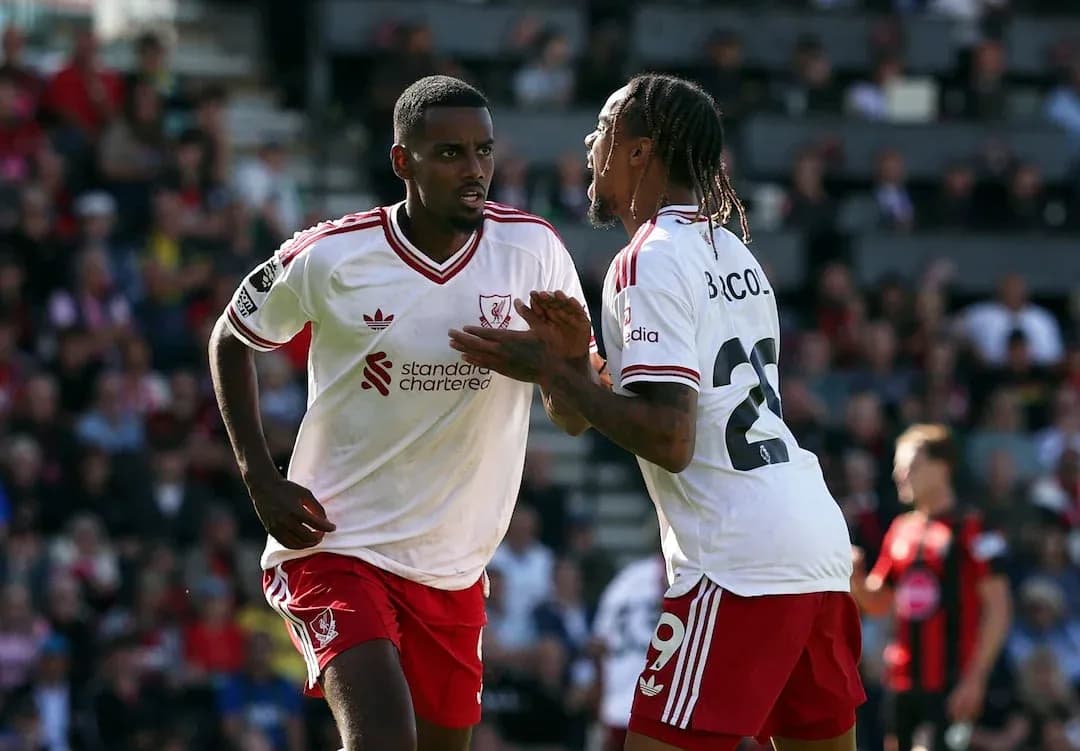
Liverpool, under Andoni Iraola, set up with Alisson Becker in goal and a back line of R. Araújo, J. Jacquet, V. van Dijk and M. Kerkez. The double pivot of D. Szoboszlai and A. Mac Allister gave them technical control, while the advanced line of C. Gakpo, F. Wirtz and B. Barcola buzzed behind A. Isak, one of the league’s most efficient finishers.
II. Tactical Voids – Absences and discipline shaping the contest
Both squads were notably thinned in specific zones. Bournemouth were without A. Adli, J. Araujo, J. Kluivert, E. J. Kroupi and V. Milosavljevic, stripping depth from wide and creative areas. That raised the burden on Tavernier and Christie to carry progression and final-third threat, especially given Bournemouth had failed to keep a single clean sheet in total this season and had already failed to score once at home.
Liverpool’s absentees were concentrated in their forward and rotational lines: C. Bradley, F. Chiesa, H. Ekitike and G. Leoni all missed out. The starting XI still had enough firepower, but Iraola’s bench options were more developmental and flexible than proven match-winners, placing extra onus on the starting front four to be decisive.
Discipline trends also framed the risk profiles. Bournemouth’s yellow cards this season skew heavily late: 42.86% of their bookings have come between 76–90 minutes, with another 21.43% between 46–60. That late-game surge in cards hints at fatigue and desperation when chasing games. Liverpool, by contrast, see 50.00% of their yellows between 46–60 minutes, a reflection of aggressive post-interval pressing, then a tapering off as game states settle. Neither side has seen a red in the league so far, but individual tendencies matter: A. Smith already has 3 yellows, and M. Kerkez and M. Tavernier have 2 each, putting the full-backs and Bournemouth’s key midfielder on disciplinary watch.
III. Key Matchups – Hunter vs Shield, and the battle for the middle
The headline duel was always going to be Alexander Isak against a Bournemouth defence that concedes more than it scores. In total this campaign, Bournemouth’s back line has allowed 1.6 goals per match on average, with no clean sheets. Isak, meanwhile, has 4 goals from 5 appearances, with 13 shots and 7 on target, and a rating of 7.47. He is not just a finisher; he has drawn 3 fouls, completed 4 dribbles and even blocked 2 shots, pressing from the front and defending from the front. Against a centre-back pairing of J. Hill and António Silva that is still bedding in, his movement between the lines and into the channels was always likely to stretch Bournemouth’s shape.
Behind him, C. Gakpo and F. Wirtz formed the creative brain. Gakpo, with 3 assists and 11 key passes so far, is one of the league’s most productive creators. His ability to receive between Bournemouth’s lines, turn and slide passes into Isak or Barcola tested the Adams–Scott pivot. Wirtz, floating centrally, added subtlety and timing, forcing Bournemouth’s midfield to decide whether to track him or hold their shape.
On the other side, Bournemouth’s hopes were pinned on the synergy between Tavernier and Evanilson. Tavernier’s season has been outstanding in spite of Bournemouth’s struggles: 3 goals, 12 shots (8 on target), 9 key passes and a rating of 7.52. He is both finisher and carrier, winning 26 of 56 duels and drawing 8 fouls. Evanilson, still goalless but with 3 assists and 6 key passes, is the facilitator. His 56 duels (25 won) and 10 fouls drawn show a forward who occupies centre-backs and buys territory.
Their challenge was to unpick a Liverpool defence anchored by V. van Dijk and protected by a midfield that concedes only 0.8 goals per match overall. Away from home, Liverpool have allowed just 2 goals in 3 matches, with an away average of 0.7 conceded. Van Dijk’s presence, alongside the emerging J. Jacquet and the combative Kerkez (who has already blocked 4 shots), meant Bournemouth’s wide overloads had to be precise. A. Smith’s overlapping on the right, despite his disciplinary risk, and A. Truffert’s surges on the left were key to generating two-versus-ones against Barcola and Araújo.
In the engine room, T. Adams versus D. Szoboszlai and A. Mac Allister was the tactical axis. Adams’ job was to break Liverpool’s rhythm, closing passing lanes into Wirtz and Gakpo while still offering a first pass into Tavernier and Christie. Liverpool’s double pivot, in turn, sought to pin Bournemouth back, switching play to isolate Barcola against Smith and inviting Kerkez forward to create overloads down the left.
IV. Statistical Prognosis – Why Liverpool’s structure told in the end
Heading into this game, the numbers pointed towards a narrow but controlled away performance. Bournemouth’s attack, averaging 1.0 goal at home, was always likely to create moments, especially through Tavernier’s form and Evanilson’s creativity. But their tendency to concede 1.3 at home, combined with a total lack of clean sheets, meant that keeping Liverpool out for 90 minutes was a tall order.
Liverpool’s away profile – 1.7 goals scored and 0.7 conceded per match – suggested a side comfortable in hostile environments, able to manage tempo and protect leads. Their penalty record this season is flawless: 1 taken, 1 scored, 0 missed, adding an extra layer of threat if Bournemouth’s late yellow-card surge tipped into box incidents.
In the end, the 1–0 away scoreline fits the statistical contours. Liverpool’s defensive solidity, the individual quality of Isak and Gakpo in the final third, and their comfort in low-margin matches on their travels aligned with the broader trends. Bournemouth’s 4-2-3-1 offered structure and moments of resistance, but with no clean sheets in total this campaign and a late-game disciplinary spike, they remain a side living on the edge, while Liverpool continue to move with the quiet, methodical stride of a team that trusts its numbers and its shape.