Bayern Munich Claim Supercup Victory Over Dortmund
Bayern Munich walked out of Signal Iduna Park on Saturday night with the Franz Beckenbauer Supercup in their hands and a familiar feeling in the air. Another trophy. Another win over Borussia Dortmund. A 2-1 scoreline that flattered the hosts, and yet still left Bayern with a few uneasy thoughts of their own.
Nathaniel Brown (28') and Michael Olise (45+1') put Bayern in control by half-time. Fabio Silva’s reply on 75 minutes gave Dortmund a late pulse, but not a comeback.
Behind that storyline, though, four themes dominated the evening.
Neuer: still a giant, now a gamble
Risk has always been Manuel Neuer’s trademark. It made him revolutionary. It helped turn Bayern into a side that could squeeze teams in their own half with a goalkeeper acting as an extra outfield player.
It now also makes him a problem.
The warning signs have been there for months. The glaring mistake to Arda Güler at the Bernabéu in April, when his loose pass handed Real Madrid a Champions League lifeline, still lingers. In Dortmund, the pattern repeated itself.
After 15 minutes, Neuer tried to thread a pass into Min-jae Kim, misjudged it, and almost put the centre-back – and his team – in trouble. Kim bailed him out with a sharp intervention. The danger vanished, but the doubt did not.
Late on, with Bayern trying to see the game out, Neuer invited chaos again. A routine back-pass from Kim turned awkward when the keeper tried to let Jobe Bellingham run past him with a feint behind his standing leg. The touch misfired, Bellingham suddenly had a clear look at goal, and only Neuer’s lightning reaction – diving at the ball to smother it – prevented a late equaliser.
He saved himself. He always has that in his locker. On the line, he remains elite.
Early in the second half, he underlined it again, flinging himself to keep out Konstantinos Karetsas’ tricky close-range effort. That reflex, that instinct, is still world class.
But the equation is changing. The moments of brilliance are now sharing space with moments of unnecessary risk. Bayern know this. They have Jonas Urbig waiting in the wings, a 23-year-old groomed as the heir and expected to see more minutes this season. The plan is clear: Neuer for the biggest nights, Urbig for the gradual handover.
The question is whether Neuer’s increasingly erratic work with the ball at his feet will accelerate that timeline. At what point does the risk outweigh the aura?
Nathaniel Brown: Bayern’s surprise No. 10 and new trump card
Bayern signed Nathaniel Brown as a left-back. On Saturday, he lined up as a No. 10 behind Harry Kane and walked away with the opening goal and a medal.
That alone tells you plenty about Vincent Kompany’s plans for him.
With Jamal Musiala absent due to a neurological issue that has already forced him off the pitch twice in pre-season, and new arrival Ismael Saibari not yet ready to start, most expected Tom Bischof to slot in as the playmaker. Kompany had other ideas.
Brown, who had already shown in pre-season that he could operate as a No. 6 and a No. 10 as well as at full-back, was dropped into the central attacking role. It was a bold call, but a deliberate one.
“For us, the spaces of the full-backs are sometimes similar to those of a No. 10. He is unbelievably good between the spaces,” Kompany told Sky after the 2-1 win, explaining why Brown started there. The coach pointed to the absences of Serge Gnabry, Lennart Karl and Musiala as part of the reasoning, but the trust was obvious.
Brown repaid it. His performance was not flawless – it couldn’t be, given he has only been at the club a few weeks and is still learning the automatisms in an unusual role – yet it was decisive. His opener set Bayern on their way and underlined why the club view him as more than just a left-back.
For a side that wants to compete on all fronts, that kind of positional flexibility is gold. And Brown is not alone.
Konrad Laimer can play on either side of defence and across the midfield as a No. 6, No. 8 or even a No. 10. Josip Stanisic can cover both flanks and step into central defence. Bayern’s full-backs are no longer just full-backs; they are puzzle pieces Kompany can drop into several different places.
On Saturday, Brown showed he might be one of the most valuable of the lot.
Kovac’s inverted wing-backs: brave idea, mixed reality
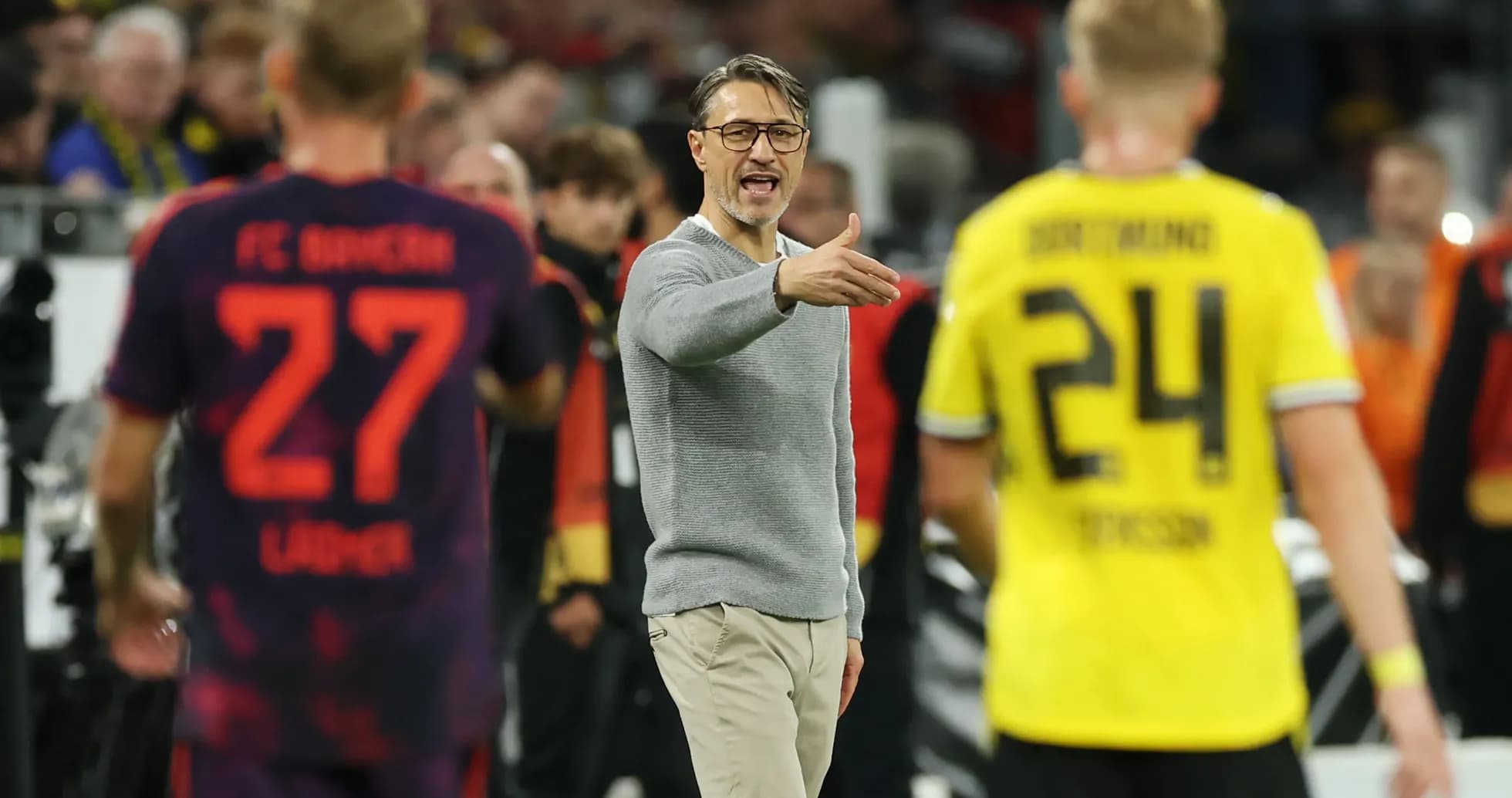
Niko Kovac did not send out a conventional Dortmund side. From the first whistle, the wing-backs looked… wrong. On purpose.
Left-footed Daniel Svensson started on the right. Right-footed Julian Ryerson took the left. The plan was clear: inverted wing-backs who could drive inside, threaten goal, and mirror what elite wingers do when they cut in to shoot or slide passes through.
“Every now and then we always need a player out wide who occupies someone,” Kovac explained afterwards. If left plays left and right plays right, you go down the line and cross. Swap them, and the inside channel opens up.
At times in the first half, it worked. Ryerson, cutting in from the left half-space, bent a dangerous cross towards the far post with his stronger right foot. Ramy Bensebaini met it with the faintest of touches, glancing the ball into the net – only for the offside flag to cut short the celebrations. The move, though, hinted at what Kovac wanted.
The flaws appeared just as quickly. With both wing-backs on their “wrong” sides, Dortmund sometimes looked clogged in central areas and lacked the natural rhythm of overlapping runs.
At half-time, Kovac abandoned the experiment and switched Ryerson and Svensson back to their usual flanks. “Because we saw that we had to change something,” he said, adding that the change “did us good.”
The game backed him up. Dortmund were sharper, more direct, and far more dangerous in the second half. They stretched Bayern more often, hit the byline, and began to pin the visitors back.
The 2-1 goal summed up the difference. Svensson, now on his natural left, surged to the byline and cut the ball back smartly for Fabio Silva, who finished from close range. It was exactly the kind of action that is harder to produce when the wing-backs are inverted.
Another moment underlined the downside of the first-half tweak. Before the break, Bensebaini drilled a low ball in from the left, finding Svensson – arriving centrally from the right – near the penalty spot. The Swede, forced onto his weaker right foot, swung and missed completely. The chance evaporated. In that position, with his stronger right, Ryerson would likely have done far more damage.
Kovac’s idea is intriguing and may yet become a useful tool. On this evidence, though, Dortmund still look more dangerous when their wing-backs are where instinct takes over, not where the whiteboard puts them.
Fabio Silva makes his case – and complicates Dortmund’s transfer plans
Serhou Guirassy’s name has faded from the rumour mill in recent weeks. For now, he looks set to stay at Dortmund. His performance against Bayern, however, echoed the more difficult stretches of last season.
Guirassy ran, pressed, and worked. What he did not do was threaten. He barely featured in dangerous areas and never really unsettled Bayern’s back line.
After just over an hour, Kovac turned to Fabio Silva in search of more spark in the box. The response was immediate and impressive.
Silva dropped into pockets cleverly, linked play and, crucially, finished when it mattered. For Dortmund’s goal, he peeled away into a deeper space, then attacked the cut-back from Svensson and buried his chance from close range. It was the kind of cold-blooded finish that strikers are judged on, and it mirrored the promising flashes he had already shown in his first year at the club.
That cameo may shift the internal debate. Silva has been on the radar of several clubs, with Betis Sevilla recently regarded as particularly keen. The 24-year-old is reportedly not fixed on staying in Dortmund, and the club’s hierarchy would be open to a sale if the right offer arrived.
Now the calculation is trickier.
Silva’s impact off the bench in the Supercup has revived hopes that he could finally break through in his second season. With the summer window entering its final stretch, Dortmund must weigh that possibility against the risk of letting him go and then scrambling for a suitable replacement.
Bayern left Dortmund with the trophy and the early-season statement. Dortmund left with a tactical puzzle, a striker dilemma, and a decision on Silva that could shape the rest of their campaign.